Social, Genetic, and Developmental Psychiatry Centre, Institute of Psychiatry, King's College London.
J Am Acad Child Adolesc Psychiatry. 2013 Oct;52(10):1048-1056.e3. doi: 10.1016/j.jaac.2013.07.016. Epub 2013 Aug 3.
Twin studies of behavior problems in childhood point to substantial genetic influence. It is now possible to estimate genetic influence using DNA alone in samples of unrelated individuals, not relying on family-based designs such as twins. A linear mixed model, which incorporates DNA microarray data, has confirmed twin results by showing substantial genetic influence for diverse traits in adults. Here we present direct comparisons between twin and DNA heritability estimates for childhood behavior problems as rated by parents, teachers, and children themselves.
Behavior problem data from 2,500 UK-representative 12-year-old twin pairs were used in twin analyses; DNA analyses were based on 1 member of the twin pair with genotype data for 1.7 million DNA markers. Diverse behavior problems were assessed, including autistic, depressive, and hyperactive symptoms. Genetic influence from DNA was estimated using genome-wide complex trait analysis (GCTA), and the twin estimates of heritability were based on standard twin model fitting.
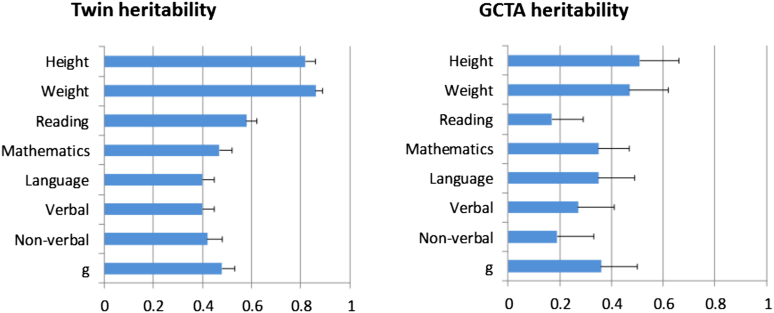
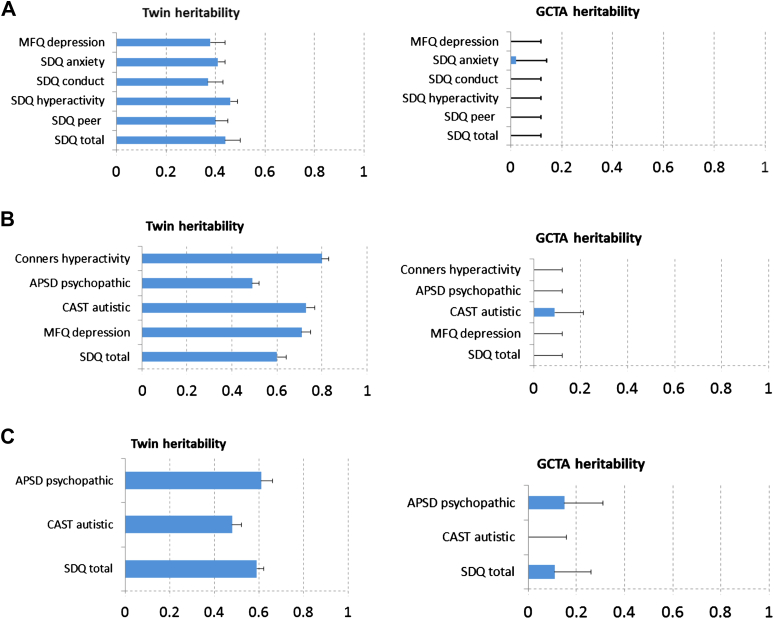
Behavior problems in childhood-whether rated by parents, teachers, or children themselves-show no significant genetic influence using GCTA, even though twin study estimates of heritability are substantial in the same sample, and even though both GCTA and twin study estimates of genetic influence are substantial for cognitive and anthropometric traits.
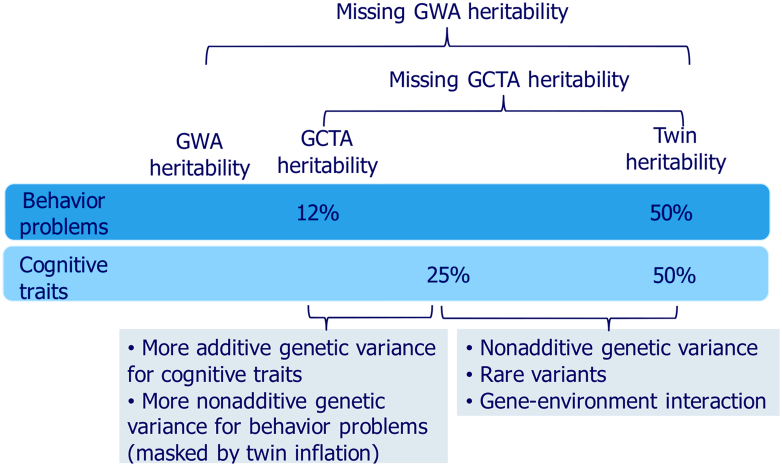
We suggest that this new type of "missing heritability," that is, the gap between GCTA and twin study estimates for behavior problems in childhood, is due to nonadditive genetic influence, which will make it more difficult to identify genes responsible for heritability.
儿童行为问题的双胞胎研究表明其受到大量遗传因素的影响。现在,通过对无亲缘关系的个体样本进行 DNA 分析,而不依赖于双胞胎等基于家庭的设计,就可以估计遗传因素的影响。一种线性混合模型,结合了 DNA 微阵列数据,通过显示成人各种特征的大量遗传影响,证实了双胞胎的研究结果。在此,我们介绍了父母、教师和儿童本人对儿童行为问题的评分的双胞胎和 DNA 遗传力估计值之间的直接比较。
使用 2500 对具有英国代表性的 12 岁双胞胎的行为问题数据进行双胞胎分析;DNA 分析基于双胞胎中的 1 位成员,其 DNA 标记有 170 万个基因型数据。评估了包括自闭症、抑郁和多动症状在内的多种行为问题。使用全基因组复杂性状分析(GCTA)来估计 DNA 的遗传影响,而双胞胎遗传力的估计值则基于标准双胞胎模型拟合。
儿童时期的行为问题-无论是父母、教师还是儿童本人进行评估-使用 GCTA 都没有显示出明显的遗传影响,尽管在同一样本中,双胞胎研究的遗传力估计值很高,并且 GCTA 和双胞胎研究的遗传影响估计值都很高认知和人体测量特征。
我们认为,这种新的“遗传缺失”类型,即儿童行为问题的 GCTA 和双胞胎研究估计值之间的差距,是由于非加性遗传影响所致,这将使确定行为问题遗传责任的基因更加困难。