Morris Martina, Vu Lung, Leslie-Cook Ayn, Akom Eniko, Stephen Aloo, Sherard Donna
Department of Statistics, University of Washington, Box 354322, Seattle, WA, 98195, USA,
AIDS Behav. 2014 Apr;18(4):783-790. doi: 10.1007/s10461-013-0618-6. Epub 2013 Sep 28.
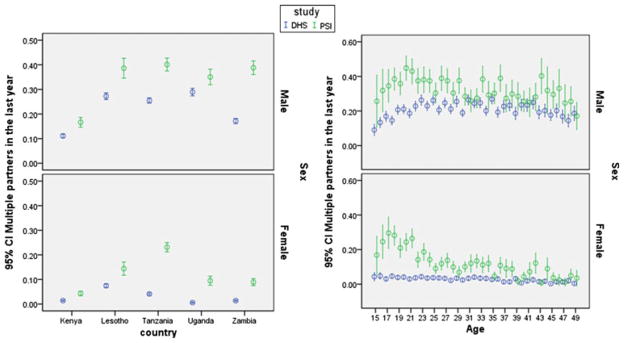
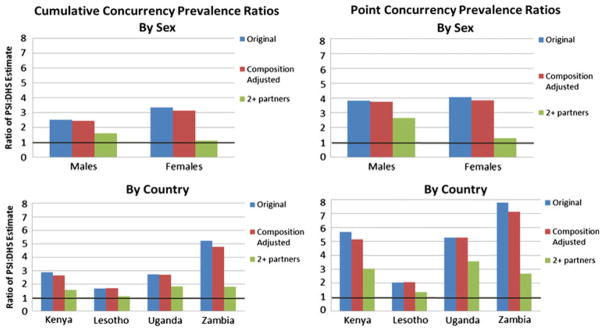
We compare estimates of multiple and concurrent sexual partnerships from Demographic and Health Surveys (DHS) with comparable Population Services International (PSI) surveys in four African countries (Kenya, Lesotho, Uganda, Zambia). DHS data produce significantly lower estimates of all indicators for both sexes in all countries. PSI estimates of multiple partnerships are 1.7 times higher [1.4 for men (M), 3.0 for women (W)], cumulative prevalence of concurrency is 2.4 times higher (2.2 M, 2.7 W), the point prevalence of concurrency is 3.5 times higher (3.5 M, 3.3 W), and the fraction of multi-partnered persons who report concurrency last year is 1.4 times higher (1.6 M, 0.9 W). These findings provide strong empirical evidence that DHS surveys systematically underestimate levels of multiple and concurrent partnerships. The underestimates will contaminate both empirical analyses of the link between sexual behavior and HIV infection, and theoretical models for combination prevention that use these data for inputs.
我们将人口与健康调查(DHS)中关于多重和同时性性伴侣关系的估计数据,与国际人口服务组织(PSI)在四个非洲国家(肯尼亚、莱索托、乌干达、赞比亚)开展的可比调查数据进行了比较。在所有国家中,DHS数据得出的所有指标的估计值均显著低于PSI数据。PSI对多重伴侣关系的估计值高1.7倍[男性(M)为1.4倍,女性(W)为3.0倍],同时性的累积患病率高2.4倍(男性2.2倍,女性2.7倍),同时性的点患病率高3.5倍(男性3.5倍,女性3.3倍),去年报告有同时性的多伴侣者比例高1.4倍(男性1.6倍,女性0.9倍)。这些发现提供了强有力的实证证据,表明DHS调查系统性地低估了多重和同时性伴侣关系的水平。这种低估将影响对性行为与艾滋病毒感染之间联系的实证分析,以及使用这些数据作为输入的联合预防理论模型。