Serviço de Reumatologia do Hospital das Clínicas (HC), Universidade Federal de Pernambuco (UFPE), Rua Tereza Amélia, s/n, Cidade Universitária, 50670-901 Recife, PE, Brazil ; Laboratório de Imunomodulação e Novas Abordagens Terapêuticas (LINAT), Núcleo de Pesquisa em Inovação Terapêutica Suely Galdino (NUPIT-SG), Universidade Federal de Pernanbuco, (UFPE), Rua Tereza Amélia, s/n, Cidade Universitária, 50670-901 Recife, PE, Brazil.
Biomed Res Int. 2013;2013:926060. doi: 10.1155/2013/926060. Epub 2013 Sep 1.
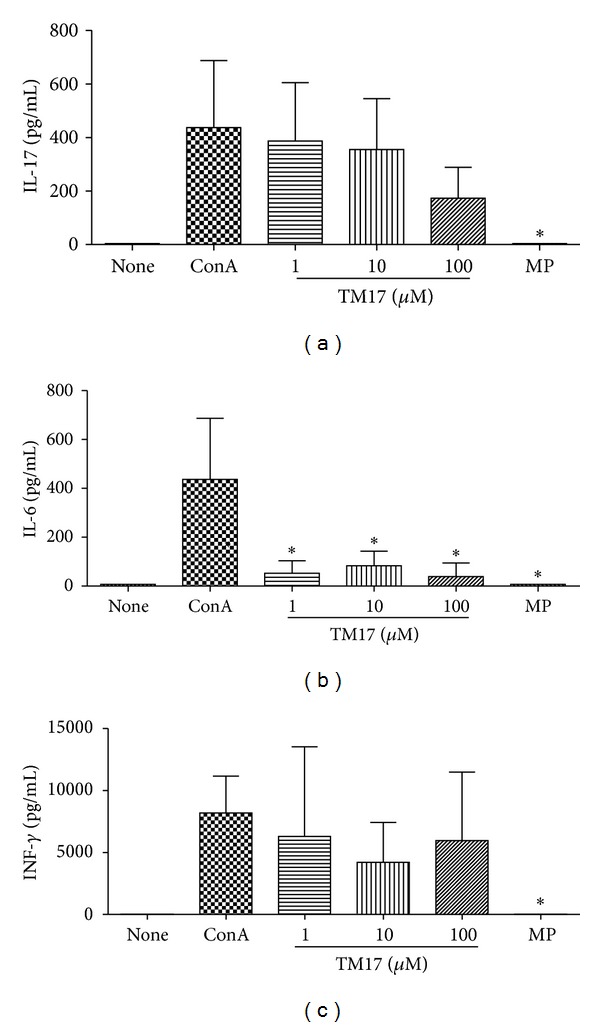
Rheumatoid arthritis (RA) is an autoimmune disease frequently characterized by chronic synovitis of multiple joints. The pathogenesis of RA is complex and involves many proinflammatory cytokines as Th17 related ones. PPAR γ is a nuclear receptor activator that represses proinflammatory gene expression. Thus, this work aimed to synthetize a new thiazolidinedione (TZD) analogue based on a well-known anti-inflammatory and PPAR γ agonist activity of this ring and evaluate its anti-inflammatory activity. After chemical structure confirmation, the compound named 5-(5-bromo-2-methoxy-benzylidene)-3-(2-nitro-benzyl)-thiazolidine-2,4-dione TM17 was submitted to cytokine releasing inhibition and PPAR γ genetic modulation assays. The new compound showed no toxicity on human and murine cells, decreasing IL-6 secretion by murine splenocytes and reducing IL-17A, IL-22, and IFN- γ expression in peripheral blood mononuclear cells from patients with RA. TM17 was more efficient in modulating the mRNA expression of PPAR γ than its well-used TZD agonist rosiglitazone. Surprisingly, TM17 was efficient on IL-17A and IFN- γ reduction, like the positive control methylprednisolone, and presented a better effect on IL-22 levels. In conclusion, PBMCs obtained from RA patients under TM17 treatment present a significant reduction in IL-17A, IL-22, and IFN- γ levels, but not IL-6 when compared with nontreated cells, as well as increase PPAR γ mRNA expression in absence of stimulus addressing it as a promising molecule in RA treatment.
类风湿关节炎(RA)是一种以多发性关节慢性滑膜炎为特征的自身免疫性疾病。RA 的发病机制复杂,涉及许多促炎细胞因子,如 Th17 相关细胞因子。PPARγ 是核受体激活剂,可抑制促炎基因的表达。因此,本研究旨在合成一种新的噻唑烷二酮(TZD)类似物,基于该环具有抗炎和 PPARγ 激动剂的已知活性,并评估其抗炎活性。在确认化学结构后,将该化合物命名为 5-(5-溴-2-甲氧基-苄叉基)-3-(2-硝基-苄基)-噻唑烷-2,4-二酮 TM17,并进行细胞因子释放抑制和 PPARγ 基因调节测定。新化合物对人和鼠细胞没有毒性,可降低鼠脾细胞中 IL-6 的分泌,并降低 RA 患者外周血单个核细胞中 IL-17A、IL-22 和 IFN-γ 的表达。TM17 对 PPARγ mRNA 表达的调节作用优于其常用的 TZD 激动剂罗格列酮。令人惊讶的是,TM17 对 IL-17A 和 IFN-γ 的降低与阳性对照甲泼尼龙一样有效,并且对 IL-22 水平的影响更好。总之,与未经处理的细胞相比,TM17 治疗的 RA 患者 PBMCs 中 IL-17A、IL-22 和 IFN-γ 水平显著降低,而 IL-6 水平没有降低,并且在没有刺激的情况下增加 PPARγ mRNA 表达,这表明 TM17 是一种有前途的 RA 治疗药物。