Satirapoj Bancha, Limwannata Pokkrong, Chaiprasert Amnart, Supasyndh Ouppatham, Choovichian Panbuppa
Division of Nephrology, Department of Medicine, Phramongkutklao Hospital, Bangkok, Thailand.
BMC Nephrol. 2013 Oct 2;14:206. doi: 10.1186/1471-2369-14-206.
Vitamin D insufficiency is associated with proteinuria and could be a risk factor for end-stage renal disease (ESRD). However, few studies have examined the significance of vitamin D insufficiency as a contributing factor for the development of ESRD in the Asian chronic kidney disease (CKD) population.
Authors examined the relationship between vitamin D status and the staging of CKD using data from an outpatient clinic-based screening in 2,895 Thai CKD patients. Serum levels of 25-hydroxyvitamin D were analyzed according to CKD stages. Vitamin D deficiency and insufficiency were defined as a serum 25-hydroxyvitamin D concentration < 10 ng/mL and 10-30 ng/mL, respectively.
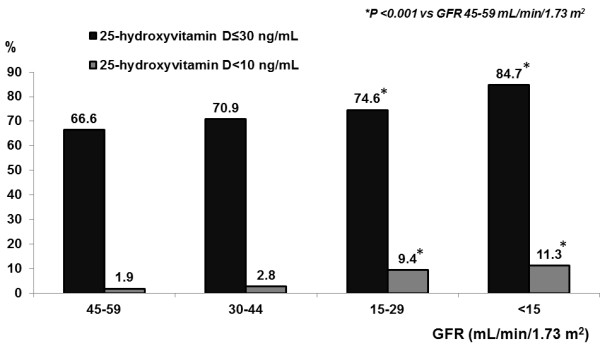
The mean (SD) 25-hydroxyvitamin D levels were significantly lower according to severity of renal impairment (CKD stage 3a: 27.84 ± 14.03 ng/mL, CKD stage 3b: 25.86 ± 11.14 ng/mL, CKD stage 4: 24.09 ± 11.65 and CKD stage 5: 20.82 ± 9.86 ng/mL, p<0.001). The prevalence of vitamin D deficiency/insufficiency was from CKD stage 3a, 3b, 4 to 5, 66.6%, 70.9%, 74.6%, and 84.7% (p<0.001). The odds ratio (95% CI) of vitamin D insufficiency/deficiency (serum 25-hydroxyvitamin D ≤ 30 ng/mL) and vitamin D deficiency (serum 25-hydroxyvitamin D < 10 ng/mL) for developing ESRD, after adjustment for age, gender, hemoglobin, serum albumin, calcium, phosphate and alkaline phosphatase were 2.19 (95% CI 1.07 to 4.48) and 16.76 (95% CI 4.89 to 57.49), respectively.
This study demonstrates that 25-hydroxyvitamin D insufficiency and deficiency are more common and associated with the level of kidney function in the Thai CKD population especially advanced stage of CKD.
维生素D不足与蛋白尿相关,可能是终末期肾病(ESRD)的一个危险因素。然而,很少有研究探讨维生素D不足作为亚洲慢性肾脏病(CKD)人群中ESRD发生的一个促成因素的意义。
作者利用来自一家门诊筛查的2895例泰国CKD患者的数据,研究了维生素D状态与CKD分期之间的关系。根据CKD分期分析血清25-羟基维生素D水平。维生素D缺乏和不足分别定义为血清25-羟基维生素D浓度<10 ng/mL和10 - 30 ng/mL。
根据肾功能损害的严重程度,平均(标准差)25-羟基维生素D水平显著降低(CKD 3a期:27.84±14.03 ng/mL,CKD 3b期:25.86±11.14 ng/mL,CKD 4期:24.09±11.65 ng/mL,CKD 5期:20.82±9.86 ng/mL,p<0.001)。维生素D缺乏/不足的患病率从CKD 3a期、3b期、4期到5期分别为66.6%、70.9%、74.6%和84.7%(p<0.001)。在对年龄、性别、血红蛋白、血清白蛋白、钙、磷和碱性磷酸酶进行校正后,维生素D不足/缺乏(血清25-羟基维生素D≤30 ng/mL)和维生素D缺乏(血清25-羟基维生素D<10 ng/mL)发展为ESRD的比值比(95%可信区间)分别为2.19(95%可信区间1.07至4.48)和16.76(95%可信区间4.89至57.49)。
本研究表明,25-羟基维生素D不足和缺乏在泰国CKD人群中更为常见,且与肾功能水平相关,尤其是在CKD晚期。