Saw Swee Hock School of Public Health, National University of Singapore and National University Health System, Block MD3, Level 3, 16 Medical Drive, Singapore 117597, Singapore.
Br J Cancer. 2013 Oct 15;109(8):2035-43. doi: 10.1038/bjc.2013.471. Epub 2013 Oct 1.
Natural history models of breast cancer progression provide an opportunity to evaluate and identify optimal screening scenarios. This paper describes a detailed Markov model characterising breast cancer tumour progression.
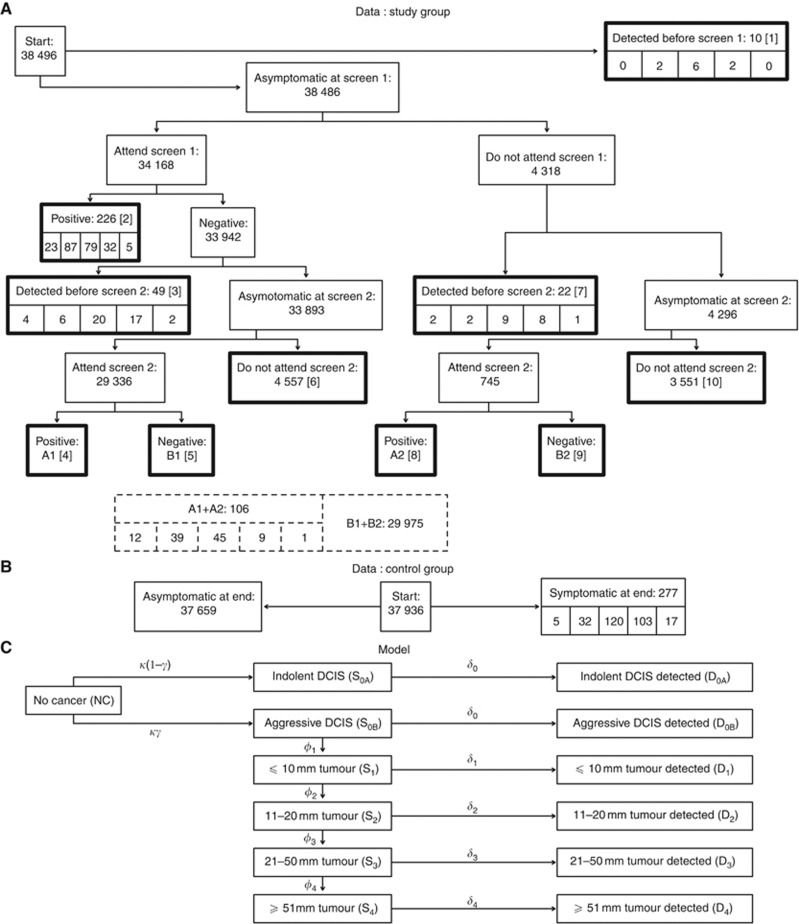
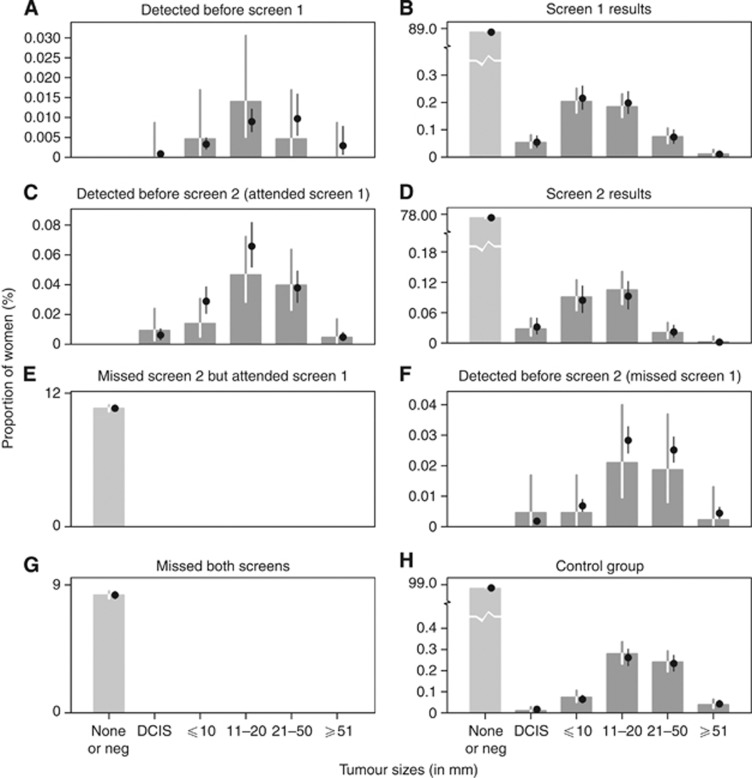
Breast cancer is modelled by a 13-state continuous-time Markov model. The model differentiates between indolent and aggressive ductal carcinomas in situ tumours, and aggressive tumours of different sizes. We compared such aggressive cancers, that is, which are non-indolent, to those which are non-growing and regressing. Model input parameters and structure were informed by the 1978-1984 Ostergotland county breast screening randomised controlled trial. Overlaid on the natural history model is the effect of screening on diagnosis. Parameters were estimated using Bayesian methods. Markov chain Monte Carlo integration was used to sample the resulting posterior distribution.
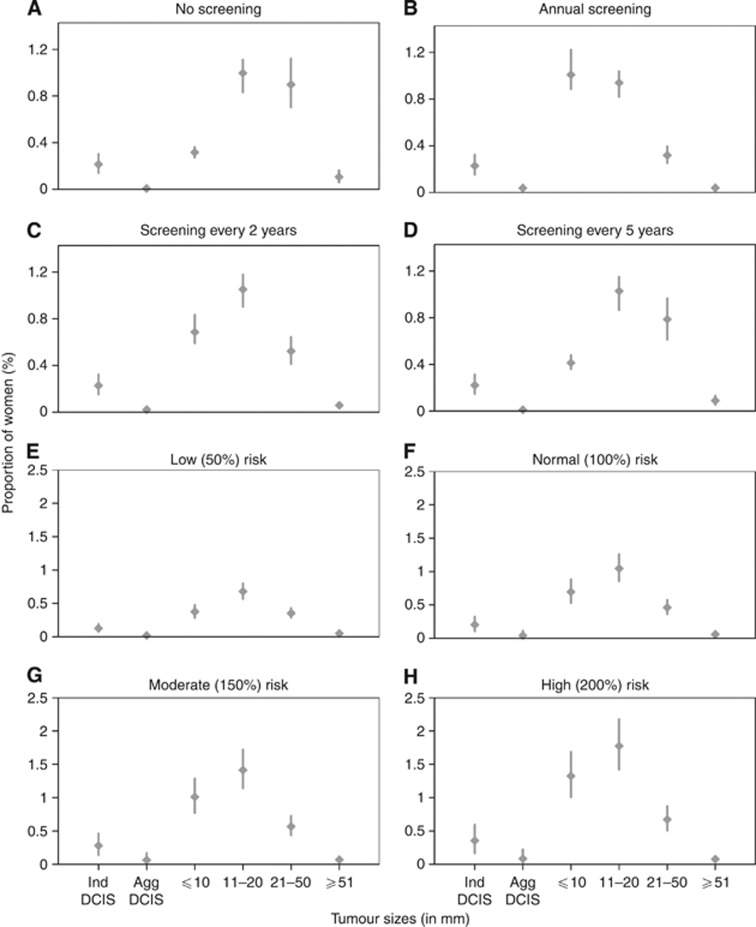
The breast cancer incidence rate in the Ostergotland population was 21 (95% CI: 17-25) per 10 000 woman-years. Accounting for length-biased sampling, an estimated 91% (95% CI: 85-97%) of breast cancers were aggressive. Larger tumours, 21-50 mm, had an average sojourn of 6 years (95% CI: 3-16 years), whereas aggressive ductal carcinomas in situ took around half a month (95% CI: 0-1 month) to progress to the invasive ≤10 mm state.
These tumour progression rate estimates may facilitate future work analysing cost-effectiveness and quality-adjusted life years for various screening strategies.
乳腺癌进展的自然史模型为评估和确定最佳筛查方案提供了机会。本文描述了一个详细的马尔可夫模型,用于描述乳腺癌肿瘤的进展。
乳腺癌由一个 13 状态连续时间马尔可夫模型进行建模。该模型区分了惰性和侵袭性导管原位癌肿瘤,以及不同大小的侵袭性肿瘤。我们将这些侵袭性癌症(即非惰性的)与非生长和消退的癌症进行了比较。模型的输入参数和结构是根据 1978-1984 年奥斯特哥特兰县乳腺癌筛查随机对照试验得出的。在自然史模型上叠加了筛查对诊断的影响。使用贝叶斯方法估计参数。马尔可夫链蒙特卡罗积分用于对所得后验分布进行抽样。
奥斯特哥特兰人群的乳腺癌发病率为 21(95%CI:17-25)/10000 妇女年。考虑到长度偏倚采样,估计 91%(95%CI:85-97%)的乳腺癌为侵袭性。21-50mm 的较大肿瘤平均停留时间为 6 年(95%CI:3-16 年),而侵袭性导管原位癌进展为侵袭性≤10mm 状态大约需要半个月(95%CI:0-1 个月)。
这些肿瘤进展速度估计值可能有助于未来分析各种筛查策略的成本效益和质量调整生命年。