The School of Biological Sciences, The University of Queensland, St Lucia, Australia.
Genome Biol Evol. 2013;5(10):1986-94. doi: 10.1093/gbe/evt145.
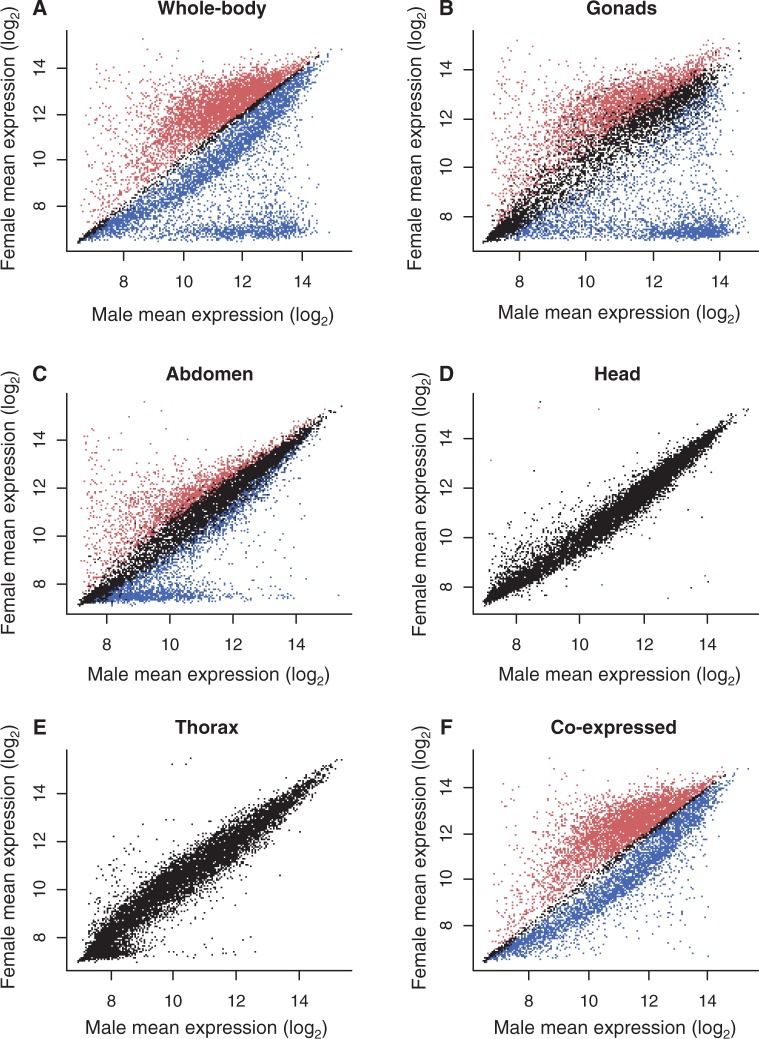
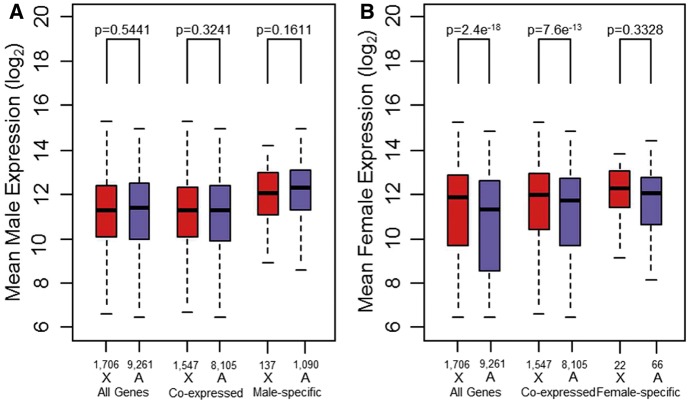
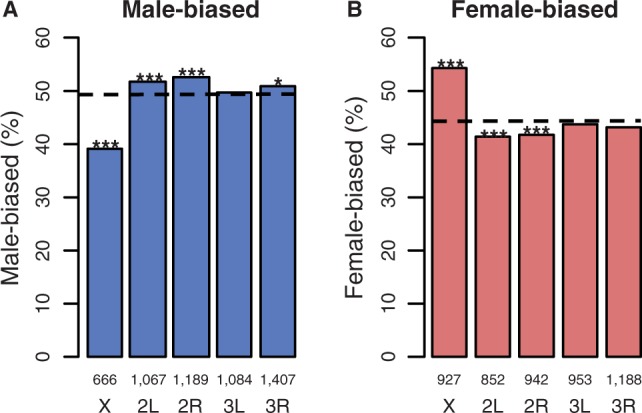
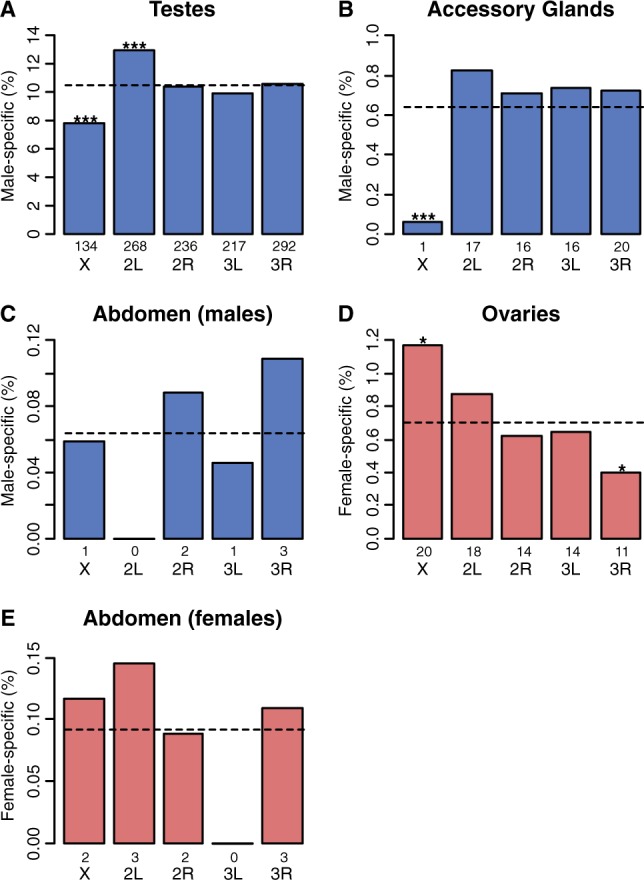
The chromosomal distribution of genes with sex-biased expression is often nonrandom, and in species with XY sex chromosome systems, it is common to observe a deficit of X-linked male-biased genes and an excess of X-linked female-biased genes. One explanation for this pattern is that sex-specific selection has shaped the gene content of the X. Alternatively, the deficit of male-biased and excess of female-biased genes could be an artifact of differences between the sexes in the global expression level of their X chromosome(s), perhaps brought about by a lack of dosage compensation in males and hyperexpression in females. In the montium fruit fly, Drosophila serrata, both these explanations can account for a deficit of male-biased and excess of female-biased X-linked genes. Using genome-wide expression data from multiple male and female tissues (n = 176 hybridizations), we found that testis- and accessory gland-specific genes are underrepresented whereas female ovary-specific genes are overrepresented on the X chromosome, suggesting that X-linkage is disfavored for male function genes but favored for female function genes. However, genes with such sex-specific functions did not fully account for the deficit of male-biased and excess of female-biased X-linked genes. We did, however, observe sex differences in the global expression level of the X chromosome and autosomes. Surprisingly, and in contrast to other species where a lack of dosage compensation in males is responsible, we found that hyperexpression of X-linked genes in both sexes leads to this imbalance in D. serrata. Our results highlight how common genomic distributions of sex-biased genes, even among closely related species, may arise via quite different evolutionary processes.
具有性别偏向表达的基因的染色体分布通常是随机的,在具有 XY 性染色体系统的物种中,观察到 X 连锁雄性偏向基因的缺乏和 X 连锁雌性偏向基因的过剩是很常见的。这种模式的一个解释是,性别特异性选择塑造了 X 的基因组成。或者,雄性偏向基因的缺乏和雌性偏向基因的过剩可能是由于性别的 X 染色体(多个 X 染色体)的整体表达水平存在差异的一种人为现象,这种差异可能是由于雄性缺乏剂量补偿和雌性过度表达引起的。在山地果蝇 Drosophila serrata 中,这两种解释都可以解释 X 连锁雄性偏向和雌性偏向基因的缺乏。利用来自多个雄性和雌性组织的全基因组表达数据(n = 176 个杂交),我们发现,睾丸和附属腺特异性基因的表达量不足,而雌性卵巢特异性基因的表达量过多,这表明 X 连锁不利于雄性功能基因,但有利于雌性功能基因。然而,具有这种性别特异性功能的基因并不能完全解释雄性偏向和雌性偏向 X 连锁基因的缺乏。然而,我们确实观察到 X 染色体和常染色体的整体表达水平存在性别差异。令人惊讶的是,与其他物种中雄性缺乏剂量补偿的情况相反,我们发现 X 连锁基因在两性中的过度表达导致了 D. serrata 中的这种不平衡。我们的结果强调了即使在密切相关的物种中,性别偏向基因的常见基因组分布如何可能通过非常不同的进化过程产生。