Department of Neurosciences and Developmental Biology, University of Vienna, 1090 Vienna, Austria.
MOE Laboratory of Biosystems Homeostasis & Protection, Life Sciences Institute, Zhejiang University, Hangzhou 310058, China.
Genes (Basel). 2020 Sep 25;11(10):1126. doi: 10.3390/genes11101126.
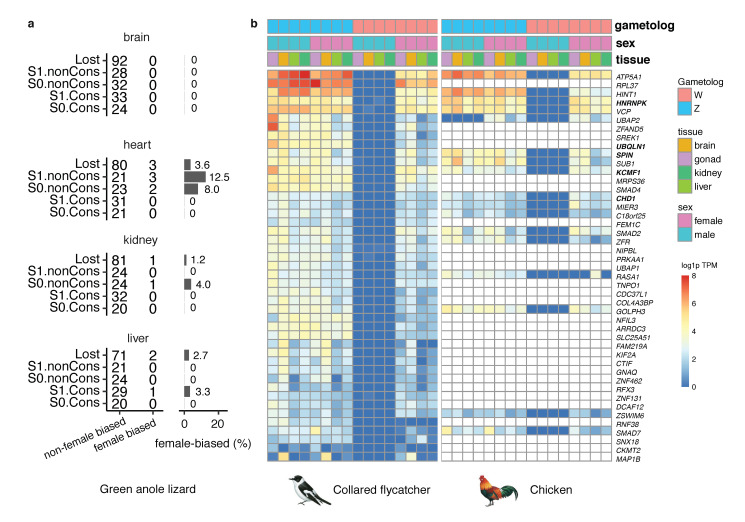
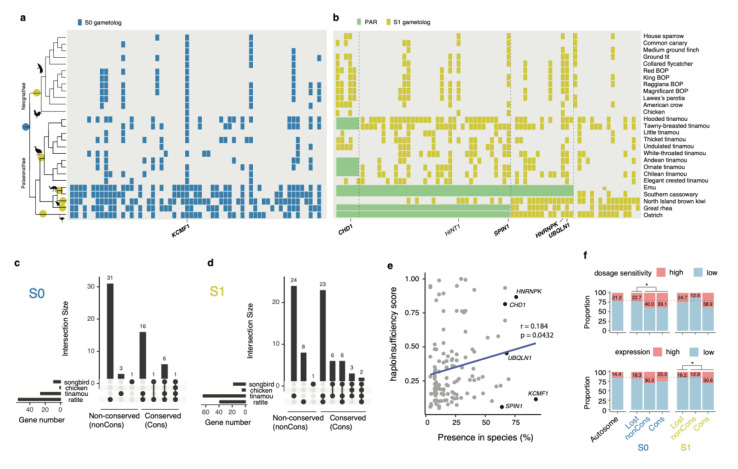
Sex chromosomes are unique genomic regions with sex-specific or sex-biased inherent patterns and are expected to be more frequently subject to sex-specific selection. Substantial knowledge on the evolutionary patterns of sex-linked genes have been gained from the studies on the male heterogametic systems (XY male, XX female), but the understanding of the role of sex-specific selection in the evolution of female-heterogametic sex chromosomes (ZW female, ZZ male) is limited. Here we collect the W-linked genes of 27 birds, covering the three major avian clades: Neoaves (songbirds), Galloanserae (chicken), and Palaeognathae (ratites and tinamous). We find that the avian W chromosomes exhibit very conserved gene content despite their independent evolution of recombination suppression. The retained W-linked genes have higher dosage-sensitive and higher expression level than the lost genes, suggesting the role of purifying selection in their retention. Moreover, they are not enriched in ancestrally female-biased genes, and have not acquired new ovary-biased expression patterns after becoming W-linked. They are broadly expressed across female tissues, and the expression profile of the W-linked genes in females is not deviated from that of the homologous Z-linked genes. Together, our new analyses suggest that female-specific positive selection on the avian W chromosomes is limited, and the gene content of the W chromosomes is mainly shaped by purifying selection.
性染色体是具有性别特异性或性别偏向固有模式的独特基因组区域,预计更容易受到性别特异性选择的影响。从对雄性异型性染色体系统(XY 雄性,XX 雌性)的研究中已经获得了大量关于性连锁基因进化模式的知识,但对性别特异性选择在雌性异型性染色体(ZW 雌性,ZZ 雄性)进化中的作用的理解是有限的。在这里,我们收集了 27 种鸟类的 W 连锁基因,涵盖了三大鸟类类群:新鸟(鸣禽)、鸡形目(鸡)和古颚总目(平胸鸟类和䳍形目)。我们发现,尽管鸟类的 W 染色体经历了独立的重组抑制进化,但它们的基因内容却非常保守。保留下来的 W 连锁基因的剂量敏感性和表达水平高于丢失的基因,这表明它们的保留是由纯化选择作用的。此外,它们在进化上没有富集到雌性偏向的基因,也没有在成为 W 连锁后获得新的卵巢偏向表达模式。它们在雌性的多种组织中广泛表达,并且 W 连锁基因在雌性中的表达模式与同源 Z 连锁基因没有偏离。总之,我们的新分析表明,鸟类 W 染色体上的雌性特异性正选择是有限的,W 染色体的基因内容主要由纯化选择塑造。