Tanaka Tsuyoshi, Kobayashi Fuminori, Joshi Giri Prasad, Onuki Ritsuko, Sakai Hiroaki, Kanamori Hiroyuki, Wu Jianzhong, Simkova Hana, Nasuda Shuhei, Endo Takashi R, Hayakawa Katsuyuki, Doležel Jaroslav, Ogihara Yasunari, Itoh Takeshi, Matsumoto Takashi, Handa Hirokazu
1Bioinformatics Research Unit, National Institute of Agrobiological Sciences, Tsukuba 305-8602, Japan.
DNA Res. 2014;21(2):103-14. doi: 10.1093/dnares/dst041. Epub 2013 Oct 1.
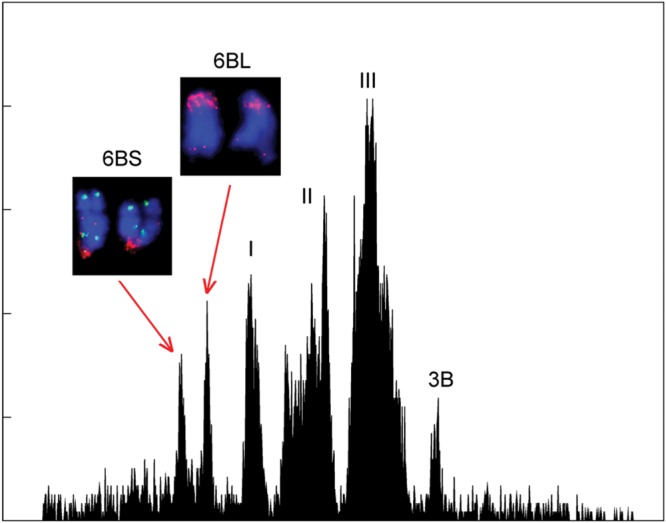
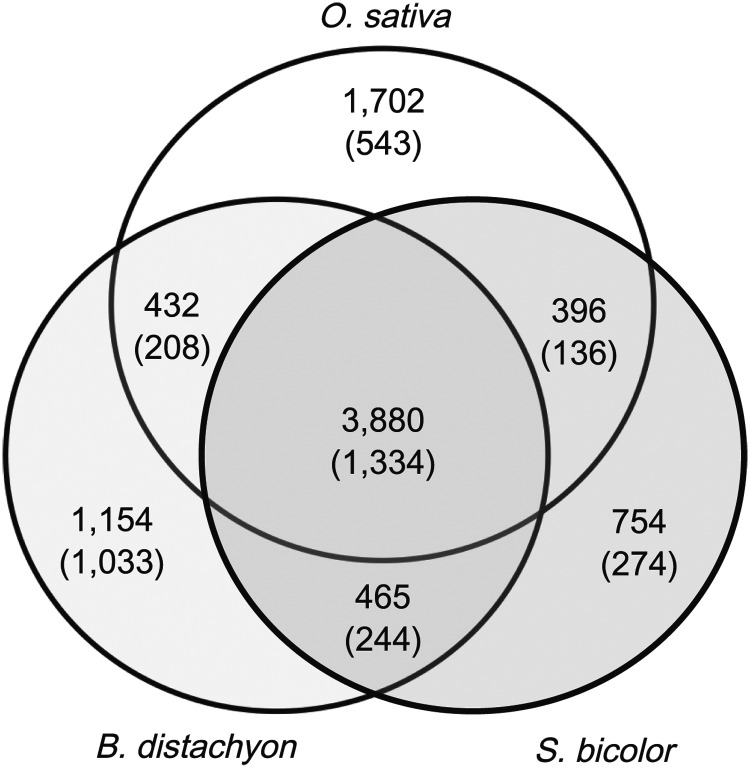
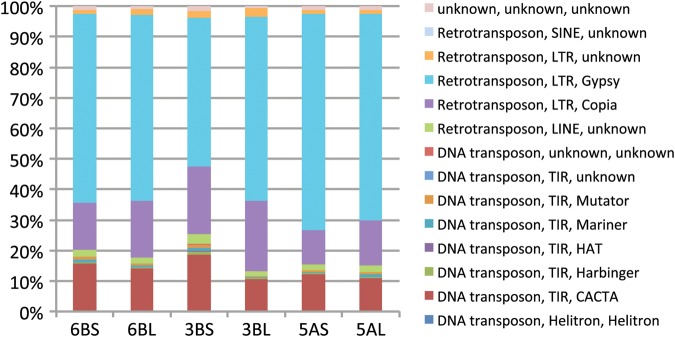
Common wheat (Triticum aestivum L.) is one of the most important cereals in the world. To improve wheat quality and productivity, the genomic sequence of wheat must be determined. The large genome size (∼17 Gb/1 C) and the hexaploid status of wheat have hampered the genome sequencing of wheat. However, flow sorting of individual chromosomes has allowed us to purify and separately shotgun-sequence a pair of telocentric chromosomes. Here, we describe a result from the survey sequencing of wheat chromosome 6B (914 Mb/1 C) using massively parallel 454 pyrosequencing. From the 4.94 and 5.51 Gb shotgun sequence data from the two chromosome arms of 6BS and 6BL, 235 and 273 Mb sequences were assembled to cover ∼55.6 and 54.9% of the total genomic regions, respectively. Repetitive sequences composed 77 and 86% of the assembled sequences on 6BS and 6BL, respectively. Within the assembled sequences, we predicted a total of 4798 non-repetitive gene loci with the evidence of expression from the wheat transcriptome data. The numbers and chromosomal distribution patterns of the genes for tRNAs and microRNAs in wheat 6B were investigated, and the results suggested a significant involvement of DNA transposon diffusion in the evolution of these non-protein-coding RNA genes. A comparative analysis of the genomic sequences of wheat 6B and monocot plants clearly indicated the evolutionary conservation of gene contents.
普通小麦(Triticum aestivum L.)是世界上最重要的谷物之一。为了提高小麦品质和产量,必须确定小麦的基因组序列。小麦庞大的基因组大小(约17 Gb/1C)和六倍体状态阻碍了其基因组测序。然而,单个染色体的流式分选使我们能够纯化并分别对一对端着丝粒染色体进行鸟枪法测序。在此,我们描述了使用大规模平行454焦磷酸测序对小麦6B染色体(914 Mb/1C)进行调查测序得到的结果。从6BS和6BL两条染色体臂的4.94 Gb和5.51 Gb鸟枪法序列数据中,分别组装得到了235 Mb和273 Mb序列,分别覆盖了总基因组区域的约55.6%和54.9%。重复序列在6BS和6BL上分别占组装序列的77%和86%。在组装序列中,我们从小麦转录组数据中预测出总共4798个具有表达证据的非重复基因位点。对小麦6B中tRNA和microRNA基因的数量及染色体分布模式进行了研究,结果表明DNA转座子扩散在这些非蛋白质编码RNA基因的进化中起到了重要作用。对小麦6B和单子叶植物基因组序列的比较分析清楚地表明了基因含量的进化保守性。