Division of Human Genetics, Center for Molecular Medicine, Jichi Medical University, Shimotsuke-shi, Tochigi, Japan.
PLoS One. 2013 Sep 25;8(9):e74720. doi: 10.1371/journal.pone.0074720. eCollection 2013.
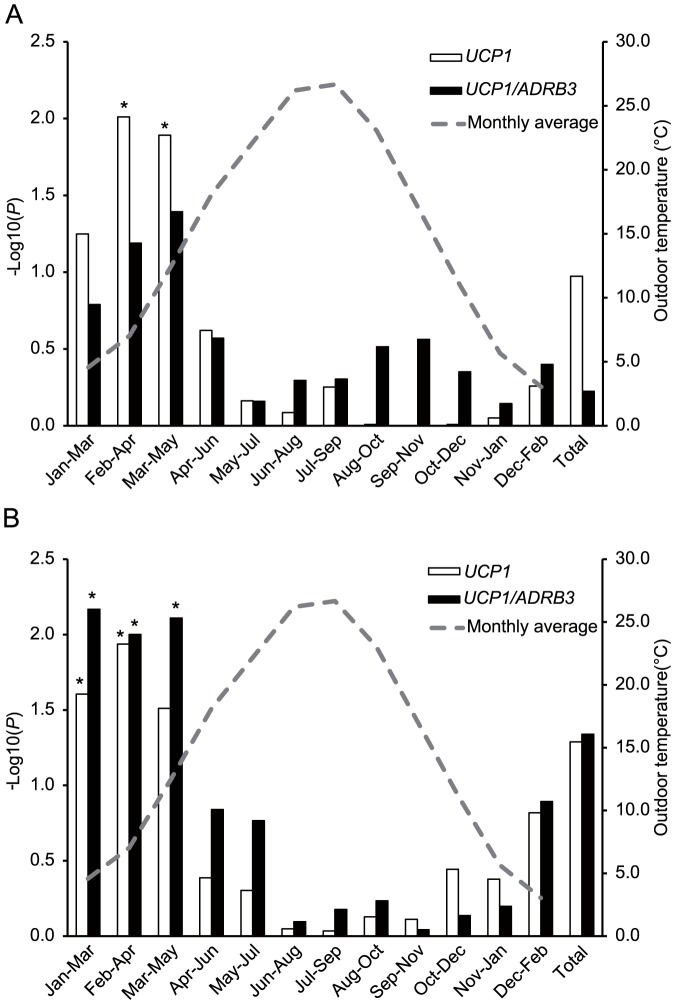
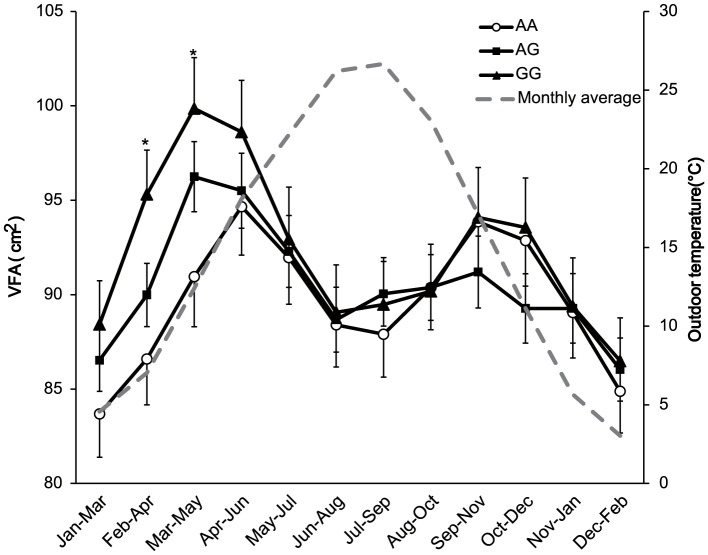
Uncoupling protein 1 (UCP1) and β3 adrenergic receptor (ADRB3) genes play central roles in the thermogenesis of brown adipose tissue (BAT) in adult humans. However, the importance of single-nucleotide polymorphisms (SNPs) in both genes during the development of obesity is controversial. Although active BAT in adult humans is frequently observed in the winter season, the effects of sampling season have not been taken into consideration in previous association studies. Here, we tested the associations of UCP1 -3826A/G and ADRB3 Trp64Arg with body mass index (BMI) and visceral fat area (VFA) in 3013 Japanese adults sampled during different seasons. Association between SNPs and the obesity-related traits were assessed using multiple linear regression models, including sex, age, physical activity, and genotypes. Both SNPs did not show significant associations in the models based on the entire cohort. However, in subsets comprising individuals mainly sampled from winter to spring, UCP1 showed significant associations with VFA (P = 0.0098) and VFA adjusted for BMI (P = 0.0128). Moreover, the effects of UCP1 on VFA were strongly negatively correlated with outdoor temperature (P = 0.00011), but not with night length (P = 0.039). ADRB3 did not show these associations, but an additive effect with UCP1 was observed for VFA adjusted for BMI (P = 0.0067). Subsets sampled in the hot season did not show significant associations for both SNPs. The season-specific effects of UCP1 on VFA were consistent with a previous finding that active BAT was more frequently found in winter than in summer, and supported the importance of cold stress in BAT activation and the significance of BAT in the development of obesity in adult humans.
解偶联蛋白 1 (UCP1) 和 β3 肾上腺素能受体 (ADRB3) 基因在成人棕色脂肪组织 (BAT) 的产热中起核心作用。然而,这两个基因中单核苷酸多态性 (SNP) 在肥胖发展中的重要性仍存在争议。尽管成人的活跃 BAT 在冬季经常被观察到,但之前的关联研究并没有考虑到采样季节的影响。在这里,我们在不同季节采集的 3013 名日本成年人中,检测了 UCP1-3826A/G 和 ADRB3-Trp64Arg 与体重指数 (BMI) 和内脏脂肪面积 (VFA) 的相关性。使用包括性别、年龄、体力活动和基因型在内的多线性回归模型,评估了 SNP 与肥胖相关特征的相关性。在基于整个队列的模型中,这两个 SNP 均未显示出显著相关性。然而,在主要从冬季到春季采样的个体亚组中,UCP1 与 VFA 显著相关 (P = 0.0098) ,与 BMI 校正后的 VFA 显著相关 (P = 0.0128)。此外,UCP1 对 VFA 的影响与室外温度呈强烈负相关 (P = 0.00011),但与夜间长度无关 (P = 0.039)。ADRB3 未显示出这些相关性,但在 BMI 校正后的 VFA 中观察到与 UCP1 的加性效应 (P = 0.0067)。在炎热季节采样的亚组中,这两个 SNP 均未显示出显著相关性。UCP1 对 VFA 的季节特异性影响与之前的发现一致,即冬季活跃的 BAT 比夏季更常见,这支持了冷应激在 BAT 激活中的重要性以及 BAT 在成人肥胖发展中的重要性。