Department of Pathology, Yonsei University College of Medicine, Seoul, Republic of Korea.
PLoS One. 2013 Sep 24;8(9):e75449. doi: 10.1371/journal.pone.0075449. eCollection 2013.
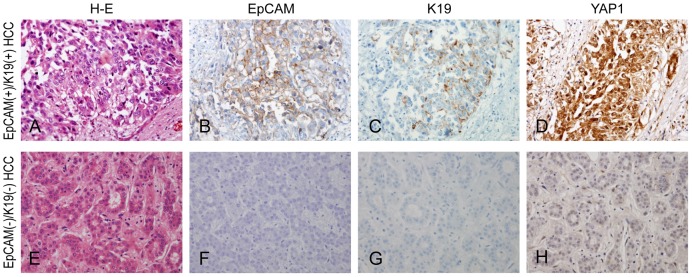
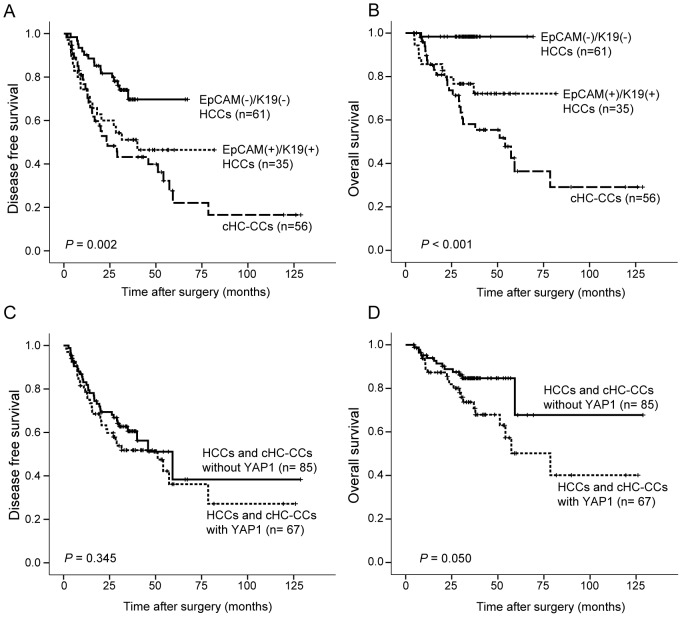
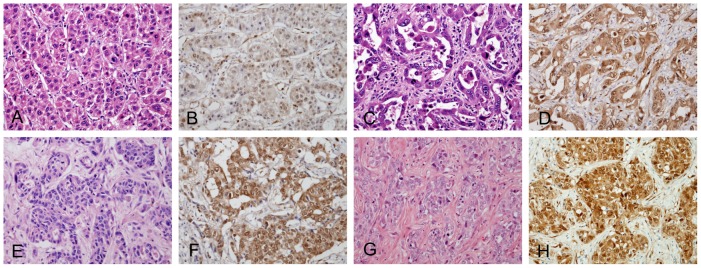
Combined hepatocellular-cholangiocarcinoma (cHC-CC) and some hepatocellular carcinomas (HCCs) express stemness-related markers, such as epithelial adhesion molecule (EpCAM) and keratin 19 (K19), the expression of which has been reported to be associated with more aggressive behavior therein than in HCCs without. Yes-associated protein 1 (YAP1), a potential oncogene, is known to promote stem cell proliferation. In the present study, YAP1 expression and clinicopathological features were evaluated and compared among three groups comprising 36 HCCs that expressed both EpCAM and K19, 64 HCCs that did not express EpCAM and K19, and 58 cHC-CCs, which consisted of 38 cases of the classical type and 20 cases of the intermediate-cell subtype. YAP1 expression was more frequently noted in EpCAM(+)/K19(+) HCCs (55.6%) and in cHC-CCs (67.2%) than in EpCAM(-)/K19(-) HCCs (17.2%) (P<0.001 for both). In cHC-CCs, YAP1 expression was observed in 63% of classical type cHC-CCs and in 75% of the intermediate subtype; moreover, such expression was correlated with poorer histological differentiation (P = 0.017) and was more frequently noted in transition zones than in HCC areas (P = 0.060). Disease-free and overall survival showed a statistically significant difference among the three groups: disease-free survival was highest for EpCAM(-)/K19(-) HCCs and lowest for cHC-CCs, with EpCAM(+)/K19(+) HCCs falling in between (P<0.05). Overall survival rate was lower in HCCs and cHC-CCs with YAP1 expression compared to those without (P = 0.05), whereas disease-free survival showed no significant difference according to YAP1 expression. Increased YAP1 expression was more frequently found in cHC-CCs and HCCs with stemness than in HCCs without, and a YAP1 pathway is suggested to be involved in the obtainment stemness characteristics in HCCs and cHC-CCs.
肝细胞癌-胆管细胞癌(cHC-CC)和部分肝细胞癌(HCC)表达干性相关标志物,如上皮细胞黏附分子(EpCAM)和角蛋白 19(K19),据报道,这些标志物的表达与 HCC 相比更具侵袭性。Yes 相关蛋白 1(YAP1)是一种潜在的癌基因,已知可促进干细胞增殖。本研究评估了 YAP1 表达与三组患者的临床病理特征的关系,三组患者分别为:36 例同时表达 EpCAM 和 K19 的 HCC、64 例不表达 EpCAM 和 K19 的 HCC 和 58 例 cHC-CC,其中包括 38 例经典型和 20 例中间细胞亚型。与不表达 EpCAM 和 K19 的 HCC(17.2%)相比,YAP1 在 EpCAM(+) / K19(+) HCC(55.6%)和 cHC-CC(67.2%)中更频繁表达(两者均 P<0.001)。在 cHC-CC 中,经典型 cHC-CC 中有 63%,中间细胞亚型中有 75%表达 YAP1;此外,这种表达与组织学分化程度较差相关(P=0.017),并且在过渡区比在 HCC 区更常见(P=0.060)。三组患者的无病生存率和总生存率存在显著差异:无病生存率以不表达 EpCAM 和 K19 的 HCC 最高,cHC-CC 最低,EpCAM(+) / K19(+) HCC 居中(P<0.05)。与不表达 YAP1 的 HCC 和 cHC-CC 相比,表达 YAP1 的 HCC 和 cHC-CC 的总生存率较低(P=0.05),而无病生存率与 YAP1 的表达无关。与不表达 EpCAM 和 K19 的 HCC 相比,在具有干性的 cHC-CC 和 HCC 中更常发现 YAP1 表达增加,提示 YAP1 通路可能参与 HCC 和 cHC-CC 获得干性特征。