USDA-ARS, Madison, Wisconsin, United States of America ; Department of Entomology, University of Wisconsin, Madison, Wisconsin, United States of America.
PLoS One. 2013 Sep 25;8(9):e76152. doi: 10.1371/journal.pone.0076152. eCollection 2013.
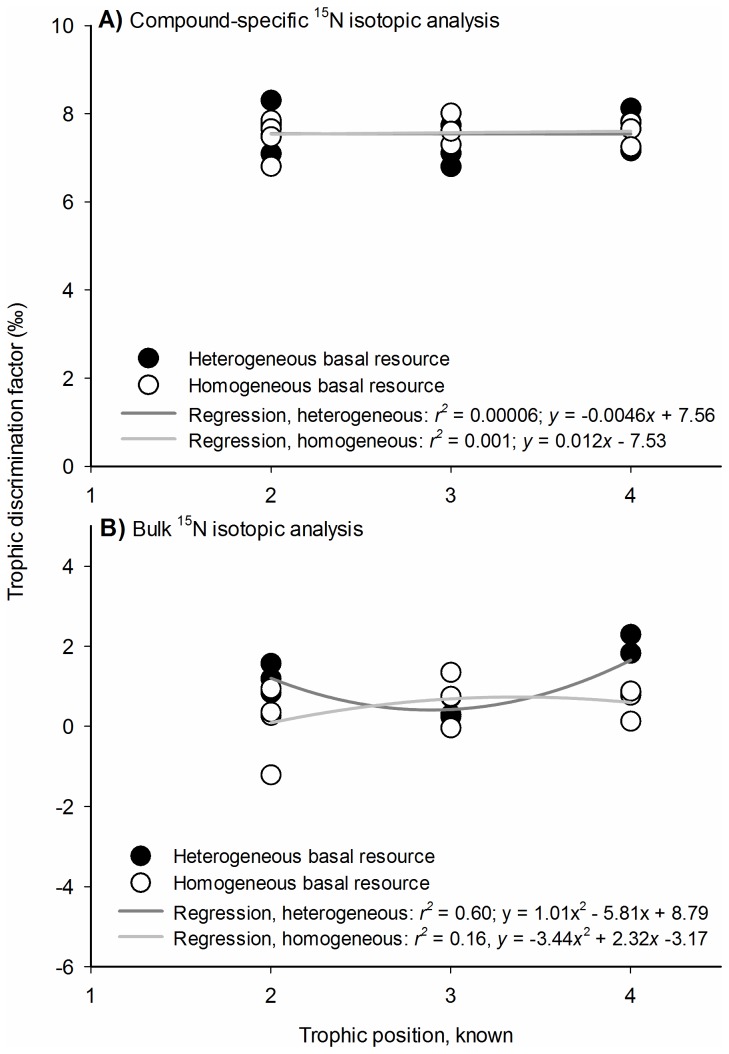
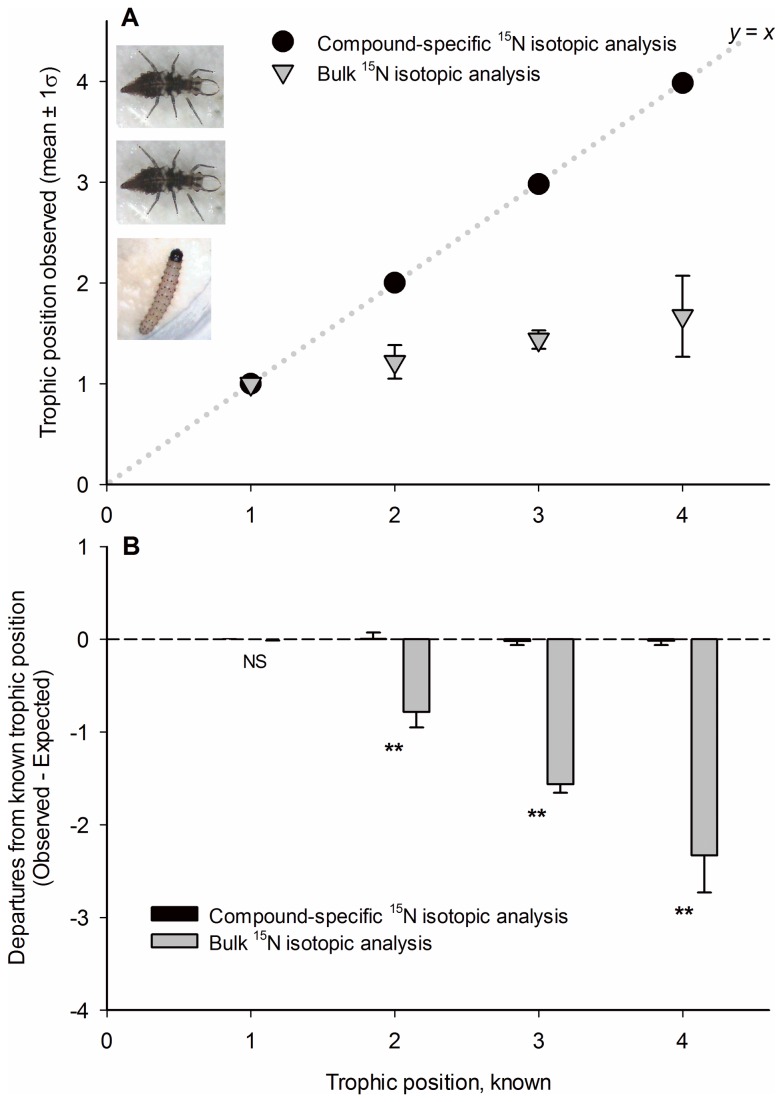
Food web ecologists have long sought to characterize the trophic niches of animals using stable isotopic analysis. However, distilling trophic position from isotopic composition has been difficult, largely because of the variability associated with trophic discrimination factors (inter-trophic isotopic fractionation and routing). We circumvented much of this variability using compound-specific isotopic analysis (CSIA). We examined the (15)N signatures of amino acids extracted from organisms reared in pure culture at four discrete trophic levels, across two model communities. We calculated the degree of enrichment at each trophic level and found there was a consistent trophic discrimination factor (~7.6‰). The constancy of the CSIA-derived discrimination factor permitted unprecedented accuracy in the measurement of animal trophic position. Conversely, trophic position estimates generated via bulk-(15)N analysis significantly underestimated trophic position, particularly among higher-order consumers. We then examined the trophic hierarchy of a free-roaming arthropod community, revealing the highest trophic position (5.07) and longest food chain ever reported using CSIA. High accuracy in trophic position estimation brings trophic function into sharper focus, providing greater resolution to the analysis of food webs.
长期以来,食物网生态学家一直试图利用稳定同位素分析来描述动物的营养生态位。然而,由于与营养辨别因子(营养级间的同位素分馏和路径)相关的可变性,从同位素组成中推断营养位置一直很困难。我们使用特定于化合物的同位素分析(CSIA)来避免这种可变性。我们研究了在两个模型群落中,从纯培养的四个不同营养级别的生物体中提取的氨基酸的(15)N 特征。我们计算了每个营养级别的富集程度,发现存在一个一致的营养辨别因子(约 7.6‰)。CSIA 衍生的辨别因子的恒定性使得对动物营养位置的测量具有前所未有的准确性。相反,通过批量(15)N 分析生成的营养位置估计值显著低估了营养位置,特别是在高阶消费者中。然后,我们研究了自由放养节肢动物群落的营养层次结构,揭示了使用 CSIA 报告的最高营养位置(5.07)和最长食物链。营养位置估计的高精度将营养功能更聚焦,为食物网分析提供了更高的分辨率。