Department of Pathology, Microbiology and Immunology, Vanderbilt University Medical Center, Nashville, Tennessee, United States of America.
PLoS One. 2013 Sep 27;8(9):e76558. doi: 10.1371/journal.pone.0076558. eCollection 2013.
The venom of Loxosceles reclusa (Brown Recluse spider) can cause a severe, life-threatening hemolysis in humans for which no therapy is currently available in the USA beyond supportive measures. Because this hemolysis is uncommon, relatively little is known about its clinical manifestation, diagnosis, or management. Here, we aimed to clarify the clinical details of envenomation, to determine the efficacy of the complement inhibitor eculizumab to prevent the hemolysis in vitro, and to investigate markers of exposure to Brown Recluse venom.
We performed a 10-year chart review of cases of Brown Recluse spider bite-mediated hemolysis at our institution. We also designed an in vitro assay to test the efficacy of eculizumab to inhibit hemolysis of venom exposed red blood cells. Finally, we compared levels of CD55, CD59 and glycophorin A on venom exposed versus venom-naïve cells.
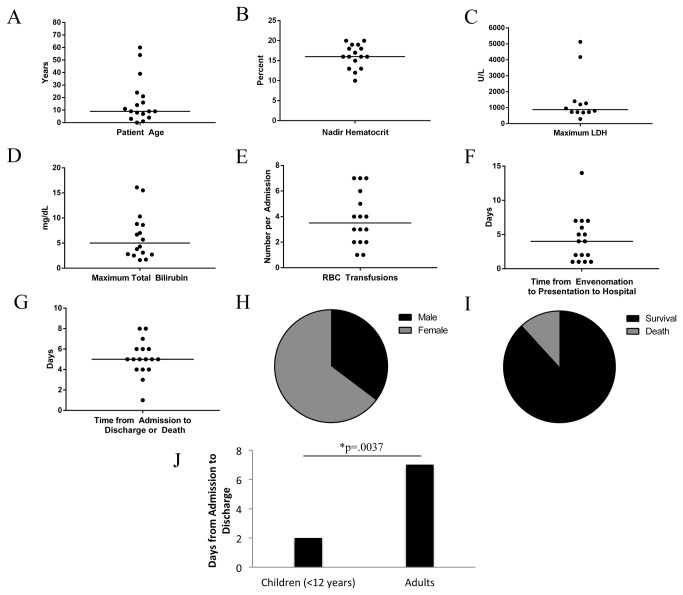
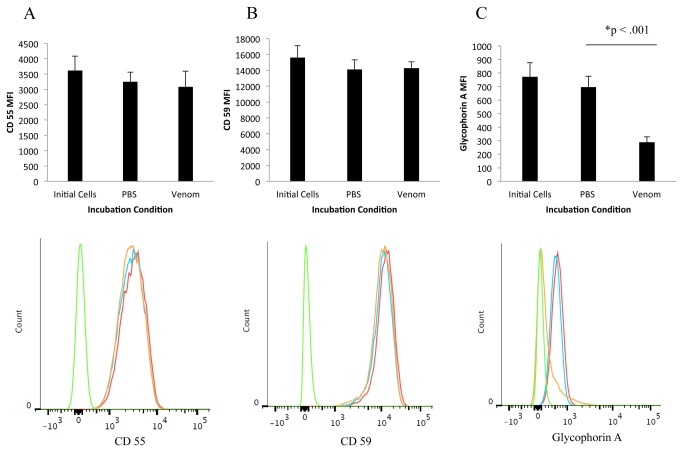
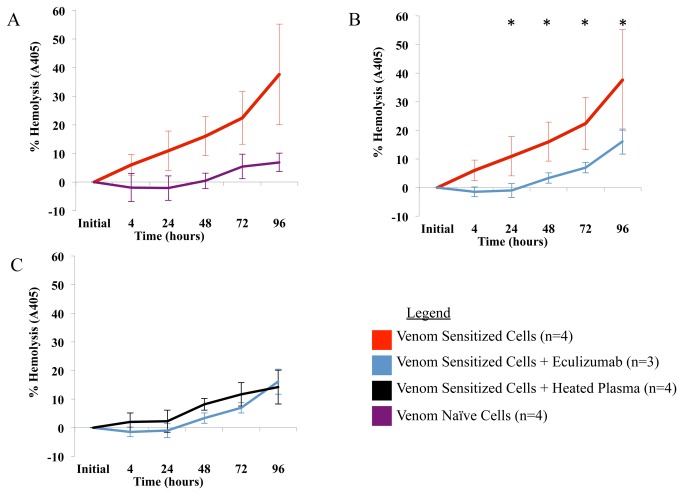
Most victims of severe Brown Recluse spider mediated hemolysis at our institution are children and follow an unpredictable clinical course. Brown Recluse spider bite mediated hemolysis is reduced by 79.2% (SD=18.8%) by eculizumab in vitro. Erythrocyte glycophorin A, but not CD55 or CD59, is reduced after red blood cells are incubated with venom in vitro.
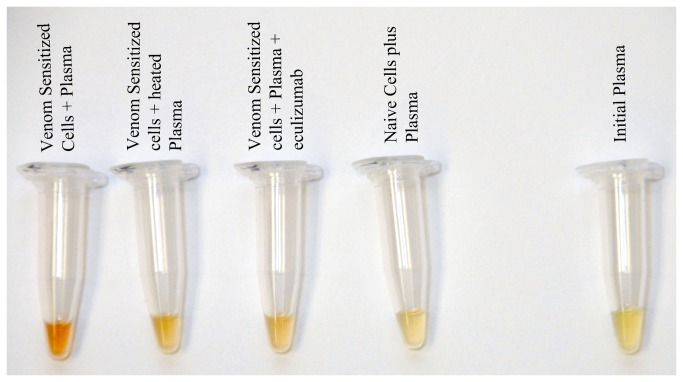
Taken together, our laboratory data and clinical observations indicate that L. reclusa venom exposure results in non-specific antibody and complement fixation on red blood cells, resulting in complement mediated hemolysis that is curtailed by the complement inhibitor eculizumab in vitro. Glycophorin A measurement by flow cytometry may help to identify victims of L. reclusa envenomation.
产自 Loxosceles reclusa(褐隐士蜘蛛)的毒液会导致人类严重的、危及生命的溶血性贫血,而在美国,目前除了支持性治疗外,尚无其他治疗方法。由于这种溶血较为罕见,人们对其临床表现、诊断或治疗方法知之甚少。在这里,我们旨在阐明其中毒的临床细节,确定补体抑制剂依库珠单抗预防体外溶血的疗效,并研究暴露于褐隐士蜘蛛毒液的标志物。
我们对我院收治的因褐隐士蜘蛛咬伤导致的溶血性贫血患者进行了 10 年的病历回顾。我们还设计了一项体外检测,以测试依库珠单抗抑制暴露于毒液的红细胞溶血的疗效。最后,我们比较了暴露于毒液和未暴露于毒液的红细胞上 CD55、CD59 和糖蛋白 A 的水平。
我院收治的严重褐隐士蜘蛛介导溶血性贫血患者多为儿童,且临床表现不可预测。体外试验中,依库珠单抗可使褐隐士蜘蛛咬伤介导的溶血减少 79.2%(标准差=18.8%)。体外孵育红细胞与毒液后,红细胞糖蛋白 A 减少,但 CD55 或 CD59 减少。
总之,我们的实验室数据和临床观察表明,L. reclusa 毒液暴露会导致非特异性抗体和补体在红细胞上固定,导致补体介导的溶血,而体外补体抑制剂依库珠单抗可抑制这种溶血。流式细胞术检测糖蛋白 A 可能有助于识别 L. reclusa 中毒的受害者。