Postgraduate Program in Medicine and Health Sciencies, Pontifícia Universidade Católica do Rio Grande do Sul, Porto Alegre/RS, Brazil.
PLoS One. 2013 Sep 27;8(9):e77227. doi: 10.1371/journal.pone.0077227. eCollection 2013.
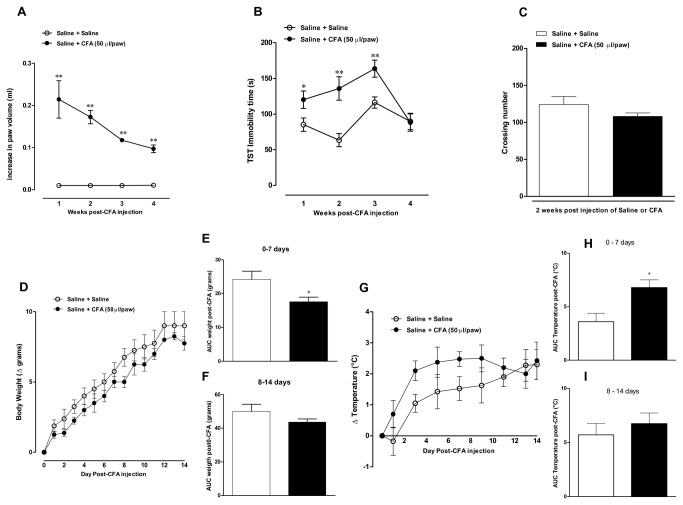
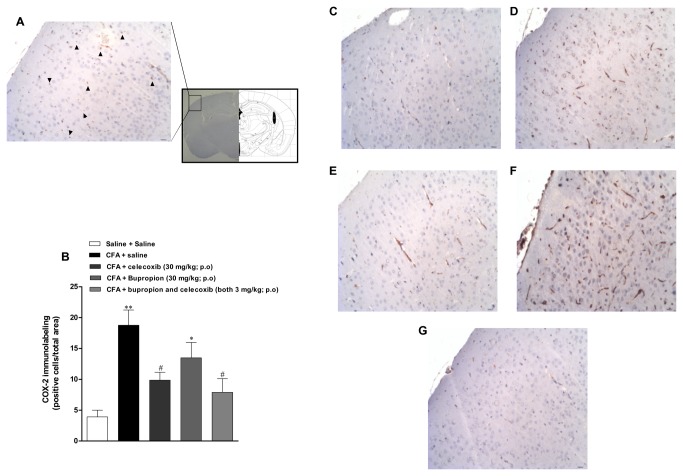
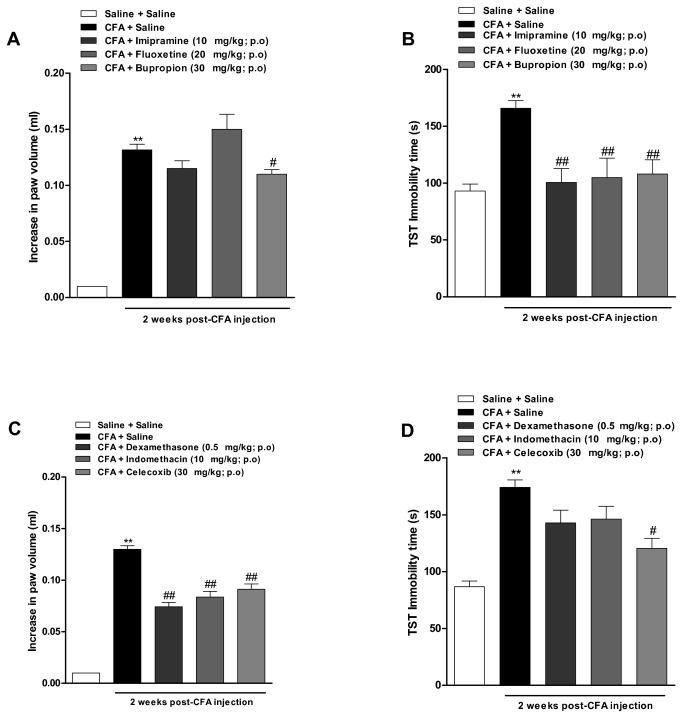
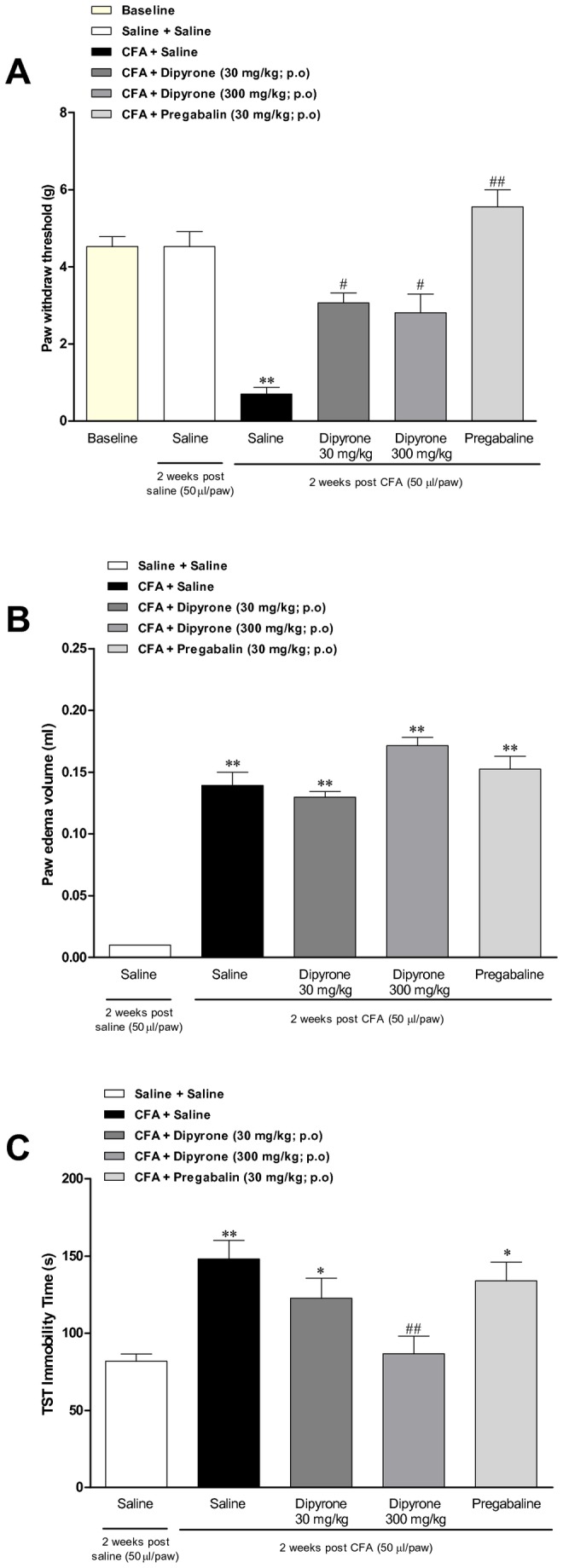
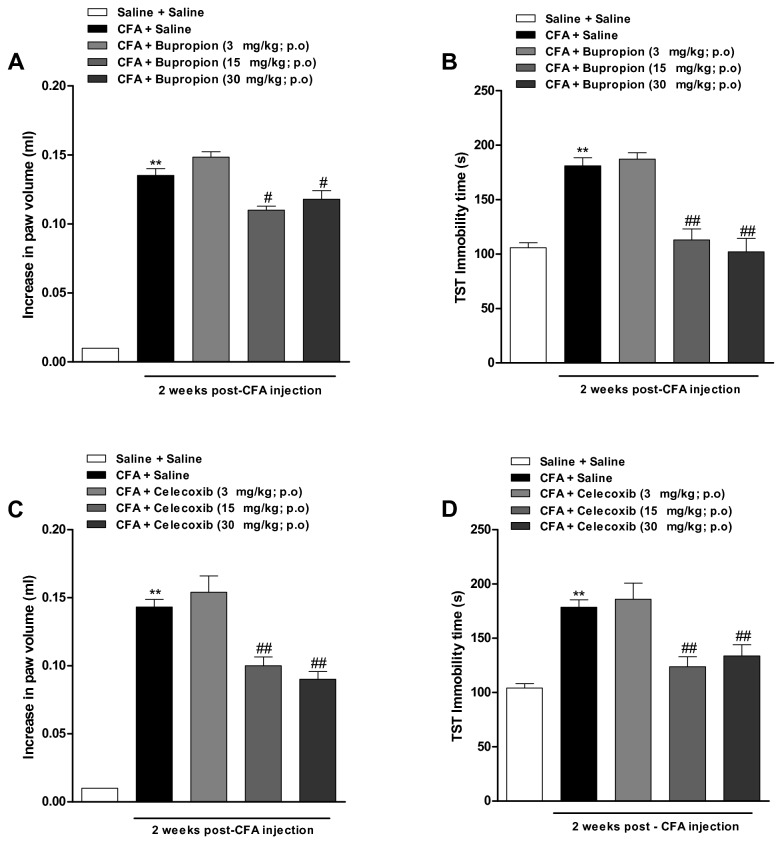
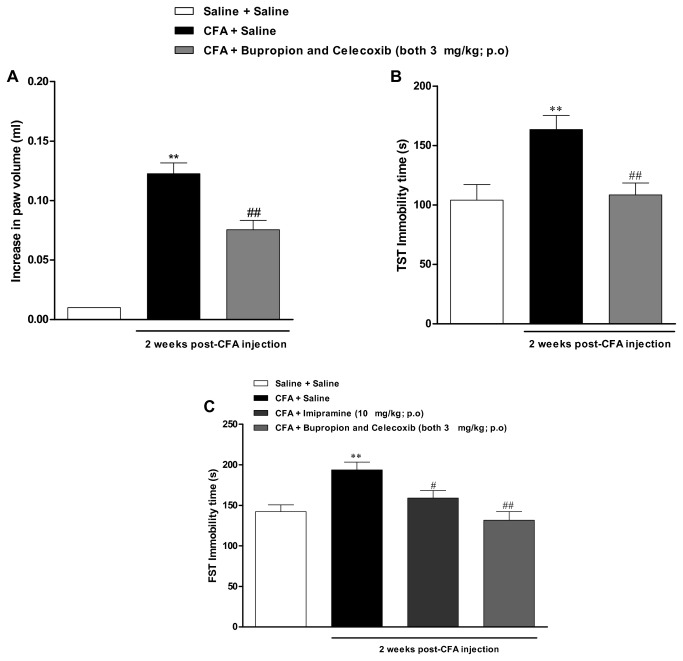
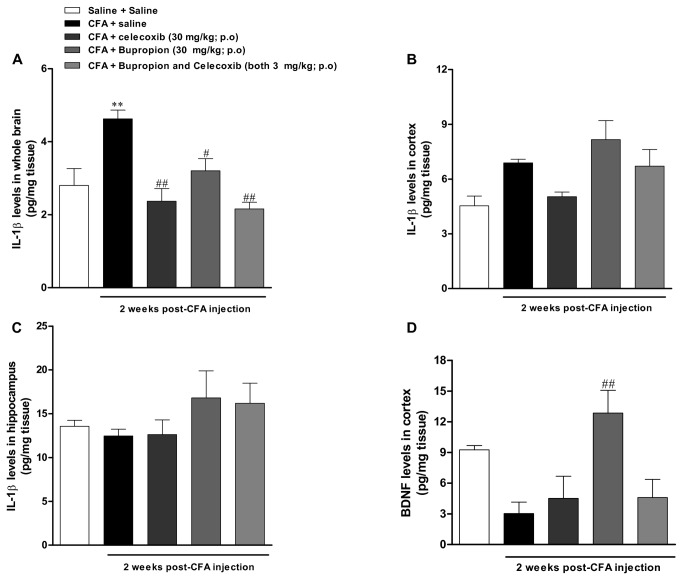
This study was aimed to characterize the depression-like behaviour in the classical model of chronic inflammation induced by Complete Freund's Adjuvant (CFA). Male Swiss mice received an intraplantar (i.pl.) injection of CFA (50 µl/paw) or vehicle. Behavioural and inflammatory responses were measured at different time-points (1 to 4 weeks), and different pharmacological tools were tested. The brain levels of IL-1β and BDNF, or COX-2 expression were also determined. CFA elicited a time-dependent edema formation and mechanical allodynia, which was accompanied by a significant increase in the immobility time in the tail suspension (TST) or forced-swimming (FST) depression tests. Repeated administration of the antidepressants imipramine (10 mg/kg), fluoxetine (20 mg/kg) and bupropion (30 mg/kg) significantly reversed depression-like behaviour induced by CFA. Predictably, the anti-inflammatory drugs dexamethasone (0.5 mg/kg), indomethacin (10 mg/kg) and celecoxib (30 mg/kg) markedly reduced CFA-induced edema. The oral treatment with the analgesic drugs dipyrone (30 and 300 mg/kg) or pregabalin (30 mg/kg) significantly reversed the mechanical allodyinia induced by CFA. Otherwise, either dipyrone or pregabalin (both 30 mg/kg) did not significantly affect the paw edema or the depressive-like behaviour induced by CFA, whereas the oral treatment with dipyrone (300 mg/kg) was able to reduce the immobility time in TST. Noteworthy, CFA-induced edema was reduced by bupropion (30 mg/kg), and depression behaviour was prevented by celecoxib (30 mg/kg). The co-treatment with bupropion and celecoxib (3 mg/kg each) significantly inhibited both inflammation and depression elicited by CFA. The same combined treatment reduced the brain levels of IL-1β, as well as COX-2 immunopositivity, whilst it failed to affect the reduction of BDNF levels. We provide novel evidence on the relationship between chronic inflammation and depression, suggesting that combination of antidepressant and anti-inflammatory agents bupropion and celecoxib might represent an attractive therapeutic strategy for depression.
本研究旨在描述完全弗氏佐剂(CFA)诱导的慢性炎症经典模型中的抑郁样行为。雄性瑞士小鼠接受足底(i.pl.)注射 CFA(50 µl/爪)或载体。在不同时间点(1 至 4 周)测量行为和炎症反应,并测试了不同的药理学工具。还测定了脑内白细胞介素 1β(IL-1β)和脑源性神经营养因子(BDNF)或环氧化酶 2(COX-2)的表达水平。CFA 引起时间依赖性水肿形成和机械性痛觉过敏,这伴随着尾巴悬挂(TST)或强制游泳(FST)抑郁测试中不动时间的显著增加。反复给予抗抑郁药丙咪嗪(10 mg/kg)、氟西汀(20 mg/kg)和安非他酮(30 mg/kg)可显著逆转 CFA 诱导的抑郁样行为。可以预见的是,抗炎药地塞米松(0.5 mg/kg)、吲哚美辛(10 mg/kg)和塞来昔布(30 mg/kg)显著减轻 CFA 引起的水肿。口服止痛药扑热息痛(30 和 300 mg/kg)或普瑞巴林(30 mg/kg)可显著逆转 CFA 引起的机械性痛觉过敏。然而,扑热息痛(30 或 300 mg/kg)或普瑞巴林(均 30 mg/kg)均未显著影响 CFA 引起的爪水肿或抑郁样行为,而扑热息痛(300 mg/kg)的口服治疗可减少 TST 中的不动时间。值得注意的是,CFA 诱导的水肿被安非他酮(30 mg/kg)减轻,而塞来昔布(30 mg/kg)则预防了 CFA 引起的抑郁行为。安非他酮和塞来昔布(各 3 mg/kg)的联合治疗显著抑制了 CFA 引起的炎症和抑郁。这种联合治疗还降低了脑内白细胞介素 1β的水平以及 COX-2 的免疫阳性率,但未能影响 BDNF 水平的降低。我们提供了慢性炎症与抑郁之间关系的新证据,表明抗抑郁药和抗炎药安非他酮和塞来昔布的联合治疗可能是治疗抑郁的一种有吸引力的治疗策略。