Orueta Juan F, Nuño-Solinís Roberto, García-Alvarez Arturo, Alonso-Morán Edurne
O+berri, Basque Institute for Healthcare Innovation, Plaza Asua 1, 48150 Sondika, Spain.
BMC Public Health. 2013 Oct 3;13:918. doi: 10.1186/1471-2458-13-918.
Multimorbidity is clearly a major challenge for healthcare systems. However, currently, its magnitude and impact on healthcare expenditures is still not well known. The objective of this paper is to present an overview of the prevalence of multimorbidity by deprivation level in the elderly population of the Basque Country.
We conducted a cross-sectional analysis that included all the inhabitants of the Basque Country aged 65 years and over (N = 452,698). This was based on data from primary care electronic medical records, hospital admissions, and outpatient care databases, for a 4-year period. The health problems of the patients were identified from their diagnoses and prescriptions. Multimorbidity was defined as the presence of two or more chronic diseases out of a list of 47 of the most important and common chronic conditions consistent with the literature. In addition, we explored socio-economic and demographic variables such as age, sex, and deprivation level.
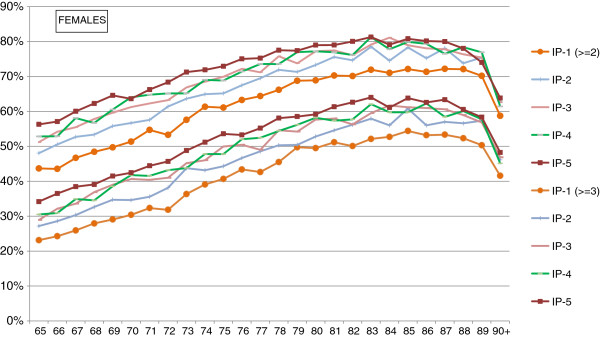
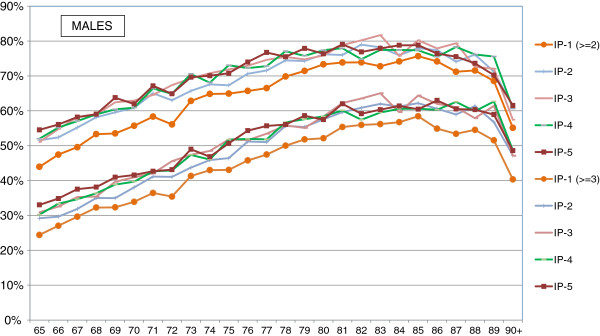
Multimorbidity was found in 66.13% of the population aged 65 and over and increases with age until 80 years. The prevalence of multimorbidity was higher in deprived (69.94%) than better-off (60.22%) areas. This pattern of differences between the most and least disadvantaged areas was observed in all age groups and more marked in female (70.96-59.78%) than in male (68.54-60.86%) populations. In almost all diseases studied (43 out of 47), 90% of patients had been diagnosed with at least one other illness. It was also frequent the coexistence of mental and physical health problems in the same person and the presence of multiple physical diseases is higher in patients with mental disease than in the rest of population (74.97% vs. 58.14%).
Multimorbidity is very common among people over 65 years old in the Basque Country, particularly in unfavourable socioeconomic environments. Given the ageing population, multimorbidity and its consequences should be taken into account in healthcare policy, organization of care and medical research. Administrative health databases are readily available sources of a range of information that can be useful for such purposes.
多病共存显然是医疗保健系统面临的一项重大挑战。然而,目前其规模及其对医疗保健支出的影响仍不太清楚。本文的目的是概述巴斯克地区老年人群中按贫困程度划分的多病共存患病率情况。
我们进行了一项横断面分析,纳入了巴斯克地区所有65岁及以上的居民(N = 452,698)。这是基于4年期间初级保健电子病历、住院记录和门诊护理数据库中的数据。通过患者的诊断和处方确定其健康问题。多病共存被定义为在与文献一致的47种最重要和最常见慢性病列表中存在两种或更多种慢性病。此外,我们还探讨了年龄、性别和贫困程度等社会经济和人口统计学变量。
在65岁及以上的人群中,66.13%的人存在多病共存情况,并且随着年龄增长至80岁患病率上升。贫困地区(69.94%)的多病共存患病率高于富裕地区(60.22%)。在所有年龄组中均观察到最贫困地区与最不贫困地区之间的这种差异模式,且在女性人群(70.96 - 59.78%)中比男性人群(68.54 - 60.86%)更为明显。在几乎所有研究的疾病(47种中的43种)中,90%的患者被诊断出至少还患有另一种疾病。同一个人同时存在精神和身体健康问题的情况也很常见,并且患有精神疾病的患者中多种身体疾病的存在比例高于其他人群(74.97%对58.14%)。
在巴斯克地区,多病共存在65岁以上人群中非常普遍,尤其是在不利的社会经济环境中。鉴于人口老龄化,在医疗保健政策、护理组织和医学研究中应考虑多病共存及其后果。行政健康数据库是一系列信息的现成来源,可用于此类目的。