Wade-Evans A, Jenkins J R
EMBO J. 1985 Mar;4(3):699-706. doi: 10.1002/j.1460-2075.1985.tb03686.x.
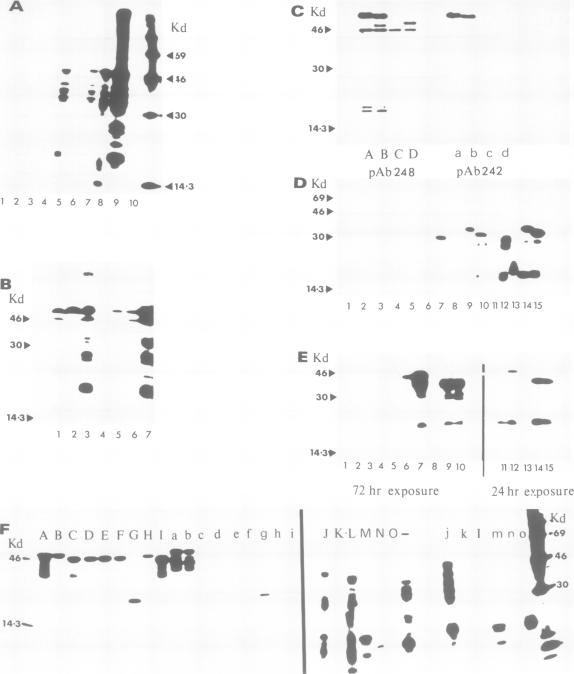
Murine p53 cDNA sequences were cloned into an in vitro expression vector, Protem Hind. Four deletion libraries were generated using Bal31 double-stranded exonuclease; two being made from constructs encoding a fusion protein constructed from SV40 small t sequences and the p53 clone, p27.la; and two from the full length p53 clone, pp53-5. Both 5'- and 3'-terminal deletions of the p53 gene were made. Transcription of these constructs using Escherichia coli RNA polymerase holoenzyme, followed by translation in mRNA-dependent rabbit reticulocyte lysate, gave in vitro, truncated protein products which were immunoprecipitated by a panel of anti-p53 monoclonal antibodies. This approach enabled us to map accurately the binding sites of seven different monoclonal antibodies, demonstrating four distinct antigenic sites on p53. A synthetic peptide was constructed corresponding to the predicted amino acid sequence of one of these epitopes. This peptide competes with the epitope on the full length p53 protein for the relevant monoclonal antibodies and dissociates the corresponding p53/antibody complexes.
将小鼠p53 cDNA序列克隆到体外表达载体Protem Hind中。使用Bal31双链外切核酸酶构建了四个缺失文库;其中两个文库来自编码由SV40小t序列和p53克隆p27.la构建的融合蛋白的构建体;另外两个文库来自全长p53克隆pp53 - 5。对p53基因进行了5'端和3'端的缺失。用大肠杆菌RNA聚合酶全酶对这些构建体进行转录,随后在依赖mRNA的兔网织红细胞裂解物中进行翻译,得到体外截短的蛋白质产物,这些产物被一组抗p53单克隆抗体免疫沉淀。这种方法使我们能够精确地定位七种不同单克隆抗体的结合位点,证明p53上有四个不同的抗原位点。构建了一种与这些表位之一的预测氨基酸序列相对应的合成肽。该肽与全长p53蛋白上的表位竞争相关单克隆抗体,并使相应的p53/抗体复合物解离。