Shimizu Miho, Furuichi Kengo, Toyama Tadashi, Kitajima Shinji, Hara Akinori, Kitagawa Kiyoki, Iwata Yasunori, Sakai Norihiko, Takamura Toshinari, Yoshimura Mitsuhiro, Yokoyama Hitoshi, Kaneko Shuichi, Wada Takashi
Corresponding author: Takashi Wada,
Diabetes Care. 2013 Nov;36(11):3655-62. doi: 10.2337/dc13-0298. Epub 2013 Oct 2.
We evaluated the structural-functional relationships and the prognostic factors for renal events, cardiovascular events, and all-cause mortality in type 2 diabetic patients with biopsy-proven diabetic nephropathy.
Japanese type 2 diabetic patients with biopsy-proven diabetic nephropathy (n = 260) were enrolled. Patients were stratified by albuminuria (proteinuria) and estimated glomerular filtration rate (eGFR) at the time of renal biopsy. The outcomes were the first occurrence of renal events (requirement of dialysis or a 50% decline in eGFR from baseline), cardiovascular events (cardiovascular death, nonfatal myocardial infarction, coronary interventions, or nonfatal stroke), and all-cause mortality.
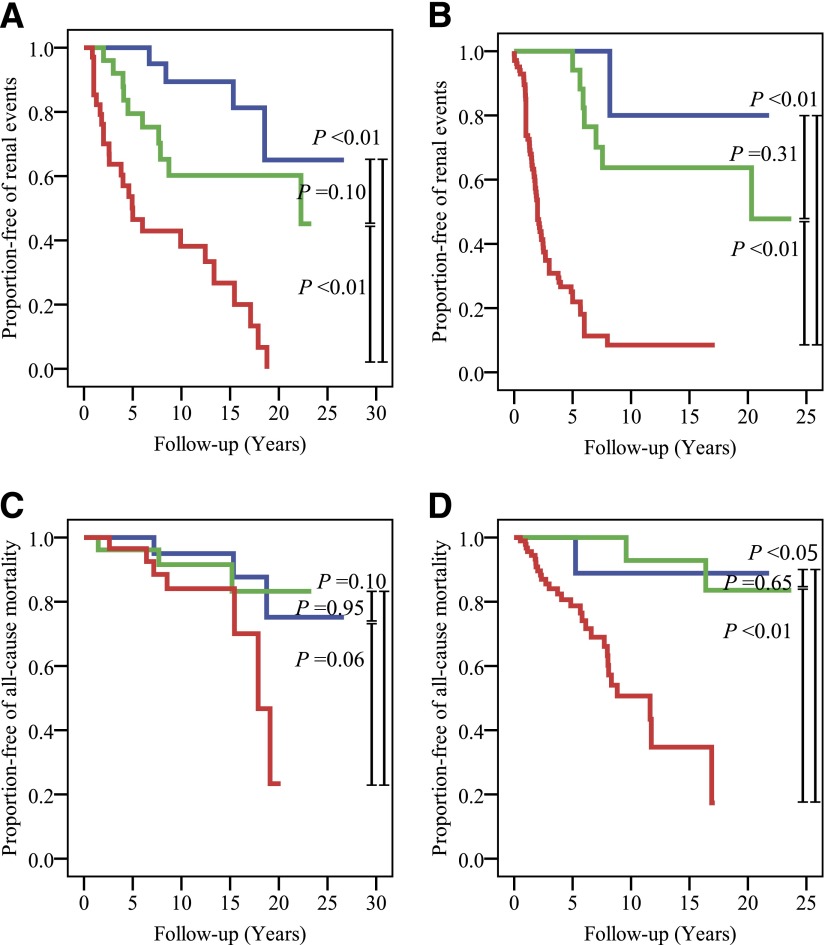
The factors associated with albuminuria (proteinuria) regardless of eGFR were hematuria, diabetic retinopathy, low hemoglobin, and glomerular lesions. The factors associated with low eGFR regardless of albuminuria (proteinuria) were age and diffuse, nodular, tubulointerstitial, and vascular lesions. The glomerular, tubulointerstitial, and vascular lesions in patients with normoalbuminuria (normal proteinuria) and low eGFR were more advanced compared to those in patients with normoalbuminuria (normal proteinuria) and maintained eGFR. In addition, compared to patients with micro-/macroalbuminuria (mild/severe proteinuria) and low eGFR, their tubulointerstitial and vascular lesions were similar or more advanced in contrast to glomerular lesions. The mean follow-up period was 8.1 years. There were 118 renal events, 62 cardiovascular events, and 45 deaths. The pathological determinants were glomerular lesions, interstitial fibrosis and tubular atrophy (IFTA), and arteriosclerosis for renal events, arteriosclerosis for cardiovascular events, and IFTA for all-cause mortality. The major clinical determinant for renal events and all-cause mortality was macroalbuminuria (severe proteinuria).
Our study suggests that the characteristic pathological lesions as well as macroalbuminuria (severe proteinuria) were closely related to the long-term outcomes of biopsy-proven diabetic nephropathy in type 2 diabetes.
我们评估了经活检证实患有糖尿病肾病的2型糖尿病患者肾脏事件、心血管事件及全因死亡率的结构-功能关系和预后因素。
纳入经活检证实患有糖尿病肾病的日本2型糖尿病患者(n = 260)。患者在肾活检时根据蛋白尿和估算肾小球滤过率(eGFR)进行分层。观察终点为首次发生肾脏事件(需要透析或eGFR自基线下降50%)、心血管事件(心血管死亡、非致死性心肌梗死、冠状动脉介入治疗或非致死性卒中)和全因死亡率。
无论eGFR如何,与蛋白尿相关的因素有血尿、糖尿病视网膜病变、低血红蛋白和肾小球病变。无论蛋白尿如何,与低eGFR相关的因素有年龄以及弥漫性、结节性、肾小管间质和血管病变。与eGFR正常且蛋白尿正常的患者相比,eGFR低且蛋白尿正常的患者的肾小球、肾小管间质和血管病变更严重。此外,与eGFR低且有微量/大量蛋白尿(轻度/重度蛋白尿)的患者相比,eGFR低且蛋白尿正常的患者的肾小管间质和血管病变相似或更严重,而肾小球病变则相反。平均随访期为8.1年。发生118例肾脏事件、62例心血管事件和45例死亡。肾脏事件的病理决定因素为肾小球病变、间质纤维化和肾小管萎缩(IFTA)以及动脉硬化,心血管事件的病理决定因素为动脉硬化,全因死亡率的病理决定因素为IFTA。肾脏事件和全因死亡率的主要临床决定因素为大量蛋白尿(重度蛋白尿)。
我们的研究表明,特征性病理病变以及大量蛋白尿(重度蛋白尿)与经活检证实的2型糖尿病糖尿病肾病的长期预后密切相关。