Department of Psychiatry, Tokyo Women's Medical University, School of Medicine, Shinjuku-ku, Tokyo, Japan.
BMC Psychiatry. 2013 Oct 3;13:243. doi: 10.1186/1471-244X-13-243.
It is desirable to establish evidence for the selection of antipsychotics from the viewpoint of recovery of social activity in individual patient with schizophrenia receiving medication. From this perspective, awareness of the importance of studies about drug effectiveness on treatment discontinuation rate, remission rate, and improvement in QOL has grown recently. In Western countries, numerous reports are available in effectiveness studies, which are related to olanzapine and risperidone primarily, whereas evidence for other second-generation antipsychotics (SGAs) is poor. In Japan, no effectiveness study has been reported: thus, it is desirable to collect data that will serve as evidence for selection of the 3 SGAs approved after olanzapine.
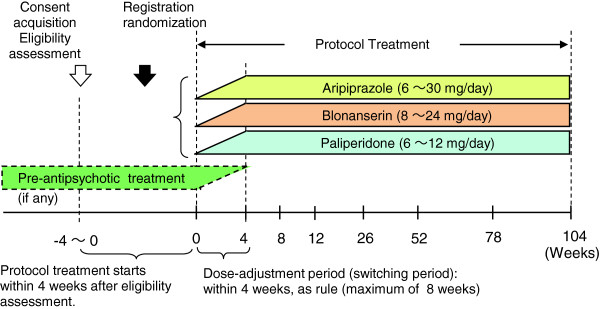
The present study was a long-term effectiveness study under healthcare setting in Japan. It was designed as an open-label, multicenter, randomized, comparative study involving 104-week oral treatment with 1 of the 3 drugs (aripiprazole, blonanserin, and paliperidone) in patients with schizophrenia aged 20 years or over who required antipsychotic medication or switching of the current medication to others for reasons such as lack of efficacy and intolerability. The primary endpoint is treatment discontinuation rate for any causes. The secondary endpoints include remission rate, improvement of social activity, alleviation, aggravation or recurrence of psychiatric symptoms, and safety. The target number of subjects was set at 300.
Because this study is expected to yield evidence regarding the selection of antipsychotics for facilitating the recovery of social activity in patients with schizophrenia, it is considered highly valuable to perform this effectiveness study under ordinary healthcare setting in Japan.
UMIN Clinical Trials Registry 000007942.
从接受药物治疗的个体精神分裂症患者的社会活动恢复角度出发,选择抗精神病药物需要有证据支持。从这个角度来看,人们最近越来越意识到研究药物对停药率、缓解率和生活质量改善的有效性的重要性。在西方国家,有许多关于奥氮平和利培酮的有效性研究报告,而其他第二代抗精神病药物(SGAs)的证据则很少。在日本,没有报告过有效性研究:因此,有必要收集可作为选择奥氮平之后批准的 3 种 SGA 的证据的数据。
本研究是日本医疗环境下的一项长期有效性研究。它被设计为一项开放性、多中心、随机、对照研究,涉及 104 周的口服治疗,共有 3 种药物(阿立哌唑、布南色林和帕利哌酮)可供 20 岁或以上需要抗精神病药物治疗或因疗效不佳和不耐受等原因更换当前药物的精神分裂症患者选择。主要终点是任何原因导致的停药率。次要终点包括缓解率、社会活动改善、精神症状的缓解、加重或复发以及安全性。目标受试者人数设定为 300 人。
由于这项研究有望为选择抗精神病药物以促进精神分裂症患者的社会活动恢复提供证据,因此在日本普通医疗环境下进行这项有效性研究被认为具有很高的价值。
UMIN 临床试验注册 000007942。