Department of Psychiatry, School of Medicine, Tokyo Women's Medical University, 8-1, Kawada-cho, Shinjuku-ku, Tokyo, 162-8666, Japan.
Present address: Institute of CNS Pharmacology, 4-26-11 Sendagaya, Shibuya-ku, Tokyo, 151-0051, Japan.
BMC Psychiatry. 2024 Sep 5;24(1):600. doi: 10.1186/s12888-024-06031-4.
We report the final results of treatment with aripiprazole, blonanserin, and paliperidone from the Japan Useful Medication Program for Schizophrenia (JUMPs), a 104-week naturalistic study.
JUMPs was an open-label, three-arm, randomized, parallel-group, 104-week study. Patients aged ≥ 20 years with schizophrenia requiring antipsychotic treatment or a switch from previous therapy were enrolled. The primary endpoint was treatment discontinuation rate over 104 weeks. Secondary endpoints included remission rate, Personal and Social Performance (PSP), safety, Positive and Negative Syndrome Scale (PANSS), and quality of life (QOL; EuroQol-5 dimension).
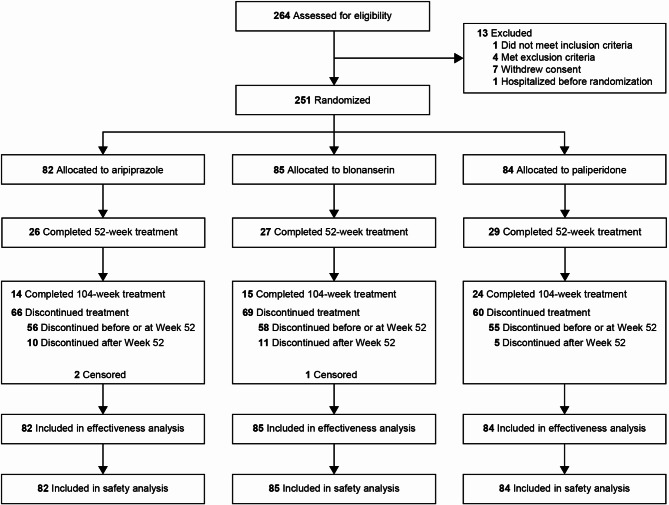
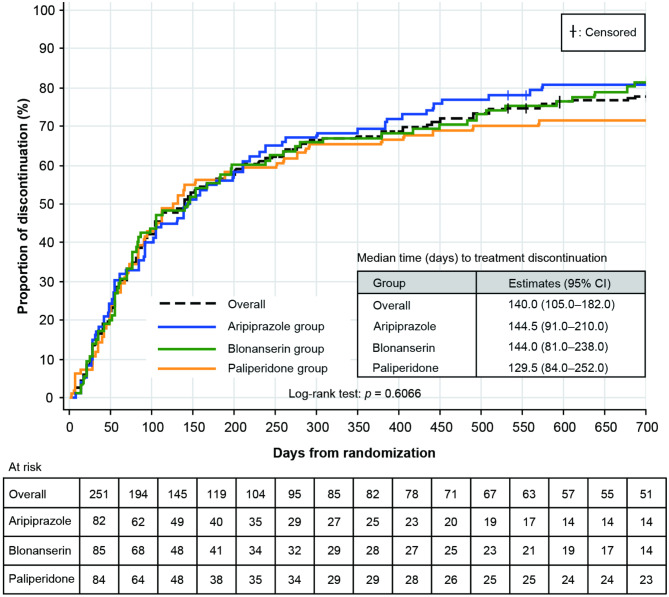
In total, 251 patients received aripiprazole (n = 82), blonanserin (n = 85), or paliperidone (n = 84). Treatment discontinuation rates (aripiprazole, 80.5%; blonanserin, 81.2%; paliperidone, 71.4%) were not significantly different (p = 0.2385) among the treatment groups at 104 weeks; comparable outcomes were observed for endpoints, including remission (42.9%, 46.7%, and 45.8%), PANSS, and safety. In the overall cohort, while the improvement in the PSP total score at Week 104 was not significantly different from baseline, a significant improvement (p < 0.05) in QOL and total PANSS scores (including all subscales) was observed at Week 104 compared with baseline. Multivariable analysis identified a shorter disease duration and a higher chlorpromazine-equivalent antipsychotic dosage level (≥ 1000 mg) before switching to monotherapy as predictors of treatment discontinuation.
The 104-week treatment outcomes were comparable between groups; the overall trend of improvement in remission rate, safety, and QOL suggests the importance of continued treatment.
UMIN-Clinical Trials Registry UMIN000007942 (public release date: 14/05/2012).
我们报告了阿立哌唑、布南色林和帕利哌酮在日本精神分裂症实用药物项目(JUMPs)中的最终治疗结果,这是一项为期 104 周的自然主义研究。
JUMPs 是一项开放标签、三臂、随机、平行组、104 周研究。纳入年龄≥20 岁、需要抗精神病治疗或从之前治疗转换的精神分裂症患者。主要终点是 104 周内的治疗停药率。次要终点包括缓解率、个人和社会表现(PSP)、安全性、阳性和阴性综合征量表(PANSS)以及生活质量(QOL;EuroQol-5 维度)。
共有 251 名患者接受阿立哌唑(n=82)、布南色林(n=85)或帕利哌酮(n=84)治疗。104 周时,各组治疗停药率(阿立哌唑,80.5%;布南色林,81.2%;帕利哌酮,71.4%)无显著差异(p=0.2385);终点观察结果相似,包括缓解率(42.9%、46.7%和 45.8%)、PANSS 和安全性。在整个队列中,虽然第 104 周 PSP 总分的改善与基线相比无显著差异,但与基线相比,第 104 周 QOL 和总 PANSS 评分(包括所有子量表)显著改善(p<0.05)。多变量分析确定,在转换为单药治疗之前,疾病持续时间较短和更高的氯丙嗪等效抗精神病药物剂量(≥1000mg)是治疗停药的预测因素。
各组 104 周治疗结果相当;缓解率、安全性和 QOL 的总体改善趋势表明持续治疗的重要性。
UMIN-临床试验注册 UMIN000007942(公开日期:2012 年 5 月 14 日)。