Tanaka Takako, Asai Masaharu, Yanagita Yorihide, Nishinakagawa Tsuyoshi, Miyamoto Naomi, Kotaki Kenji, Yano Yudai, Kozu Ryo, Honda Sumihisa, Senjyu Hideaki
Department of Cardiopulmonary Rehabilitation Science, Nagasaki University Graduate School of Biomedical Sciences, 1-7-1 Sakamoto, Nagasaki 852-8520, Japan.
BMC Public Health. 2013 Aug 17;13:766. doi: 10.1186/1471-2458-13-766.
Air pollution is known to be a leading cause of respiratory symptoms. Many cross-sectional studies reported that air pollution caused respiratory disease in Japanese individuals in the 1960s. Japan has laws regulating air pollution levels and providing compensation for victims of pollution-related respiratory disease. However, long-term changes in respiratory function and symptoms in individuals who were exposed to air pollution in the 1960s have not been well studied. This study aimed to investigate longitudinal respiratory function and symptoms in older, non-smoking, long-term officially-acknowledged victims of pollution-related illness.
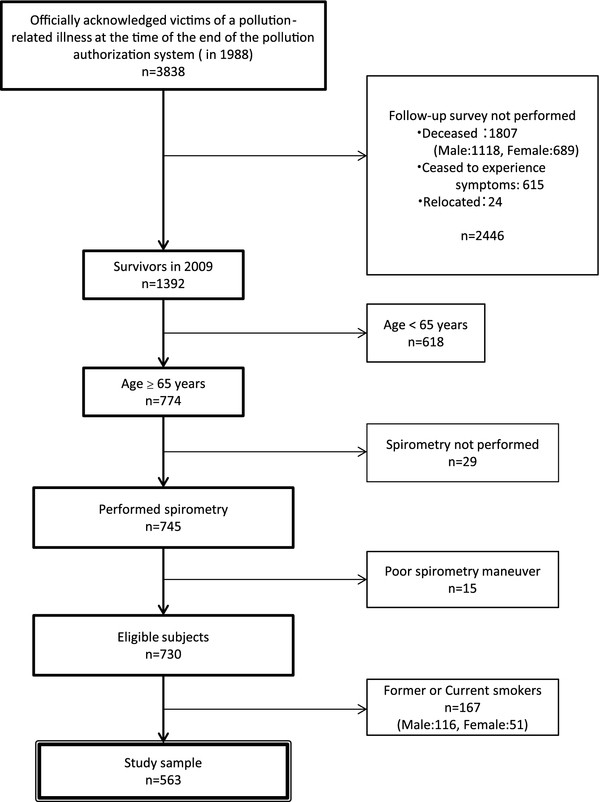
The study included 563 officially-acknowledged victims of pollution-related illness living in Kurashiki, Okayama who were aged ≥ 65 years in 2009. Data were retrospectively collected from yearly respiratory symptom questionnaires and spirometry examinations conducted from 2000 to 2009.
Respiratory function declined significantly from 2000 to 2009 (p < 0.01), but the mean annual changes were relatively small. The change in mean vital capacity was -40.5 ml/year in males and -32.7 ml/year in females, and the change in mean forced expiratory volume in 1 second was -27.6 ml/year in males and -23.9 ml/year in females. Dyspnea was the only symptom that worsened significantly from 2000 to 2009 in both sexes (males: p < 0.05, females: p < 0.01).
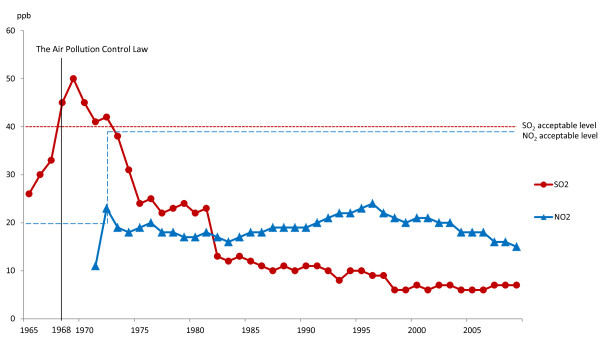
Our results suggest that the high concentrations of air pollutants around 1970 resulted in a decrease in respiratory function and an increase in respiratory symptoms in the study population. From 2000 to 2009, the mean annual changes in respiratory function were within the normal range, even though the severity of dyspnea worsened. The changes in respiratory function and symptoms over the study period were probably due to aging. The laws governing air pollution levels and providing compensation for officially-acknowledged victims of pollution-related illness in Japan may be effective for respiratory disease cause by pollution.
空气污染是导致呼吸道症状的主要原因之一。许多横断面研究报告称,20世纪60年代日本的空气污染导致了呼吸道疾病。日本有相关法律对空气污染水平进行规范,并为与污染相关的呼吸道疾病受害者提供赔偿。然而,20世纪60年代接触过空气污染的个体的呼吸功能和症状的长期变化尚未得到充分研究。本研究旨在调查年龄较大、不吸烟、长期被官方认定为污染相关疾病受害者的人群的纵向呼吸功能和症状。
该研究纳入了2009年居住在冈山县仓敷市、年龄≥65岁的563名官方认定的污染相关疾病受害者。数据通过回顾性收集2000年至2009年每年的呼吸道症状问卷和肺活量测定检查获得。
2000年至2009年呼吸功能显著下降(p<0.01),但年平均变化相对较小。男性平均肺活量的变化为每年-40.5毫升,女性为每年-32.7毫升;男性1秒用力呼气量的变化为每年-27.6毫升,女性为每年-23.9毫升。呼吸困难是2000年至2009年期间男女唯一显著加重的症状(男性:p<0.05,女性:p<0.01)。
我们的结果表明,1970年左右的高浓度空气污染物导致了研究人群呼吸功能下降和呼吸道症状增加。从2000年到2009年,尽管呼吸困难的严重程度有所加重,但呼吸功能的年平均变化仍在正常范围内。研究期间呼吸功能和症状的变化可能是由于衰老。日本有关空气污染水平的法律以及为官方认定的污染相关疾病受害者提供赔偿的法律可能对污染引起的呼吸道疾病有效。