Department of Geriatric Medicine, Xiang-Ya Hospital, Central South University, Xiang-Ya Road 87#, Changsha, Hunan 410008, China.
Cardiovasc Diabetol. 2013 Oct 4;12:141. doi: 10.1186/1475-2840-12-141.
Accumulation of advanced glycation end products (AGEs) in the vasculature triggers a series of morphological and functional changes contributing to endothelial hyperpermeability. The reorganisation and redistribution of the cytoskeleton regulated by profilin-1 mediates endothelial cell contraction, which results in vascular hyperpermeability. This study aimed to investigate the pivotal role of profilin-1 in the process of endothelial cell damage induced by AGEs.
Human umbilical vein endothelial cells (HUVECs) were incubated with AGEs. The mRNA and protein expression of profilin-1 was determined using real-time PCR and western blotting analyses. The levels of intercellular adhesion molecule-1 (ICAM-1), nitric oxide (NO) and reactive oxygen species (ROS), as well as the activities of nuclear factor-κB (NF-κB) and protein kinase C (PKC), were detected using the appropriate kits. The levels of asymmetric dimethylarginine (ADMA) were determined using HPLC. The distribution of the cytoskeleton was visualised using immunofluorescent staining.
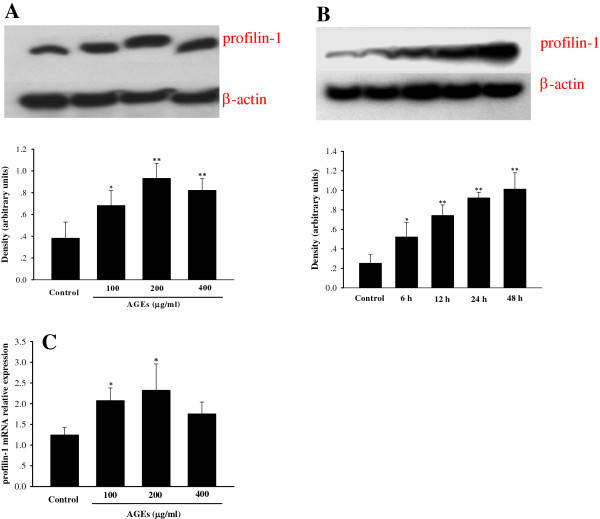
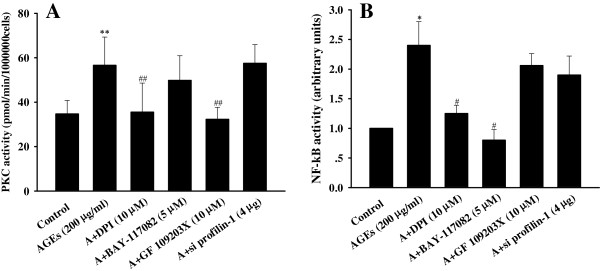
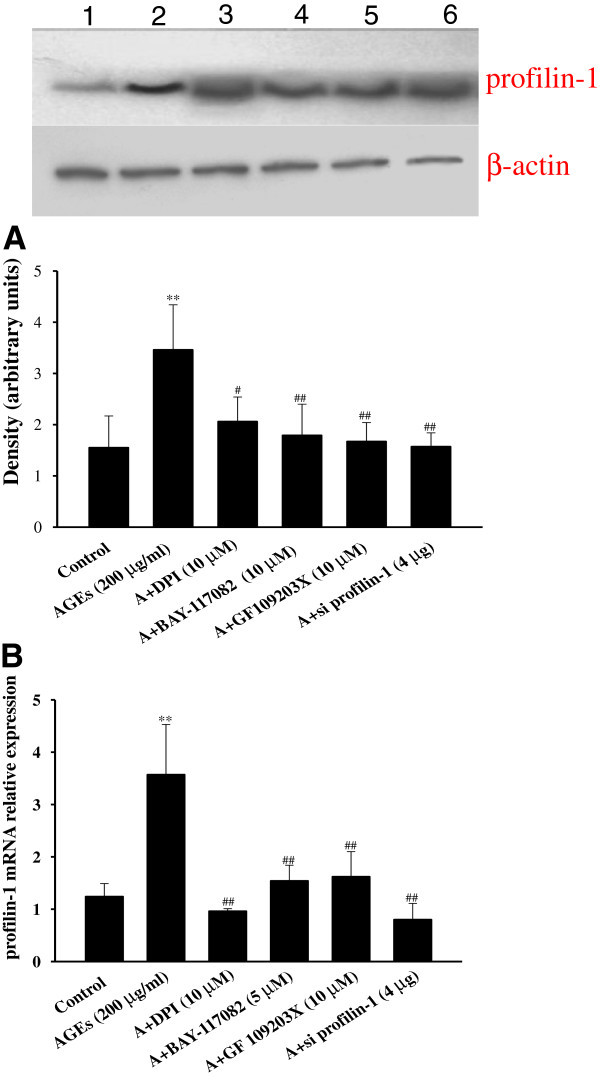
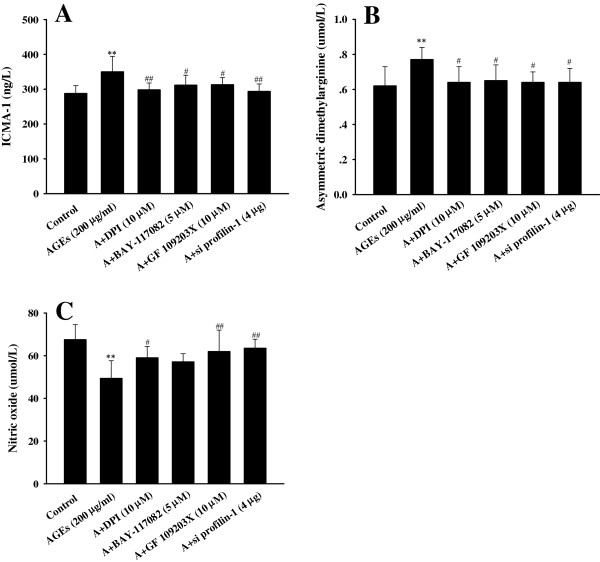
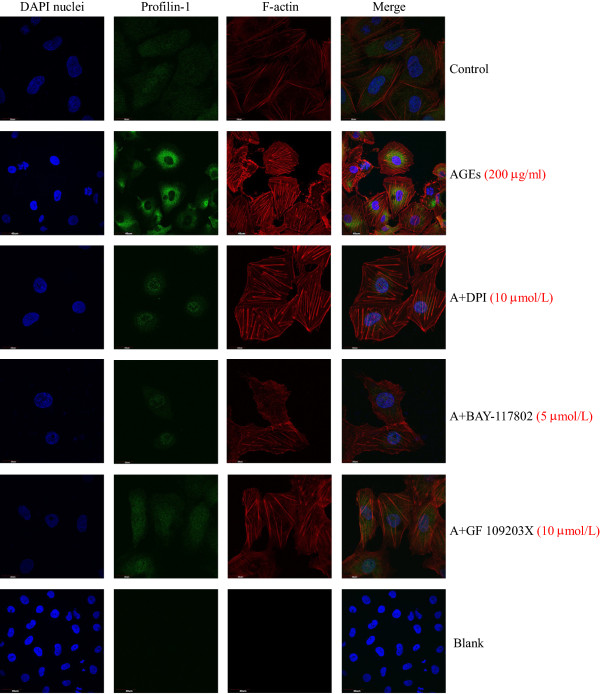
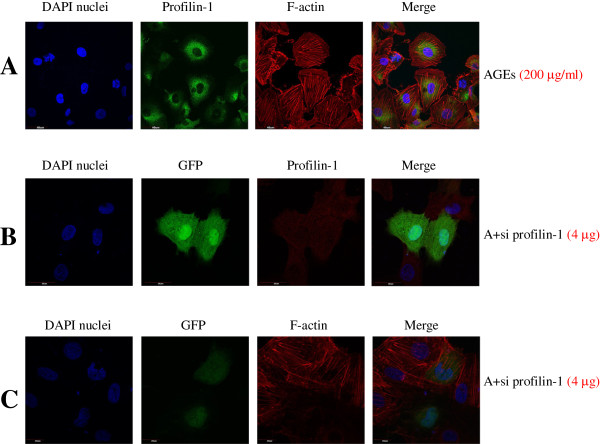
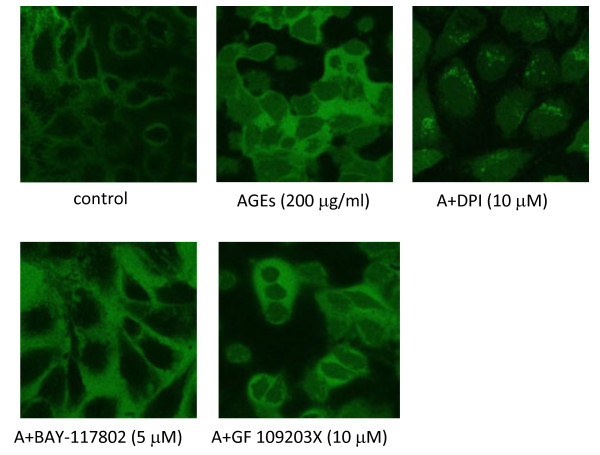
Compared with the control, incubation of endothelial cells with AGEs (200 μg/ml) for 4 or 24 h significantly up-regulated the mRNA and protein expression of profilin-1, markedly increased the levels of ICAM-1 and ADMA and decreased the production of NO (P<0.05, P<0.01), which was significantly attenuated by pretreatment with DPI (an antioxidant), GF 109203X (PKC inhibitor) or BAY-117082 (NF-κB inhibitor). DPI (10 μmol/L) markedly decreased the elevated levels of ROS induced by AGEs (200 μg/ml, 24 h); however, GF 109203X (10 μmol/L) and BAY-117082 (5 μmol/L) exhibited no significant effect on the formation of ROS by AGEs. Immunofluorescent staining indicated that AGEs markedly increased the expression of profilin-1 in the cytoplasm and the formation of actin stress fibres, resulting in the rearrangement and redistribution of the cytoskeleton. This effect was significantly ameliorated by DPI, GF 109203X, BAY-117082 or siRNA treatment of profilin-1. Incubation with DPI and GF 109203X markedly inhibited the activation of PKC triggered by AGEs, and DPI and BAY-117082 significantly decreased the activity of NF-κB mediated by AGEs. Disruption of profilin-1 gene expression attenuated the extent of endothelial abnormalities by reducing ICAM-1 and ADMA levels and elevating NO levels (P<0.05, P<0.01), but this disruption had no effect on the activities of NF-κB and PKC (P>0.05).
These findings suggested that profilin-1 might act as an ultimate and common cellular effector in the process of metabolic memory (endothelial abnormalities) mediated by AGEs via the ROS/PKC or ROS/NF-қB signalling pathways.
血管中晚期糖基化终产物(AGEs)的积累引发了一系列形态和功能变化,导致内皮细胞通透性增加。原肌球蛋白-1调节的细胞骨架的重组和再分布介导内皮细胞收缩,导致血管通透性增加。本研究旨在探讨原肌球蛋白-1在 AGEs 诱导的内皮细胞损伤过程中的关键作用。
将人脐静脉内皮细胞(HUVECs)与 AGEs 孵育。使用实时 PCR 和 Western blot 分析测定原肌球蛋白-1的 mRNA 和蛋白表达。使用适当的试剂盒检测细胞间黏附分子-1(ICAM-1)、一氧化氮(NO)和活性氧(ROS)的水平,以及核因子-κB(NF-κB)和蛋白激酶 C(PKC)的活性。使用高效液相色谱法测定不对称二甲基精氨酸(ADMA)的水平。使用免疫荧光染色观察细胞骨架的分布。
与对照组相比,内皮细胞与 AGEs(200μg/ml)孵育 4 或 24 小时显著上调原肌球蛋白-1的 mRNA 和蛋白表达,显著增加 ICAM-1 和 ADMA 的水平,降低 NO 的产生(P<0.05,P<0.01),用抗氧化剂 DPI、PKC 抑制剂 GF 109203X 或 NF-κB 抑制剂 BAY-117082 预处理可显著减弱这种作用。DPI(10μmol/L)显著降低了 AGEs(200μg/ml,24 小时)诱导的 ROS 水平升高;然而,GF 109203X(10μmol/L)和 BAY-117082(5μmol/L)对 AGEs 形成的 ROS 无明显影响。免疫荧光染色表明,AGEs 显著增加了细胞质中原肌球蛋白-1的表达和肌动蛋白应力纤维的形成,导致细胞骨架的重排和再分布。这种作用被 DPI、GF 109203X、BAY-117082 或原肌球蛋白-1的 siRNA 处理显著改善。用 DPI 和 GF 109203X 孵育可显著抑制 AGEs 触发的 PKC 活化,而 DPI 和 BAY-117082 可显著降低 AGEs 介导的 NF-κB 活性。原肌球蛋白-1基因表达的破坏通过降低 ICAM-1 和 ADMA 水平和升高 NO 水平减轻内皮异常的程度(P<0.05,P<0.01),但这一破坏对 NF-κB 和 PKC 的活性没有影响(P>0.05)。
这些发现表明,原肌球蛋白-1可能作为代谢记忆(AGEs 介导的内皮异常)过程中的最终和共同的细胞效应物,通过 ROS/PKC 或 ROS/NF-қB 信号通路发挥作用。