HIV/STI Department, Public Health England.
J Infect Dis. 2013 Nov 1;208(9):1397-403. doi: 10.1093/infdis/jit361.
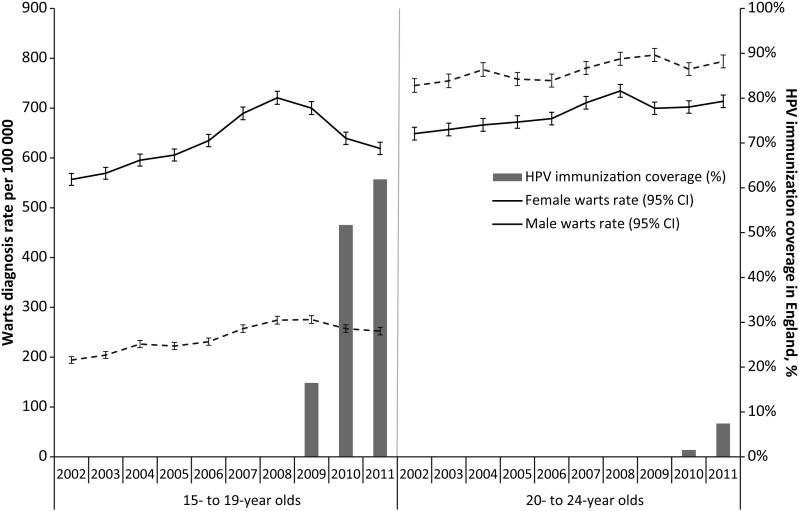
Diagnoses of genital warts (GW) in genitourinary medicine (GUM) clinics have been increasing in England for many years. In 2008, an HPV immunization program began with a bivalent vaccine (Cervarix). This was expected to markedly reduce infections and disease due to human papillomavirus (HPV) 16/18 but not HPV 6/11 infections or disease. However, from 2009 to 2011 there were decreases in reported diagnoses of GW in young females at GUM clinics.
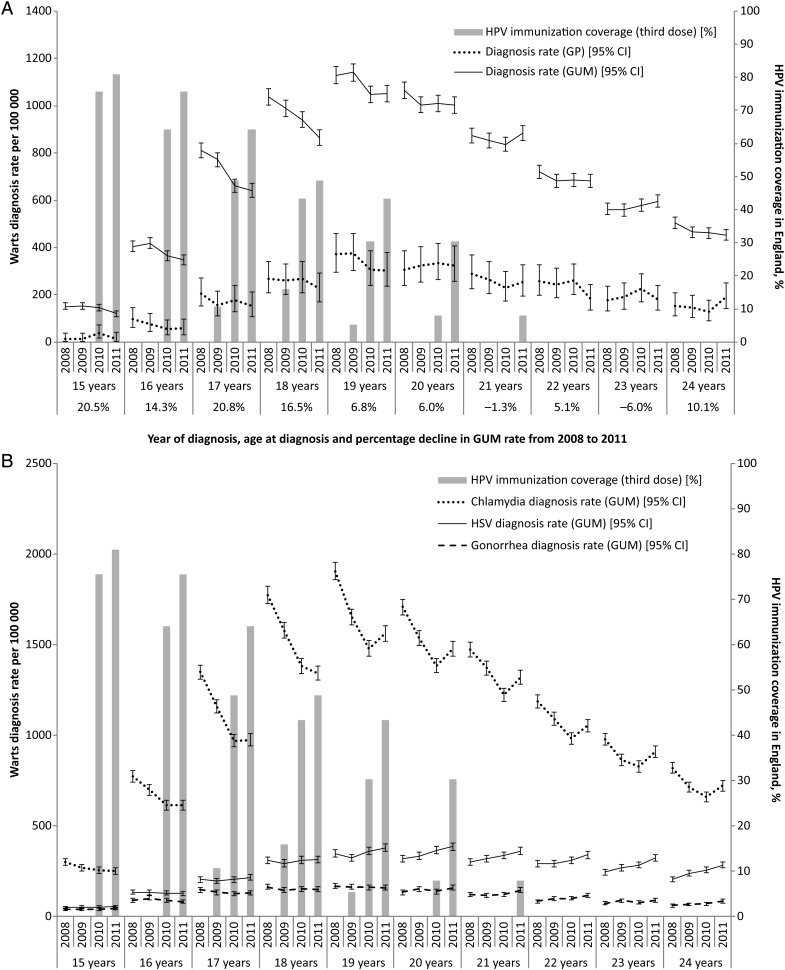
Using data from GUM clinics and a sample of general practices (GPs) throughout England, we analyzed rates of GW diagnoses by age, year of diagnosis, and estimated immunization coverage.
The overall reduction in GW diagnoses at GUM clinics between 2008 and 2011 was 13.3% among 16- to 19-year-old females, with the greatest decline of 20.8% in 17-year-olds. Declines were positively associated with estimated immunization coverage. A similar pattern was seen in GP diagnoses, but not among older women, and for other GUM consultations.
Several factors might contribute to declines in GW. However, the size and pattern of the declines strongly suggest that we are observing an unexpected, moderately protective effect of HPV 16/18 vaccination against GW.
在英国,多年来,泌尿科门诊(GUM)对生殖器疣(GW)的诊断一直在增加。2008 年,开始实施 HPV 免疫接种计划,使用二价疫苗(Cervarix)。预计这将显著减少 HPV 16/18 感染和疾病,但不会减少 HPV 6/11 感染或疾病。然而,2009 年至 2011 年,GUM 诊所年轻女性 GW 诊断报告数量有所下降。
利用 GUM 诊所和英格兰各地普通实践(GP)的数据,我们分析了按年龄、诊断年份和估计免疫覆盖率计算的 GW 诊断率。
2008 年至 2011 年,GUM 诊所 16 至 19 岁女性的 GW 诊断总数减少了 13.3%,17 岁女性的降幅最大,为 20.8%。下降与估计免疫覆盖率呈正相关。GP 诊断也呈现出类似的模式,但在年龄较大的女性以及其他 GUM 咨询中并未如此。
有几个因素可能导致 GW 下降。然而,下降的规模和模式强烈表明,我们正在观察 HPV 16/18 疫苗接种对 GW 产生意外的、适度的保护作用。