Fundación Instituto de Inmunología de Colombia FIDIC, Carrera 50 # 26-20, Bogotá, Colombia.
Malar J. 2013 Oct 5;12:356. doi: 10.1186/1475-2875-12-356.
The tight junction (TJ) is one of the most important structures established during merozoite invasion of host cells and a large amount of proteins stored in Toxoplasma and Plasmodium parasites' apical organelles are involved in forming the TJ. Plasmodium falciparum and Toxoplasma gondii apical membrane antigen 1 (AMA-1) and rhoptry neck proteins (RONs) are the two main TJ components. It has been shown that RON4 plays an essential role during merozoite and sporozoite invasion to target cells. This study has focused on characterizing a novel Plasmodium vivax rhoptry protein, RON4, which is homologous to PfRON4 and PkRON4.
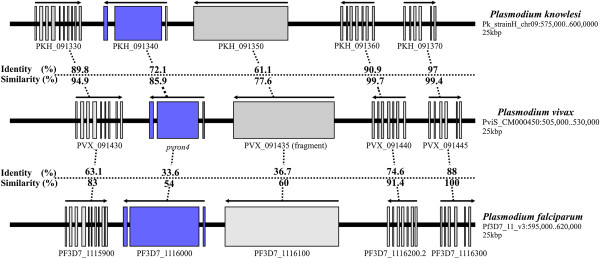
The ron4 gene was re-annotated in the P. vivax genome using various bioinformatics tools and taking PfRON4 and PkRON4 amino acid sequences as templates. Gene synteny, as well as identity and similarity values between open reading frames (ORFs) belonging to the three species were assessed. The gene transcription of pvron4, and the expression and localization of the encoded protein were also determined in the VCG-1 strain by molecular and immunological studies. Nucleotide and amino acid sequences obtained for pvron4 in VCG-1 were compared to those from strains coming from different geographical areas.
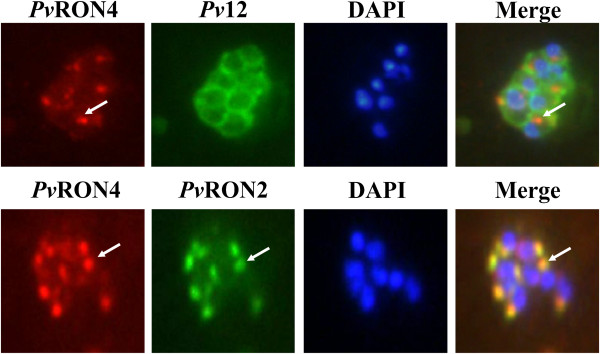
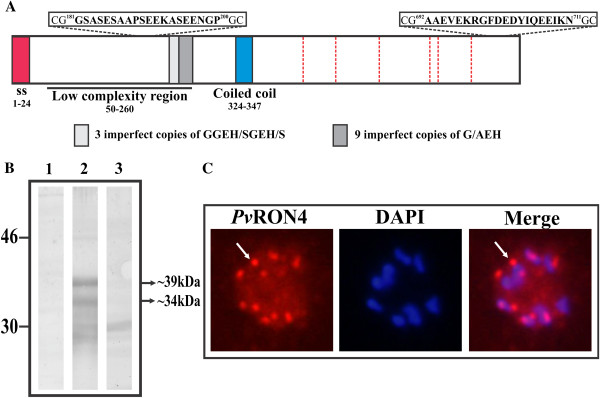
PvRON4 is a 733 amino acid long protein, which is encoded by three exons, having similar transcription and translation patterns to those reported for its homologue, PfRON4. Sequencing PvRON4 from the VCG-1 strain and comparing it to P. vivax strains from different geographical locations has shown two conserved regions separated by a low complexity variable region, possibly acting as a "smokescreen". PvRON4 contains a predicted signal sequence, a coiled-coil α-helical motif, two tandem repeats and six conserved cysteines towards the carboxy-terminus and is a soluble protein lacking predicted transmembranal domains or a GPI anchor. Indirect immunofluorescence assays have shown that PvRON4 is expressed at the apical end of schizonts and co-localizes at the rhoptry neck with PvRON2.
Genomic, transcriptional and expression data reported for PvRON4, as well as its primary structure characteristics suggest that this protein participates in reticulocyte invasion, as has been shown for its homologue PfRON4.
紧密连接(TJ)是疟原虫入侵宿主细胞时建立的最重要结构之一,大量储存在弓形虫和疟原虫顶细胞器中的蛋白质参与形成 TJ。恶性疟原虫和刚地弓形虫顶膜抗原 1(AMA-1)和棒状体颈蛋白(RONs)是 TJ 的两个主要成分。已经表明,RON4 在裂殖体和孢子体入侵靶细胞的过程中发挥着重要作用。本研究集中于鉴定一种新的恶性疟原虫棒状体蛋白 RON4,其与 PfRON4 和 PkRON4 同源。
使用各种生物信息学工具,以 PfRON4 和 PkRON4 氨基酸序列为模板,重新注释 P. vivax 基因组中的 ron4 基因。评估三个物种的基因同线性以及开放阅读框(ORF)之间的身份和相似性值。通过分子和免疫学研究,还确定了 VCG-1 株中的 pvron4 基因转录以及编码蛋白的表达和定位。比较 VCG-1 中获得的 pvron4 的核苷酸和氨基酸序列与来自不同地理区域的株的序列。
PvRON4 是一种 733 个氨基酸长的蛋白质,由三个外显子编码,其转录和翻译模式与同源物 PfRON4 相似。对 VCG-1 株中的 PvRON4 进行测序,并将其与来自不同地理区域的 P. vivax 株进行比较,显示出两个保守区域被一个低复杂度可变区隔开,可能起到“烟幕”的作用。PvRON4 包含一个预测的信号序列、一个卷曲螺旋 α-螺旋模体、两个串联重复和六个位于羧基末端的保守半胱氨酸,是一种缺乏预测跨膜结构域或 GPI 锚的可溶性蛋白。间接免疫荧光分析表明,PvRON4 在裂殖体的顶端表达,并与 PvRON2 在棒状体颈处共定位。
报告的 PvRON4 的基因组、转录和表达数据以及其一级结构特征表明,该蛋白参与网织红细胞入侵,正如其同源物 PfRON4 所示。