Fundación Instituto de Inmunología de Colombia, Carrera 50 No, 26-20, Bogotá, Colombia.
Malar J. 2011 Oct 24;10:314. doi: 10.1186/1475-2875-10-314.
Plasmodium vivax malaria remains a major health problem in tropical and sub-tropical regions worldwide. Several rhoptry proteins which are important for interaction with and/or invasion of red blood cells, such as PfRONs, Pf92, Pf38, Pf12 and Pf34, have been described during the last few years and are being considered as potential anti-malarial vaccine candidates. This study describes the identification and characterization of the P. vivax rhoptry neck protein 1 (PvRON1) and examine its antigenicity in natural P. vivax infections.
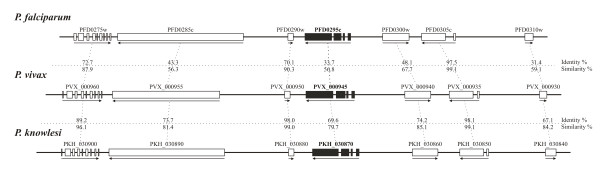
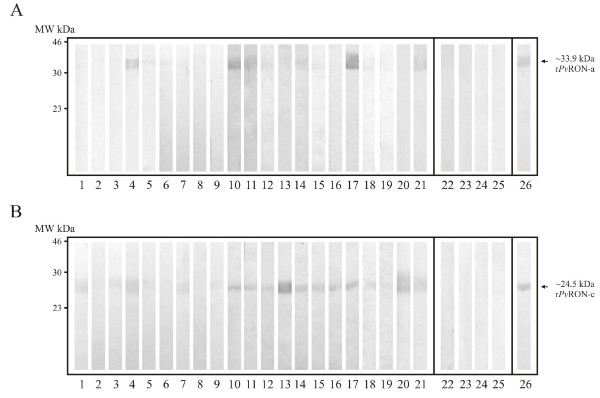
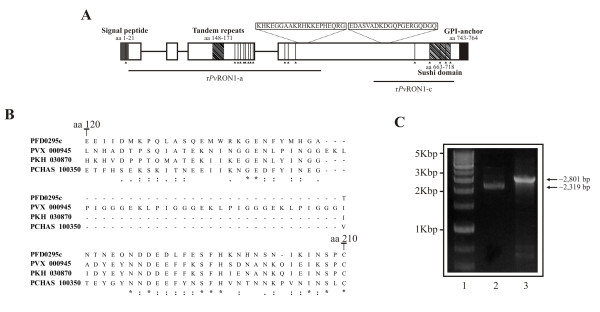
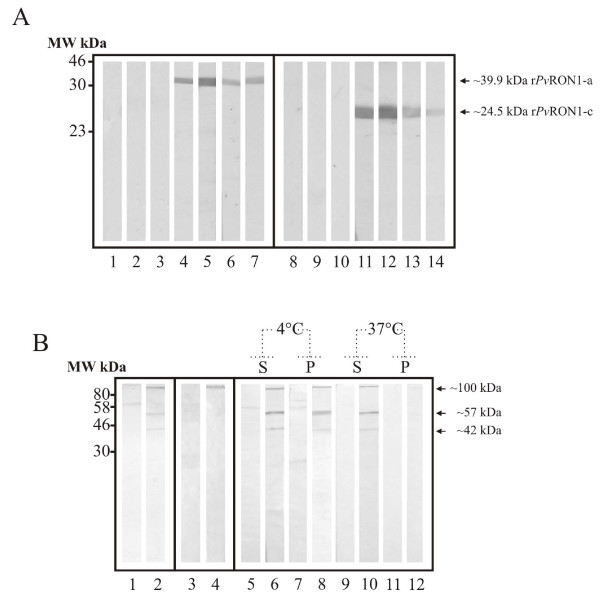
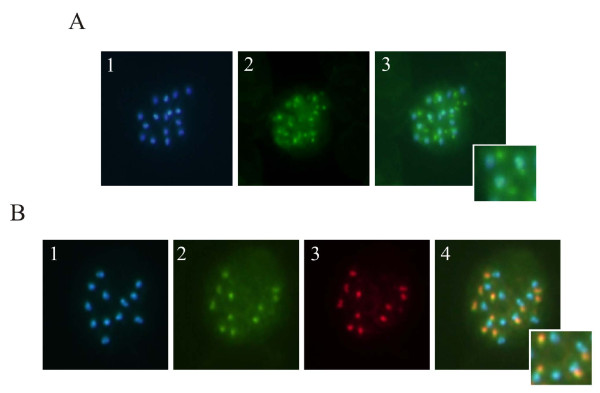
The PvRON1 encoding gene, which is homologous to that encoding the P. falciparum apical sushi protein (ASP) according to the plasmoDB database, was selected as our study target. The pvron1 gene transcription was evaluated by RT-PCR using RNA obtained from the P. vivax VCG-1 strain. Two peptides derived from the deduced P. vivax Sal-I PvRON1 sequence were synthesized and inoculated in rabbits for obtaining anti-PvRON1 antibodies which were used to confirm the protein expression in VCG-1 strain schizonts along with its association with detergent-resistant microdomains (DRMs) by Western blot, and its localization by immunofluorescence assays. The antigenicity of the PvRON1 protein was assessed using human sera from individuals previously exposed to P. vivax malaria by ELISA.
In the P. vivax VCG-1 strain, RON1 is a 764 amino acid-long protein. In silico analysis has revealed that PvRON1 shares essential characteristics with different antigens involved in invasion, such as the presence of a secretory signal, a GPI-anchor sequence and a putative sushi domain. The PvRON1 protein is expressed in parasite's schizont stage, localized in rhoptry necks and it is associated with DRMs. Recombinant protein recognition by human sera indicates that this antigen can trigger an immune response during a natural infection with P. vivax.
This study shows the identification and characterization of the P. vivax rhoptry neck protein 1 in the VCG-1 strain. Taking into account that PvRON1 shares several important characteristics with other Plasmodium antigens that play a functional role during RBC invasion and, as shown here, it is antigenic, it could be considered as a good vaccine candidate. Further studies aimed at assessing its immunogenicity and protection-inducing ability in the Aotus monkey model are thus recommended.
间日疟原虫疟疾仍然是全世界热带和亚热带地区的一个主要健康问题。在过去的几年中,已经描述了几种与红细胞相互作用和/或入侵有关的重要棒状体蛋白,如 PfRONs、Pf92、Pf38、Pf12 和 Pf34,它们被认为是潜在的抗疟疫苗候选物。本研究描述了间日疟原虫棒状体颈蛋白 1(PvRON1)的鉴定和特性,并研究了其在天然间日疟原虫感染中的抗原性。
根据 plasmoDB 数据库,选择与编码恶性疟原虫顶寿司蛋白(ASP)的基因同源的 PvRON1 编码基因作为我们的研究目标。使用从间日疟原虫 VCG-1 株获得的 RNA 通过 RT-PCR 评估 pvron1 基因的转录。合成了两个源自推导的间日疟原虫 Sal-I PvRON1 序列的肽,并接种在兔子中以获得抗-PvRON1 抗体,该抗体用于通过 Western blot 确认 VCG-1 株裂殖子中的蛋白表达,并通过免疫荧光测定法确定其与去污剂抗性微区(DRMs)的关联。使用先前接触过间日疟原虫的个体的人血清通过 ELISA 评估 PvRON1 蛋白的抗原性。
在间日疟原虫 VCG-1 株中,RON1 是一种 764 个氨基酸长的蛋白。计算机分析表明,PvRON1 与参与入侵的不同抗原具有重要特征,例如存在分泌信号、GPI-锚序列和推定的寿司结构域。PvRON1 蛋白在寄生虫的裂殖体阶段表达,定位于棒状体颈部,与 DRMs 相关。重组蛋白对人血清的识别表明,该抗原在自然感染间日疟原虫时可引发免疫反应。
本研究表明在 VCG-1 株中鉴定和表征了间日疟原虫棒状体颈蛋白 1。考虑到 PvRON1 与其他在 RBC 入侵过程中发挥功能作用的恶性疟原虫抗原具有一些重要特征,并且如这里所示,它具有抗原性,因此可以将其视为一种良好的疫苗候选物。因此,建议进一步研究其在食蟹猴模型中的免疫原性和保护诱导能力。