University of Washington School of Medicine, Box 357735, 1705 North East Pacific Street, Seattle, WA 98195, USA.
J Mol Biol. 2013 Dec 13;425(24):4965-80. doi: 10.1016/j.jmb.2013.09.038. Epub 2013 Oct 2.
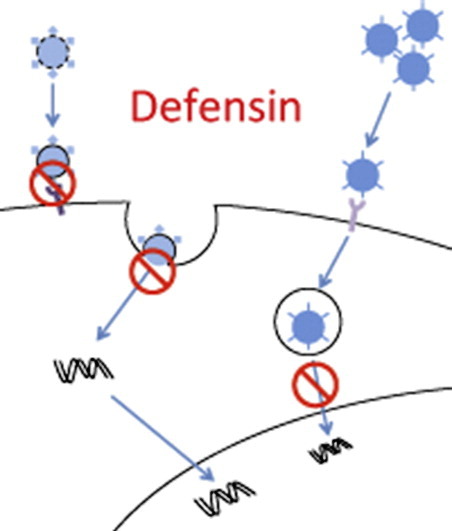
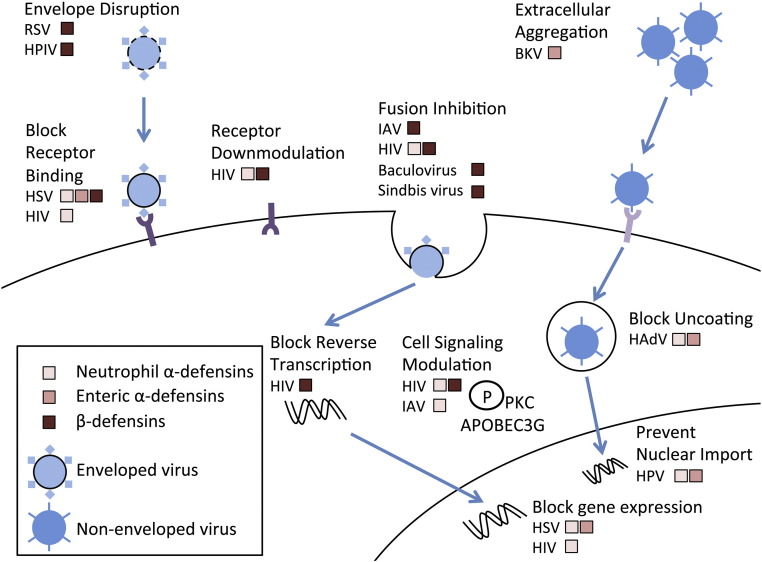
Defensins are an effector component of the innate immune system with broad antimicrobial activity. Humans express two types of defensins, α- and β-defensins, which have antiviral activity against both enveloped and non-enveloped viruses. The diversity of defensin-sensitive viral species reflects a multitude of antiviral mechanisms. These include direct defensin targeting of viral envelopes, glycoproteins, and capsids in addition to inhibition of viral fusion and post-entry neutralization. Binding and modulation of host cell surface receptors and disruption of intracellular signaling by defensins can also inhibit viral replication. In addition, defensins can function as chemokines to augment and alter adaptive immune responses, revealing an indirect antiviral mechanism. Nonetheless, many questions regarding the antiviral activities of defensins remain. Although significant mechanistic data are known for α-defensins, molecular details for β-defensin inhibition are mostly lacking. Importantly, the role of defensin antiviral activity in vivo has not been addressed due to the lack of a complete defensin knockout model. Overall, the antiviral activity of defensins is well established as are the variety of mechanisms by which defensins achieve this inhibition; however, additional research is needed to fully understand the role of defensins in viral pathogenesis.
防御素是先天免疫系统的效应组成部分,具有广泛的抗菌活性。人类表达两种类型的防御素,即α-防御素和β-防御素,它们对包膜和非包膜病毒均具有抗病毒活性。防御素敏感的病毒种类多样性反映了多种抗病毒机制。这些机制包括直接针对病毒包膜、糖蛋白和衣壳的防御素靶向作用,以及抑制病毒融合和进入后中和。防御素还可以通过结合和调节宿主细胞表面受体以及破坏细胞内信号转导来抑制病毒复制。此外,防御素可以作为趋化因子增强和改变适应性免疫反应,揭示出一种间接的抗病毒机制。尽管防御素的抗病毒活性有许多问题仍有待解决,但对于α-防御素的抗病毒机制已经有了大量的了解,而β-防御素抑制的分子细节则大多缺乏。重要的是,由于缺乏完整的防御素敲除模型,防御素抗病毒活性在体内的作用尚未得到解决。总的来说,防御素的抗病毒活性是明确的,防御素实现这种抑制的机制也多种多样;然而,需要进一步的研究来充分了解防御素在病毒发病机制中的作用。