Colorectal Cancer Branch, Research Institute, National Cancer Center, Goyang-si, Gyeonggi-do, Republic of Korea.
Int J Cancer. 2014 Apr 15;134(8):1844-53. doi: 10.1002/ijc.28517. Epub 2013 Oct 21.
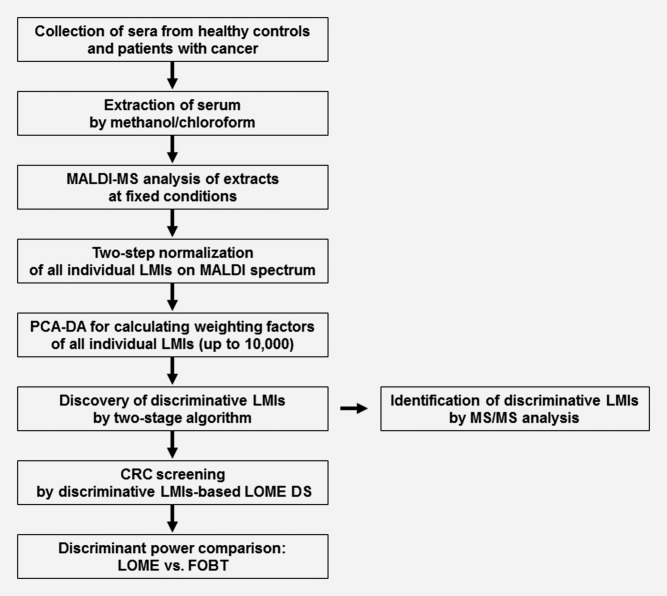
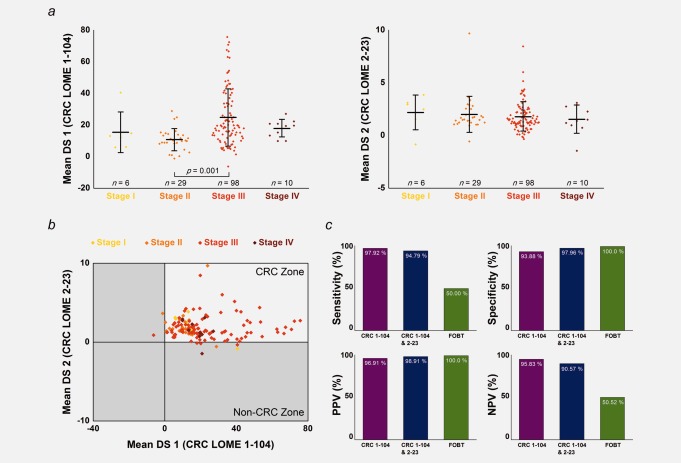
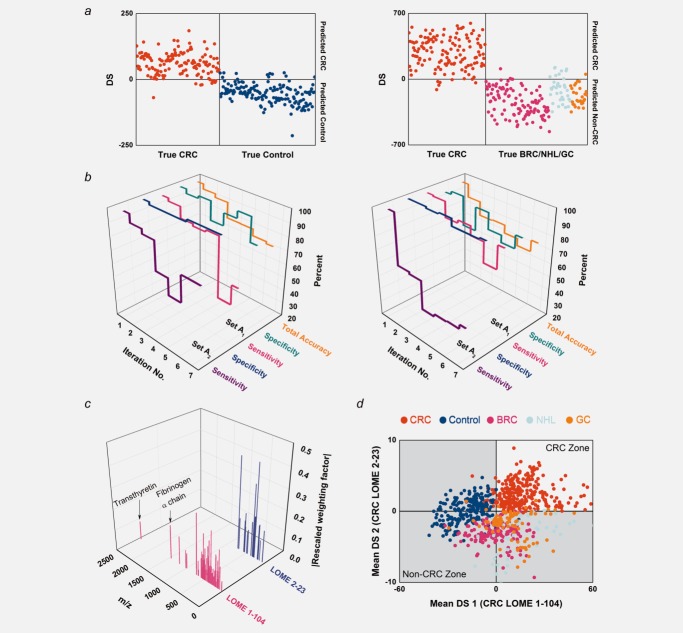
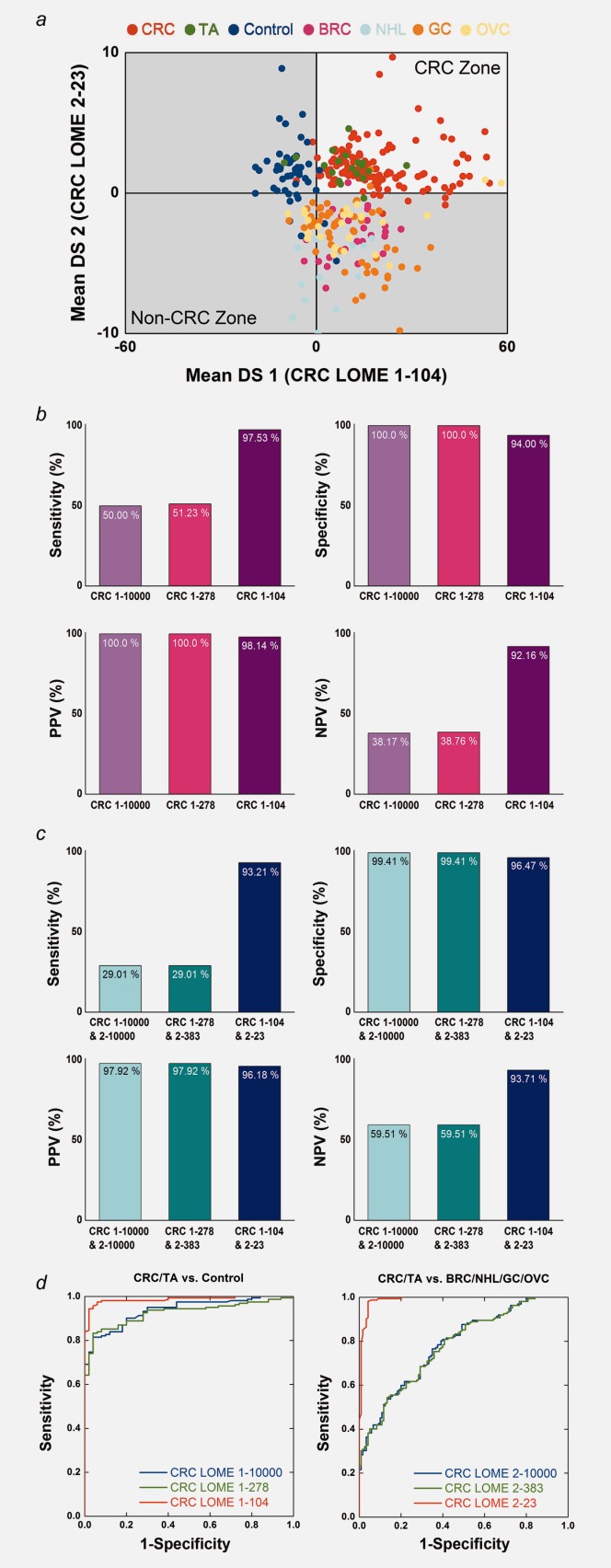
Blood metabolites can be detected as low-mass ions (LMIs) by mass spectrometry (MS). These LMIs may reflect the pathological changes in metabolism that occur as part of a disease state, such as cancer. We constructed a LMI discriminant equation (LOME) to investigate whether systematic LMI profiling might be applied to cancer screening. LMI information including m/z and mass peak intensity was obtained by five independent MALDI-MS analyses, using 1,127 sera collected from healthy individuals and cancer patients with colorectal cancer (CRC), breast cancer (BRC), gastric cancer (GC) and other types of cancer. Using a two-stage principal component analysis to determine weighting factors for individual LMIs and a two-stage LMI selection procedure, we selected a total of 104 and 23 major LMIs by the LOME algorithms for separating CRC from control and rest of cancer samples, respectively. CRC LOME demonstrated excellent discriminating power in a validation set (sensitivity/specificity: 93.21%/96.47%). Furthermore, in a fecal occult blood test (FOBT) of available validation samples, the discriminating power of CRC LOME was much stronger (sensitivity/specificity: 94.79%/97.96%) than that of the FOBT (sensitivity/specificity: 50.00%/100.0%), which is the standard CRC screening tool. The robust discriminating power of the LOME scheme was reconfirmed in screens for BRC (sensitivity/specificity: 92.45%/96.57%) and GC (sensitivity/specificity: 93.18%/98.85%). Our study demonstrates that LOMEs might be powerful noninvasive diagnostic tools with high sensitivity/specificity in cancer screening. The use of LOMEs could potentially enable screening for multiple diseases (including different types of cancer) from a single sampling of LMI information.
血液代谢物可以通过质谱(MS)检测为低质量离子(LMIs)。这些 LMIs 可能反映出疾病状态下代谢的病理变化,例如癌症。我们构建了一个 LMI 判别方程(LOME),以研究系统的 LMI 分析是否可以应用于癌症筛查。通过对来自健康个体和结直肠癌(CRC)、乳腺癌(BRC)、胃癌(GC)和其他类型癌症患者的 1127 份血清进行 5 次独立 MALDI-MS 分析,获得了包括 m/z 和质量峰强度在内的 LMI 信息。使用两阶段主成分分析确定个体 LMI 的加权因子和两阶段 LMI 选择过程,我们通过 LOME 算法分别选择了 104 和 23 个主要 LMI,用于将 CRC 与对照和其他癌症样本分开。CRC LOME 在验证集中表现出出色的判别能力(敏感性/特异性:93.21%/96.47%)。此外,在可用验证样本的粪便潜血试验(FOBT)中,CRC LOME 的判别能力要强得多(敏感性/特异性:94.79%/97.96%)比 FOBT(敏感性/特异性:50.00%/100.0%)强,FOBT 是标准的 CRC 筛查工具。在 BRC(敏感性/特异性:92.45%/96.57%)和 GC(敏感性/特异性:93.18%/98.85%)筛查中,LOME 方案的稳健判别能力得到了再次确认。我们的研究表明,LOME 可能是一种具有高敏感性/特异性的强大非侵入性诊断工具,可用于癌症筛查。LOME 的使用有可能使从单个 LMI 信息样本中筛查多种疾病(包括不同类型的癌症)成为可能。