Département de Microbiologie et Infectiologie, Faculté de Médecine, Université de Sherbrooke, Sherbrooke, QC J1E 4K8, Canada and Institut für Biochemie, Genetik und Mikrobiologie, Universität Regensburg, 93053 Regensburg, Germany.
Nucleic Acids Res. 2014 Jan;42(1):380-95. doi: 10.1093/nar/gkt871. Epub 2013 Oct 4.
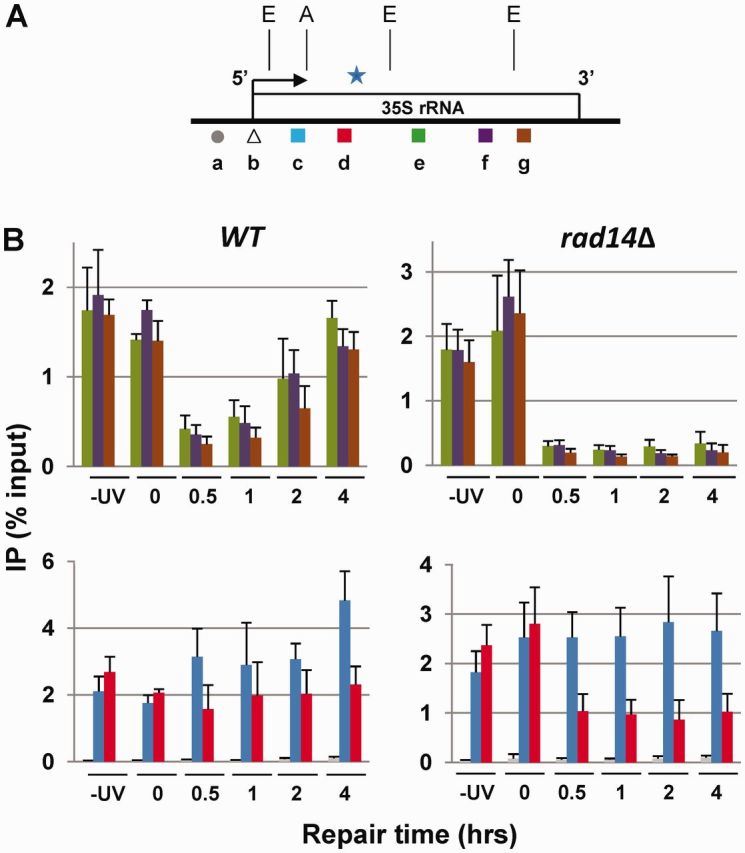
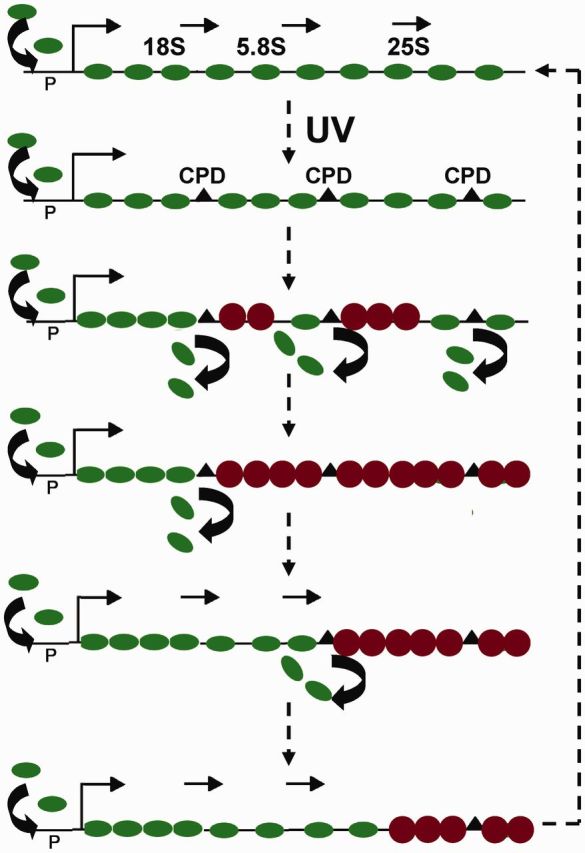
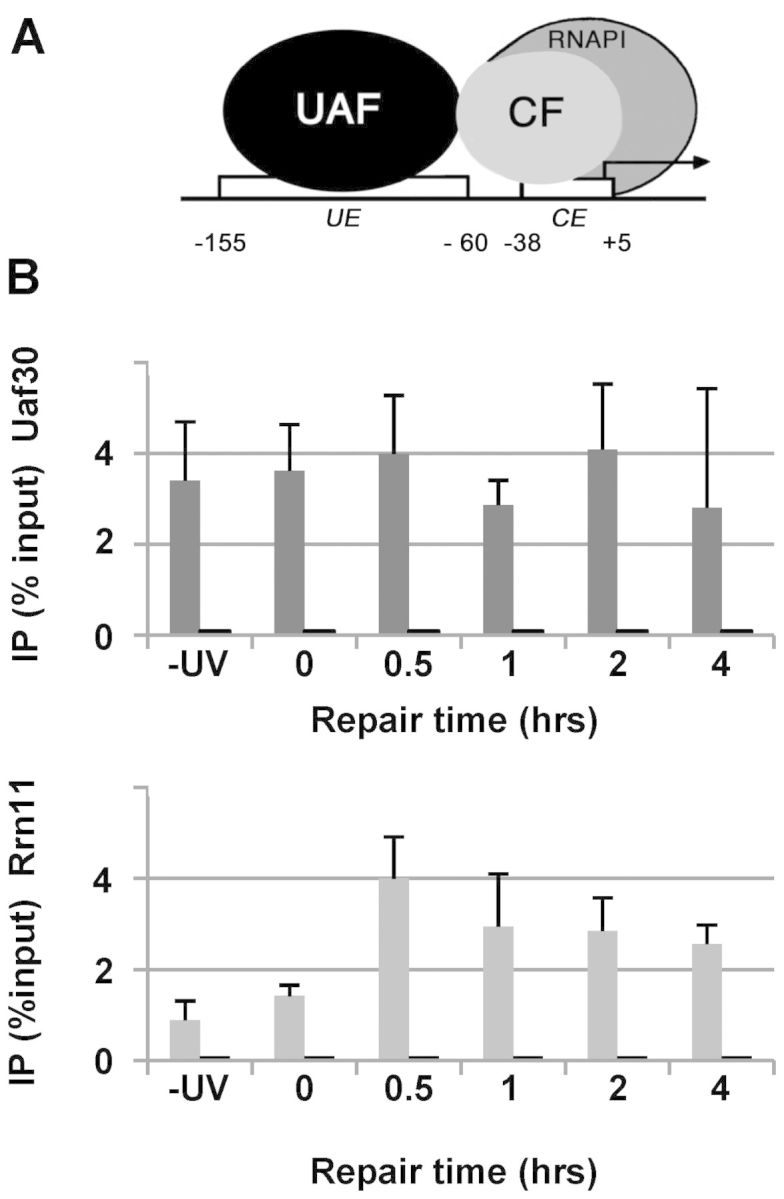
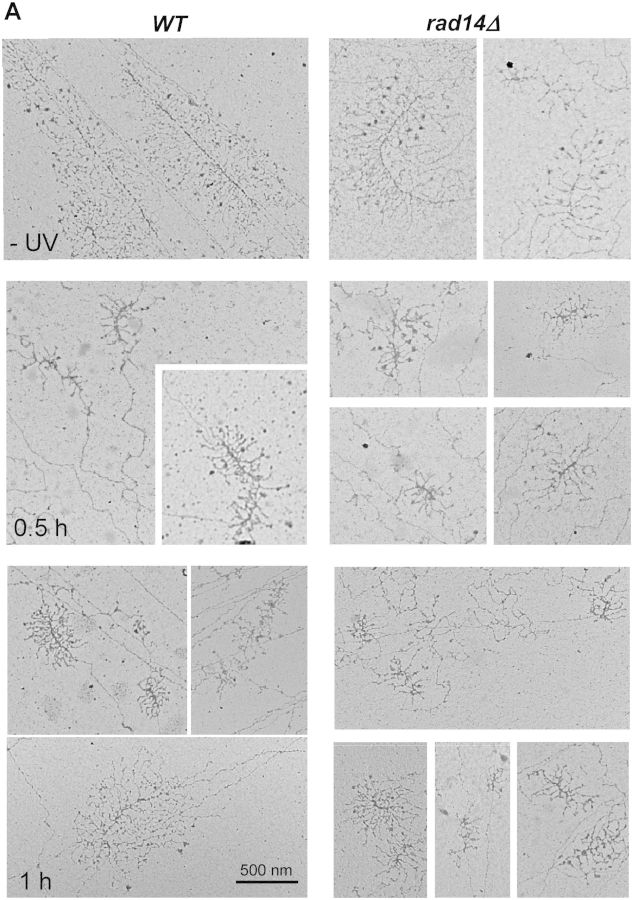
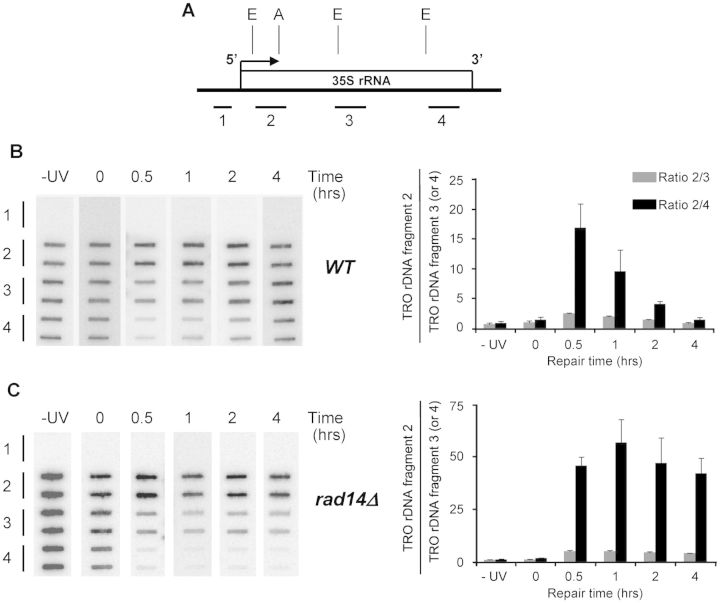
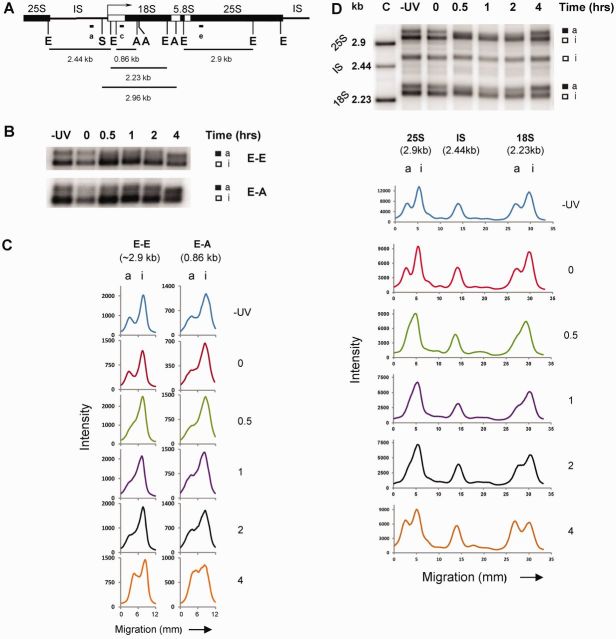
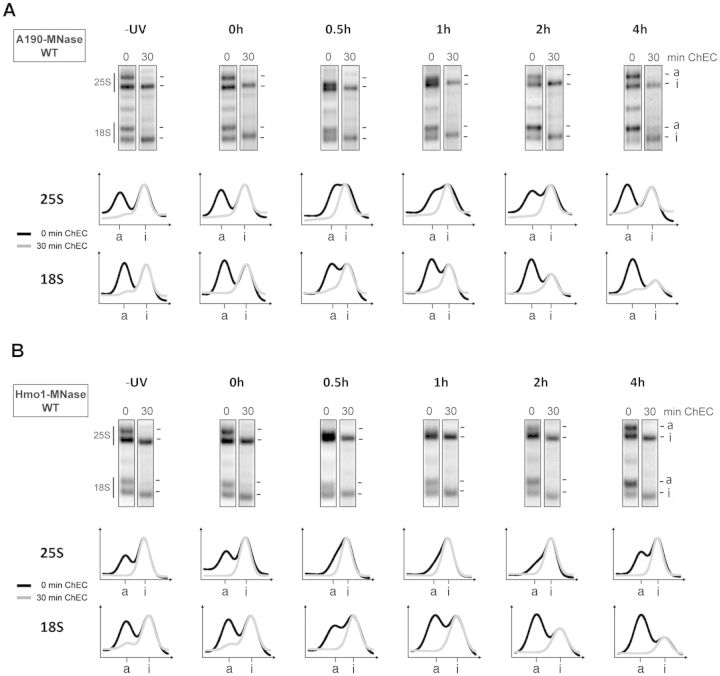
The cytotoxicity of UV light-induced DNA lesions results from their interference with transcription and replication. DNA lesions arrest elongating RNA polymerases, an event that triggers transcription-coupled nucleotide excision repair. Since arrested RNA polymerases reduce the accessibility of repair factors to DNA lesions, they might be displaced. The fate of arrested RNA polymerases-II at DNA lesions has been extensively studied, yielding partially contradictory results. Considerably less is known about RNA polymerases-I that transcribe nucleosomes-depleted rRNA genes at very high rate. To investigate the fate of arrested RNA polymerases-I at DNA lesions, chromatin-immunoprecipitation, electron microscopy, transcription run-on, psoralen-cross-linking and chromatin-endogenous cleavage were employed. We found that RNA polymerases-I density increased at the 5'-end of the gene, likely due to continued transcription initiation followed by elongation and pausing/release at the first DNA lesion. Most RNA polymerases-I dissociated downstream of the first DNA lesion, concomitant with chromatin closing that resulted from deposition of nucleosomes. Although nucleosomes were deposited, the high mobility group-box Hmo1 (component of actively transcribed rRNA genes) remained associated. After repair of DNA lesions, Hmo1 containing chromatin might help to restore transcription elongation and reopening of rRNA genes chromatin.
紫外线诱导的 DNA 损伤的细胞毒性源于其对转录和复制的干扰。DNA 损伤会阻止延伸中的 RNA 聚合酶,从而引发转录偶联的核苷酸切除修复。由于被阻止的 RNA 聚合酶降低了修复因子与 DNA 损伤的可及性,它们可能会被置换。在 DNA 损伤处被阻止的 RNA 聚合酶-II 的命运已经得到了广泛的研究,结果存在部分矛盾。关于转录高速度核小体缺失 rRNA 基因的 RNA 聚合酶-I 的了解要少得多。为了研究 DNA 损伤处被阻止的 RNA 聚合酶-I 的命运,采用了染色质免疫沉淀、电子显微镜、转录运行、补骨脂素交联和染色质内源性切割。我们发现,RNA 聚合酶-I 的密度在基因的 5'端增加,可能是由于连续的转录起始,然后在第一个 DNA 损伤处延伸和暂停/释放。大多数 RNA 聚合酶-I 在第一个 DNA 损伤的下游解离,伴随着由于核小体沉积导致的染色质闭合。尽管沉积了核小体,但高迁移率族框 Hmo1(活跃转录的 rRNA 基因的组成部分)仍与之相关。在修复 DNA 损伤后,含有 Hmo1 的染色质可能有助于恢复 rRNA 基因的转录延伸和染色质的重新开放。