Gomes Teresa, Vinhas Solange Alves, Reis-Santos Bárbara, Palaci Moisés, Peres Renata Lyrio, Aguiar Paola P, Ribeiro Fabiola Karla Correa, Marques Hebert Silva, Dettoni Valdério do Valle, Johnson John L, Riley Lee W, Maciel Ethel Leonor
Graduate Program in Infectious Diseases, Federal University of Espírito Santo, Vitória, Brazil.
PLoS One. 2013 Oct 2;8(10):e74517. doi: 10.1371/journal.pone.0074517. eCollection 2013.
Factors related to the development of extrapulmonary forms of tuberculosis (EPTB) are still poorly understood, particularly in high-endemic countries like Brazil. The objective of the paper is to determine host and Mycobacterium tuberculosis (MTB) strain-related factors associated with the development of EPTB in Espírito Santo state, Brazil.
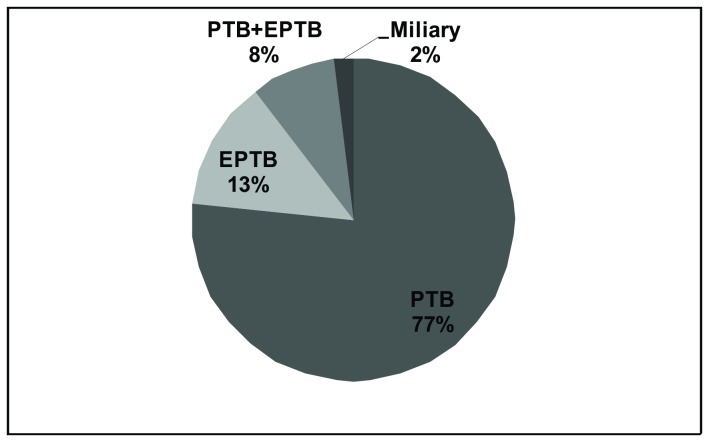
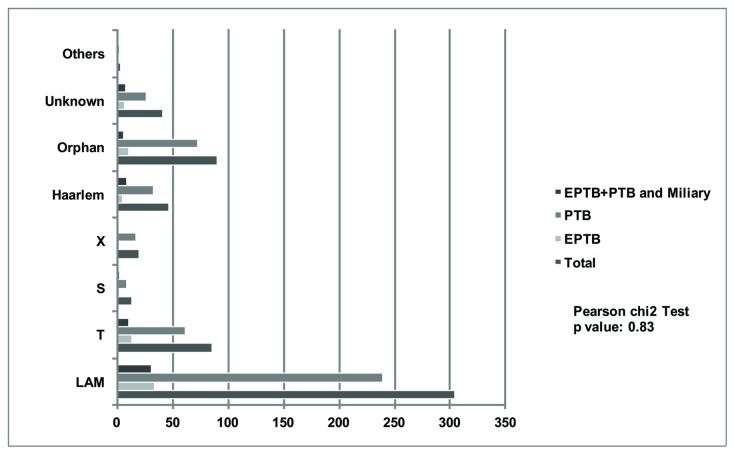
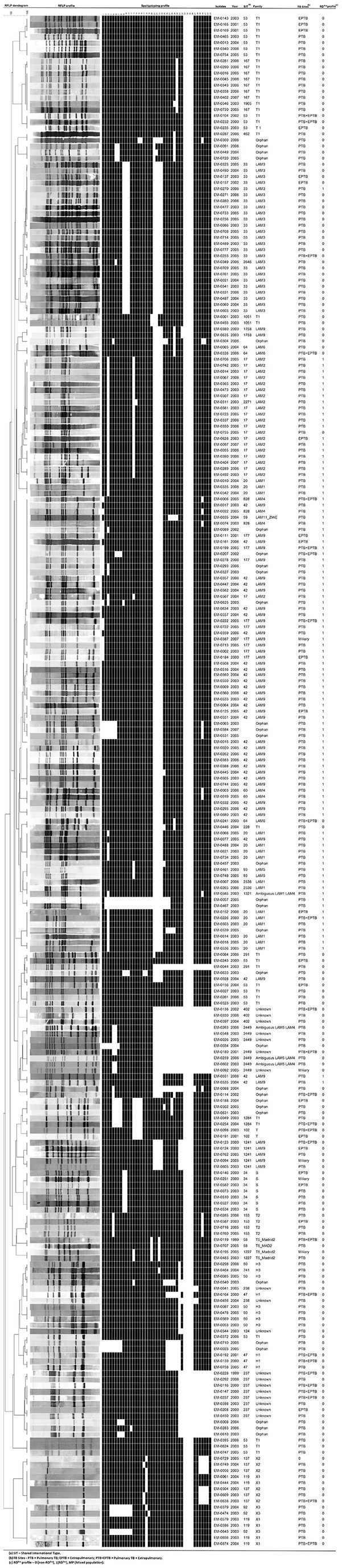
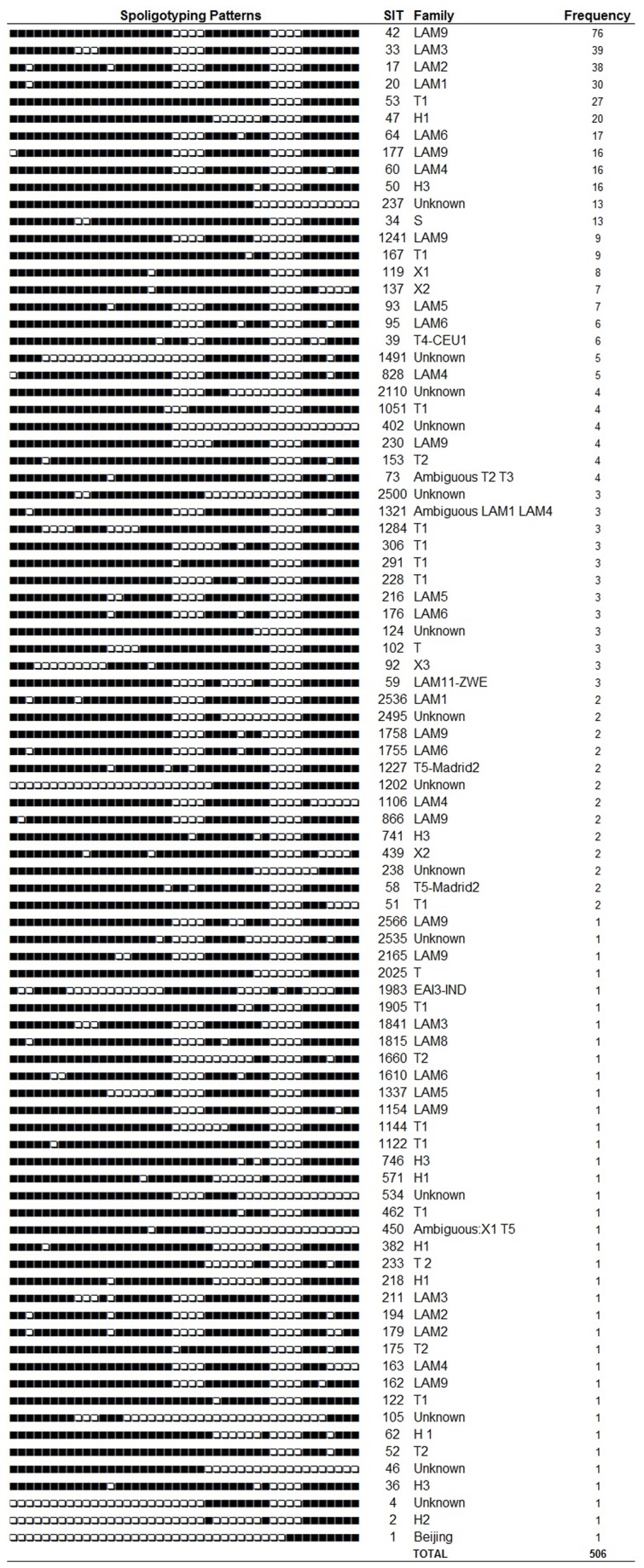
We conducted a retrospective laboratory-based surveillance study of new tuberculosis (TB) cases diagnosed in Espírito Santo state, Brazil between 1998 and 2007. We genotyped 612 isolates of MTB from 606 TB patients using spoligotyping and IS6110-restriction fragment length polymorphism (RFLP) typing and compared sociodemographic and clinical characteristics of patients with pulmonary TB (PTB) and EPTB. Among 606 patients, 464 (77%) had PTB, 79 (13%) had EPTB, 51 (8%) had both, and 12 (2%) had miliary TB. The IS6110 RFLP analysis demonstrated that 250 (41%) isolates belonged to clustered RFLP patterns, 27 (11%) of which were from EPTB. We identified 73 clusters including 35 (48%) composed of 2 isolates each. By spoligotyping, 506 (83%) MTB isolates fell into known patterns and 106 (17%) fell into patterns with no family assignment; 297 (48%) isolates belonged to the Latin-American Mediterranean family. Higher school level (4-7 years OR: 0.16 95% CI 0.34-0.73 and > 8 years of education, OR 0.06 95% CI 0.009-0.50) white ethnicity (OR: 2.54 95% CI 1.03-6.25) and HIV infection (OR: 16.83 95% CI 5.23-54.18) were associated with EPTB. No specific strain lineage or percentage of clustering was associated with EPTB.
These results demonstrate that risk factors for EPTB are related more to host than to MTB strain lineage characteristics.
肺外结核(EPTB)发病相关因素仍未完全明确,在巴西等高流行国家尤其如此。本文旨在确定巴西圣埃斯皮里图州与EPTB发病相关的宿主及结核分枝杆菌(MTB)菌株相关因素。
我们对1998年至2007年间在巴西圣埃斯皮里图州诊断出的新发结核病(TB)病例进行了一项基于实验室的回顾性监测研究。我们使用间隔寡核苷酸分型(spoligotyping)和IS6110 - 限制性片段长度多态性(RFLP)分型对606例TB患者的612株MTB分离株进行基因分型,并比较了肺结核(PTB)和EPTB患者的社会人口学及临床特征。在606例患者中,464例(77%)患有PTB,79例(13%)患有EPTB,51例(8%)两者皆有,12例(2%)患有粟粒性TB。IS6110 RFLP分析表明,250株(41%)分离株属于聚集性RFLP模式,其中27株(11%)来自EPTB。我们识别出73个聚类,其中35个(48%)每个聚类由2株分离株组成。通过间隔寡核苷酸分型,506株(83%)MTB分离株属于已知模式,106株(17%)属于无家族归属的模式;297株(48%)分离株属于拉丁美洲地中海家族。较高的学历水平(4 - 7年,比值比:0.16,95%置信区间0.34 - 0.73;超过8年教育,比值比0.06,95%置信区间0.009 - 0.50)、白人种族(比值比:2.54,95%置信区间1.03 - 6.25)和HIV感染(比值比:16.83,95%置信区间5.23 - 54.18)与EPTB相关。没有特定的菌株谱系或聚类百分比与EPTB相关。
这些结果表明,EPTB的危险因素与宿主因素的关系大于与MTB菌株谱系特征的关系。