Department of Medical Microbiology, Faculty of Health Sciences, University of Pretoria, Private Bag X323, Arcadia, Pretoria, 0007, South Africa.
National Tuberculosis Control Program, Ministry of Health, Manzini, Kingdom of Eswatini.
BMC Infect Dis. 2020 Jul 31;20(1):556. doi: 10.1186/s12879-020-05256-4.
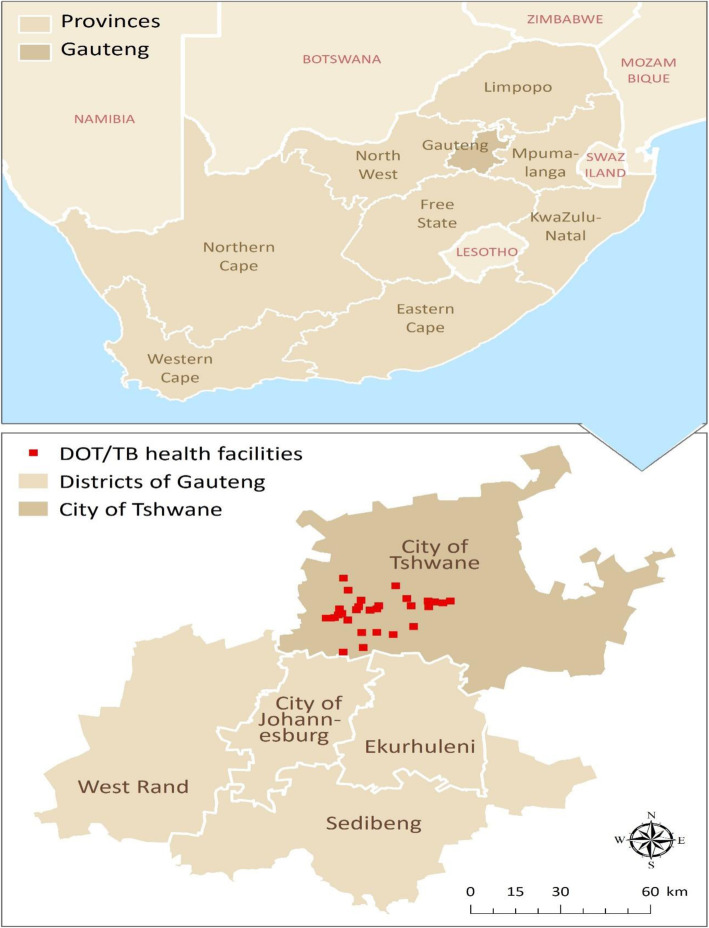
There is a general dearth of information on extrapulmonary tuberculosis (EPTB). Here, we investigated Mycobacterium tuberculosis (Mtb) drug resistance and transmission patterns in EPTB patients treated in the Tshwane metropolitan area, in South Africa.
Consecutive Mtb culture-positive non-pulmonary samples from unique EPTB patients underwent mycobacterial genotyping and were assigned to phylogenetic lineages and transmission clusters based on spoligotypes. MTBDRplus assay was used to search mutations for isoniazid and rifampin resistance. Machine learning algorithms were used to identify clinically meaningful patterns in data. We computed odds ratio (OR), attributable risk (AR) and corresponding 95% confidence intervals (CI).
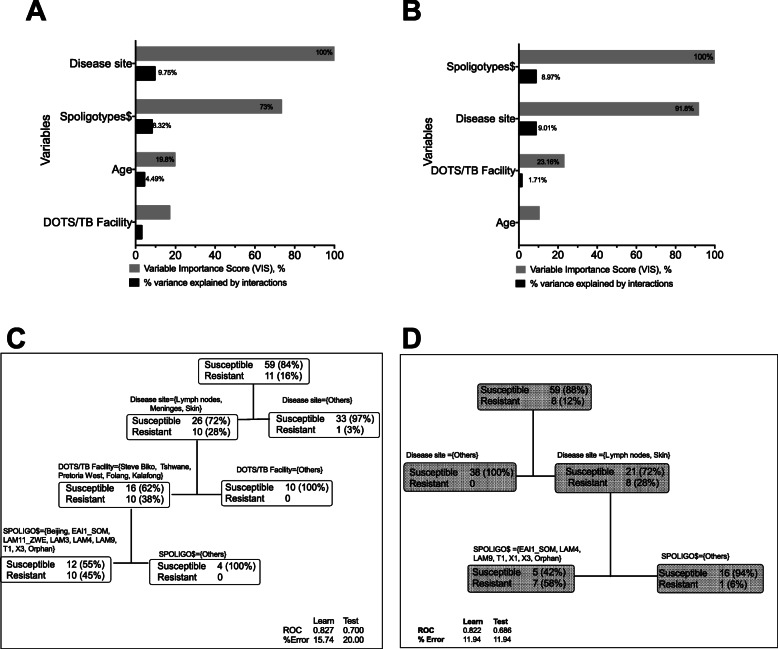
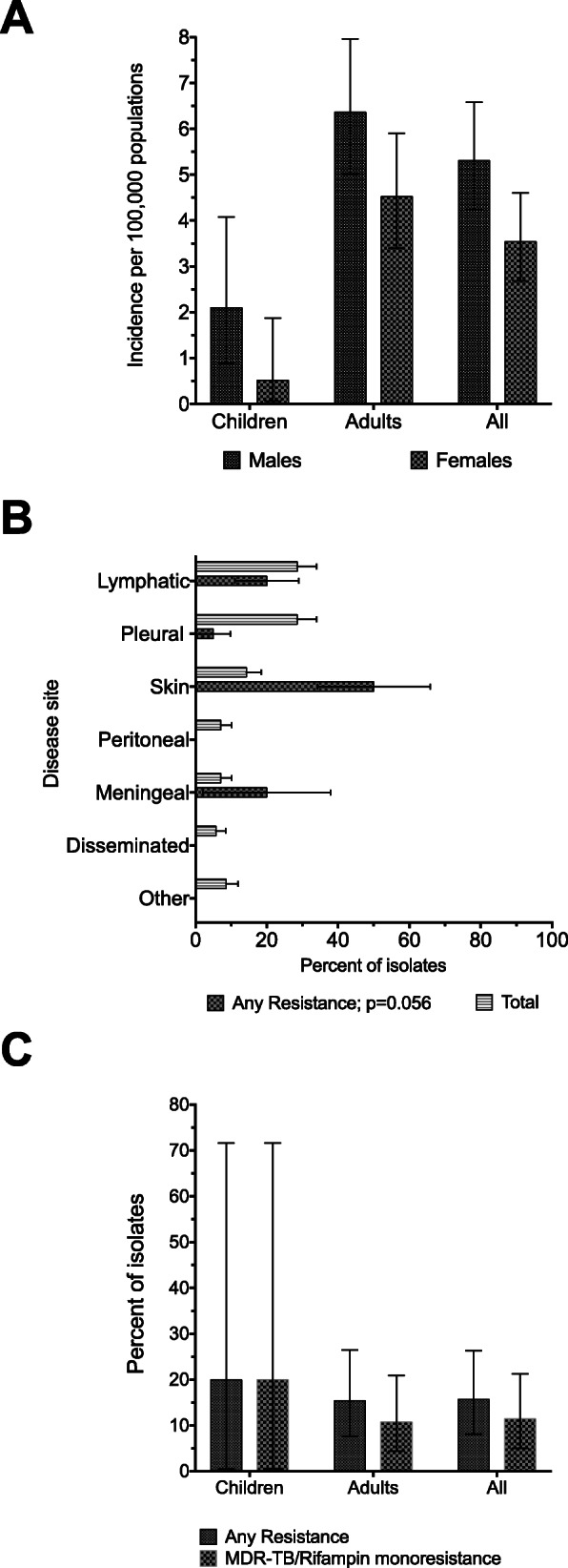
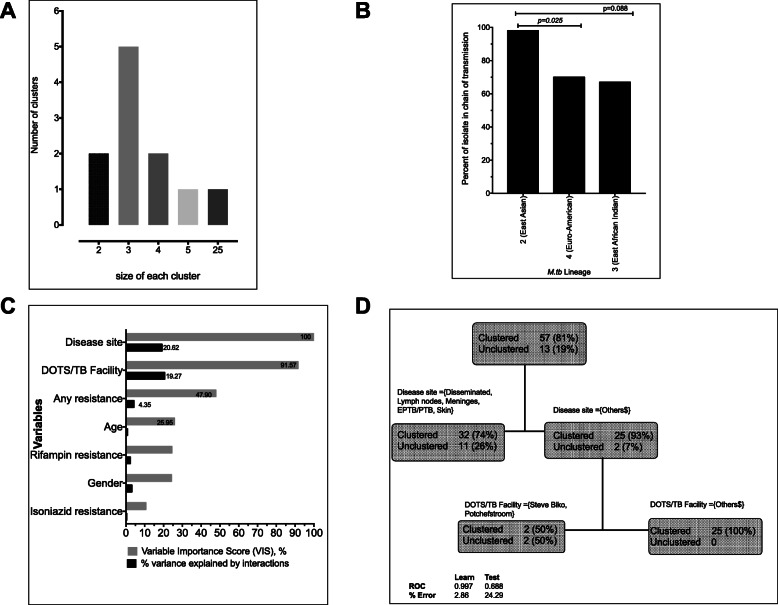
Of the 70 isolates examined, the largest cluster comprised 25 (36%) Mtb strains that belonged to the East Asian lineage. East Asian lineage was significantly more likely to occur within chains of transmission when compared to the Euro-American and East-African Indian lineages: OR = 10.11 (95% CI: 1.56-116). Lymphadenitis, meningitis and cutaneous TB, were significantly more likely to be associated with drug resistance: OR = 12.69 (95% CI: 1.82-141.60) and AR = 0.25 (95% CI: 0.06-0.43) when compared with other EPTB sites, which suggests that poor rifampin penetration might be a contributing factor.
The majority of Mtb strains circulating in the Tshwane metropolis belongs to East Asian, Euro-American and East-African Indian lineages. Each of these are likely to be clustered, suggesting on-going EPTB transmission. Since 25% of the drug resistance was attributable to sanctuary EPTB sites notorious for poor rifampin penetration, we hypothesize that poor anti-tuberculosis drug dosing might have a role in the development of resistance.
关于肺外结核(EPTB)的信息普遍匮乏。在这里,我们研究了南非茨瓦内大都市区接受治疗的 EPTB 患者中的结核分枝杆菌(Mtb)耐药性和传播模式。
对来自独特的 EPTB 患者的连续 Mtb 培养阳性非肺部样本进行分枝杆菌基因分型,并根据 spoligotypes 将其分配到系统发育谱系和传播群。使用 MTBDRplus 检测来寻找异烟肼和利福平耐药的突变。使用机器学习算法在数据中识别有临床意义的模式。我们计算了比值比(OR)、归因风险(AR)和相应的 95%置信区间(CI)。
在所检查的 70 个分离物中,最大的簇包含 25 株(36%)Mtb 菌株,它们属于东亚谱系。与欧亚谱系和东非-印度谱系相比,东亚谱系在传播链中更有可能发生:OR=10.11(95%CI:1.56-116)。与其他 EPTB 部位相比,淋巴结炎、脑膜炎和皮肤性结核病更有可能与耐药性相关:OR=12.69(95%CI:1.82-141.60)和 AR=0.25(95%CI:0.06-0.43),这表明利福平渗透不良可能是一个促成因素。
在茨瓦内大都市区循环的大多数 Mtb 菌株属于东亚、欧亚和东非-印度谱系。这些谱系中的每一个都可能聚集在一起,表明正在发生 EPTB 传播。由于 25%的耐药性归因于隐匿性 EPTB 部位,这些部位因利福平渗透不良而臭名昭著,我们假设抗结核药物剂量不足可能在耐药性发展中起作用。