Scorza Ralph, Kriss Alissa B, Callahan Ann M, Webb Kevin, Demuth Mark, Gottwald Tim
U.S. Dept. of Agriculture, Appalachian Fruit Research Station, Kearneysville, West Virginia, United States of America.
PLoS One. 2013 Oct 1;8(10):e75291. doi: 10.1371/journal.pone.0075291. eCollection 2013.
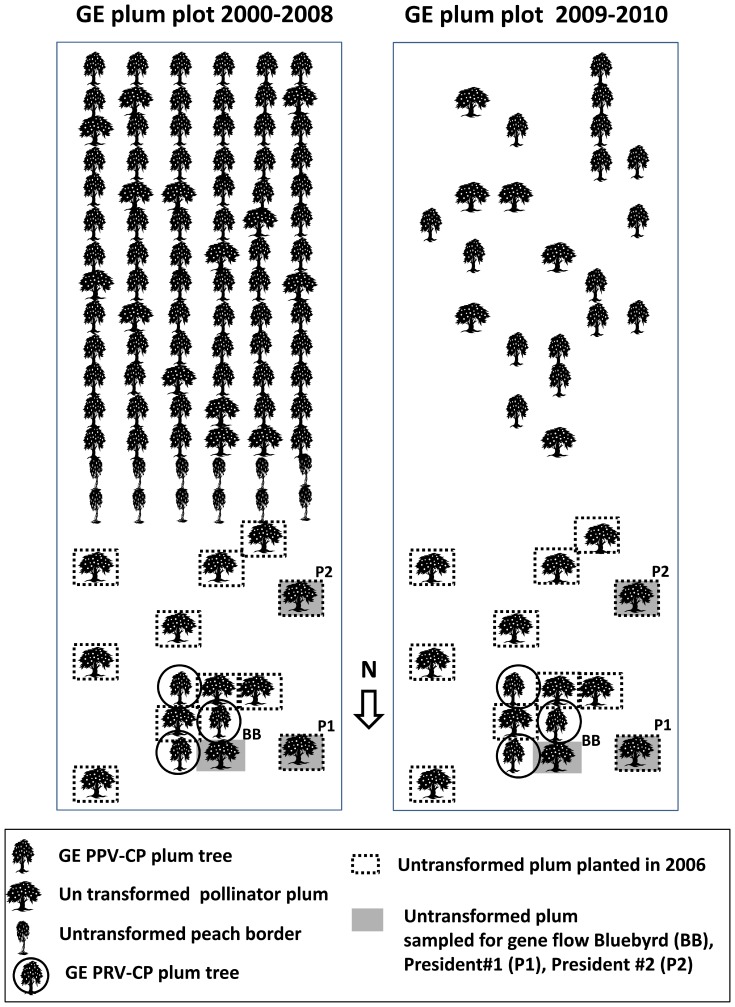
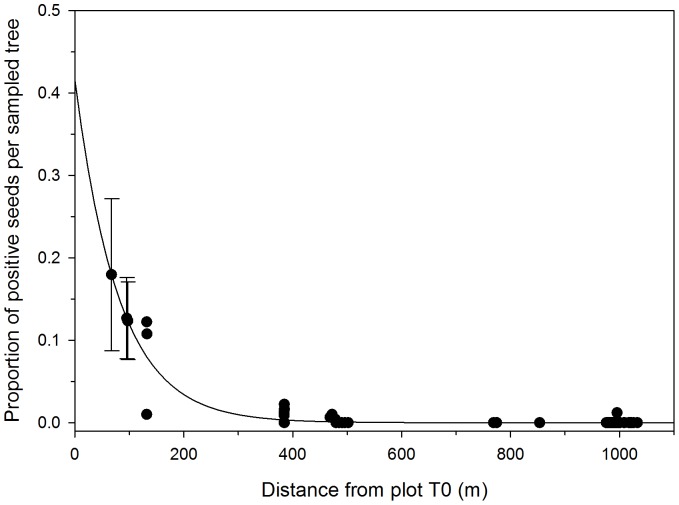
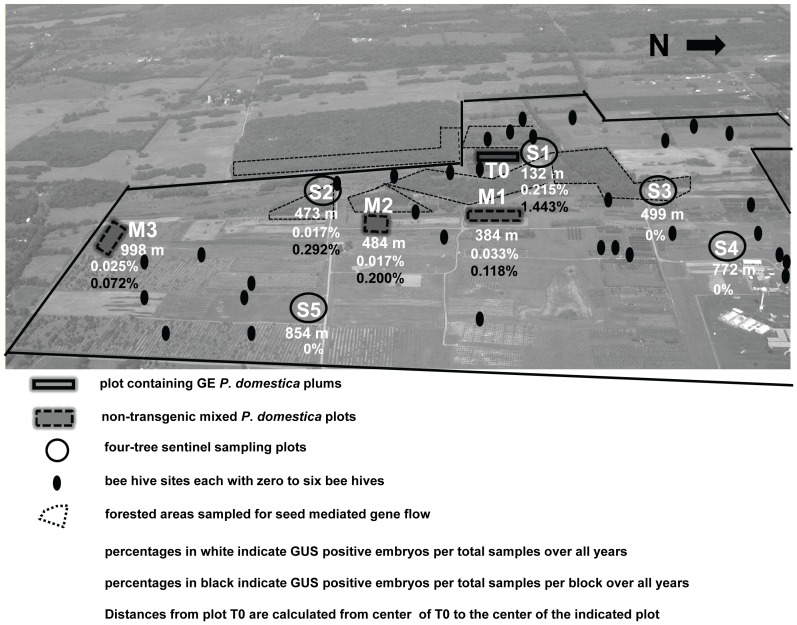
Pollen flow from a 0.46 ha plot of genetically engineered (GE) Prunus domestica located in West Virginia, USA was evaluated from 2000-2010. Sentinel plum trees were planted at distances ranging from 132 to 854 m from the center of the GE orchard. Plots of mixed plum varieties and seedlings were located at 384, 484 and 998 m from the GE plot. Bee hives (Apis mellifera) were dispersed between the GE plum plot and the pollen flow monitoring sites. Pollen-mediated gene flow from out of the GE plum plot to non-GE plums under the study conditions was low, only occurring at all in 4 of 11 years and then in only 0.31% of the 12,116 seeds analyzed. When it occurred, gene flow, calculated as the number of GUS positive embryos/total embryos sampled, ranged from 0.215% at 132 m from the center of the GE plum plot (28 m from the nearest GE plum tree) to 0.033-0.017% at longer distances (384-998 m). Based on the percentage of GUS positive seeds per individual sampled tree the range was 0.4% to 12%. Within the GE field plot, gene flow ranged from 4.9 to 39%. Gene flow was related to distance and environmental conditions. A single year sample from a sentinel plot 132 m from the center of the GE plot accounted for 65% of the total 11-year gene flow. Spatial modeling indicated that gene flow dramatically decreased at distances over 400 m from the GE plot. Air temperature and rainfall were, respectively, positively and negatively correlated with gene flow, reflecting the effects of weather conditions on insect pollinator activity. Seed-mediated gene flow was not detected. These results support the feasibility of coexistence of GE and non-GE plum orchards.
2000年至2010年期间,对位于美国西弗吉尼亚州一块0.46公顷的转基因欧洲李试验田的花粉传播情况进行了评估。在距离转基因果园中心132米至854米的范围内种植了哨兵李树。混合李品种和实生苗地块位于距离转基因地块384米、484米和998米处。蜂箱(意大利蜜蜂)分布在转基因李试验田和花粉传播监测点之间。在研究条件下,从转基因李试验田向外通过花粉介导的基因流到非转基因李的情况很少,在11年中只有4年出现,而且在分析的12116粒种子中仅占0.31%。当基因流发生时,以GUS阳性胚数/采样的总胚数计算,基因流范围从距离转基因李试验田中心132米处(距离最近的转基因李树28米)的0.215%到更远距离(384 - 998米)的0.033 - 0.017%。根据每棵采样树的GUS阳性种子百分比,范围为0.4%至12%。在转基因田间地块内,基因流范围为4.9%至39%。基因流与距离和环境条件有关。距离转基因地块中心132米的一个哨兵地块的单一年份样本占11年总基因流的65%。空间模型表明,距离转基因地块超过400米时,基因流显著减少。气温和降雨分别与基因流呈正相关和负相关,反映了天气条件对昆虫传粉者活动的影响。未检测到种子介导的基因流。这些结果支持了转基因和非转基因李果园共存的可行性。