Academic Unit of Neurology, Trinity Biomedical Sciences Institute, Dublin, Ireland.
PLoS One. 2013 Sep 30;8(9):e74733. doi: 10.1371/journal.pone.0074733. eCollection 2013.
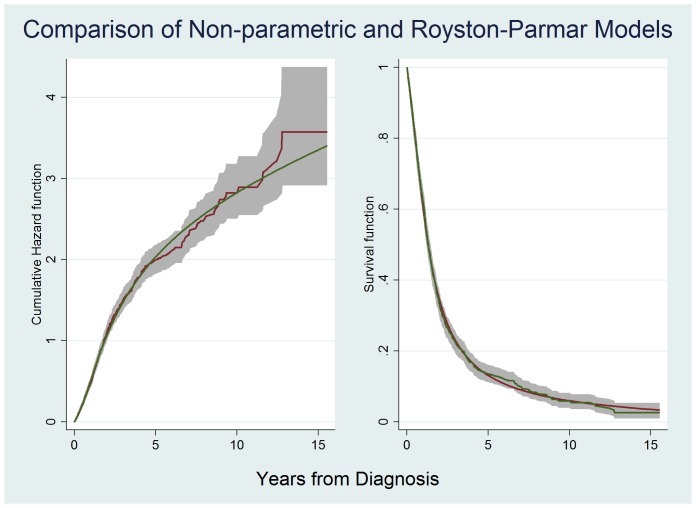
The Irish ALS register is a valuable resource for examining survival factors in Irish ALS patients. Cox regression has become the default tool for survival analysis, but recently new classes of flexible parametric survival analysis tools known as Royston-Parmar models have become available.
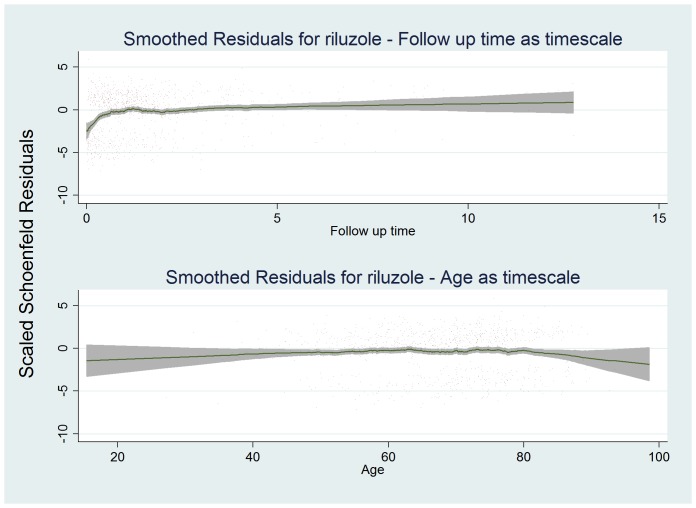
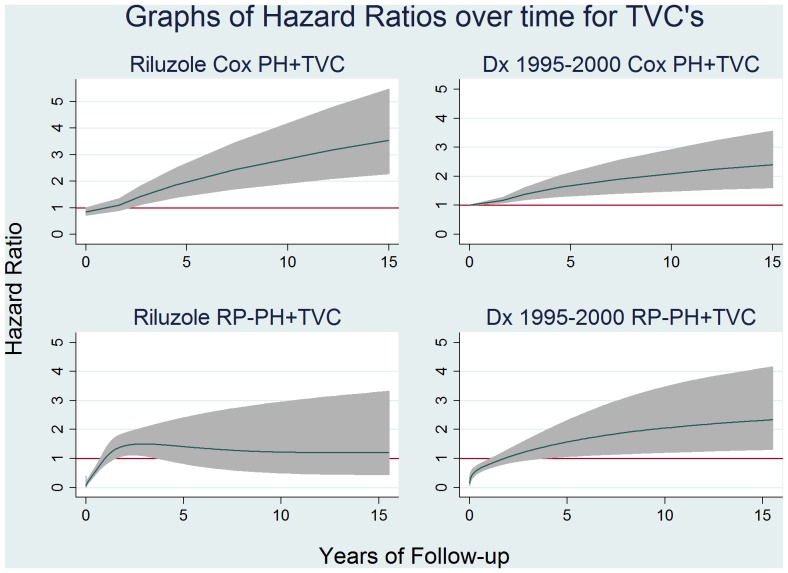
We employed Cox proportional hazards and Royston-Parmar flexible parametric modeling to examine factors affecting survival in Irish ALS patients. We further examined the effect of choice of timescale on Cox models and the proportional hazards assumption, and extended both Cox and Royston-Parmar models with time varying components.
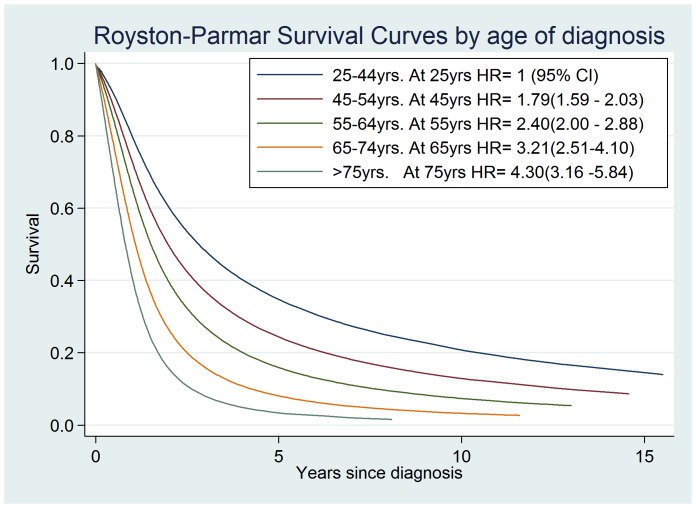
On comparison of models we chose a Royston-Parmar proportional hazards model without time varying covariates as the best fit. Using this model we confirmed the association of known survival markers in ALS including age at diagnosis (Hazard Ratio (HR) 1.34 per 10 year increase; 95% CI 1.26-1.42), diagnostic delay (HR 0.96 per 12 weeks delay; 95% CI 0.94-0.97), Definite ALS (HR 1.47 95% CI 1.17-1.84), bulbar onset disease (HR 1.58 95% CI 1.33-1.87), riluzole use (HR 0.72 95% CI 0.61-0.85) and attendance at an ALS clinic (HR 0.74 95% CI 0.64-0.86).
Our analysis explored the strengths and weaknesses of Cox proportional hazard and Royston-Parmar flexible parametric methods. By including time varying components we were able to gain deeper understanding of the dataset. Variation in survival between time periods appears to be due to missing data in the first time period. The use of age as timescale to account for confounding by age resolved breaches of the proportional hazards assumption, but in doing so may have obscured deficiencies in the data. Our study demonstrates the need to test for, and fully explore, breaches of the Cox proportional hazards assumption. Royston-Parmar flexible parametric modeling proved a powerful method for achieving this.
爱尔兰 ALS 注册是研究爱尔兰 ALS 患者生存因素的宝贵资源。Cox 回归已成为生存分析的默认工具,但最近出现了新的灵活参数生存分析工具类别,称为 Royston-Parmar 模型。
我们使用 Cox 比例风险和 Royston-Parmar 灵活参数建模来检查影响爱尔兰 ALS 患者生存的因素。我们进一步检查了 Cox 模型和比例风险假设中时间尺度选择的影响,并使用时间变化成分扩展了 Cox 和 Royston-Parmar 模型。
在模型比较中,我们选择了一个没有时间变化协变量的 Royston-Parmar 比例风险模型作为最佳拟合。使用该模型,我们确认了与 ALS 中已知生存标志物的关联,包括诊断时的年龄(每增加 10 岁的风险比(HR)为 1.34;95%CI 为 1.26-1.42)、诊断延迟(每延迟 12 周的 HR 为 0.96;95%CI 为 0.94-0.97)、明确的 ALS(HR 为 1.47;95%CI 为 1.17-1.84)、延髓发病疾病(HR 为 1.58;95%CI 为 1.33-1.87)、利鲁唑使用(HR 为 0.72;95%CI 为 0.61-0.85)和参加 ALS 诊所(HR 为 0.74;95%CI 为 0.64-0.86)。
我们的分析探讨了 Cox 比例风险和 Royston-Parmar 灵活参数方法的优缺点。通过包含时间变化成分,我们能够更深入地了解数据集。时间段之间的生存差异似乎是由于第一个时间段中的缺失数据造成的。使用年龄作为时间尺度来解释年龄混杂的比例风险假设的违反,但这样做可能掩盖了数据的缺陷。我们的研究表明,需要测试并充分探索 Cox 比例风险假设的违反情况。Royston-Parmar 灵活参数建模被证明是实现这一目标的强大方法。