State Key Laboratory for Biology of Plant Diseases and Insect Pests, Institute of Plant Protection, Chinese Academy of Agricultural Sciences, Beijing, China.
PLoS One. 2013 Sep 30;8(9):e74760. doi: 10.1371/journal.pone.0074760. eCollection 2013.
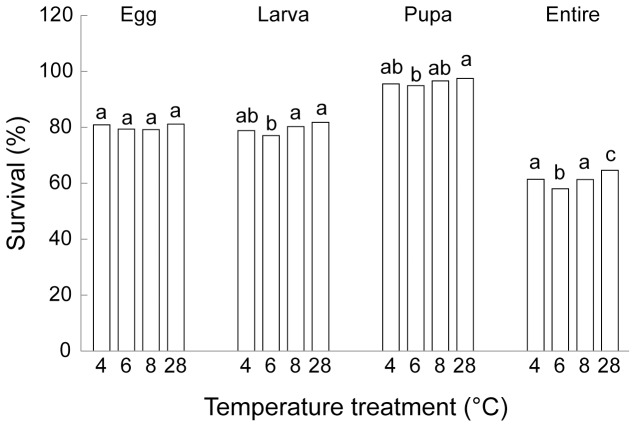
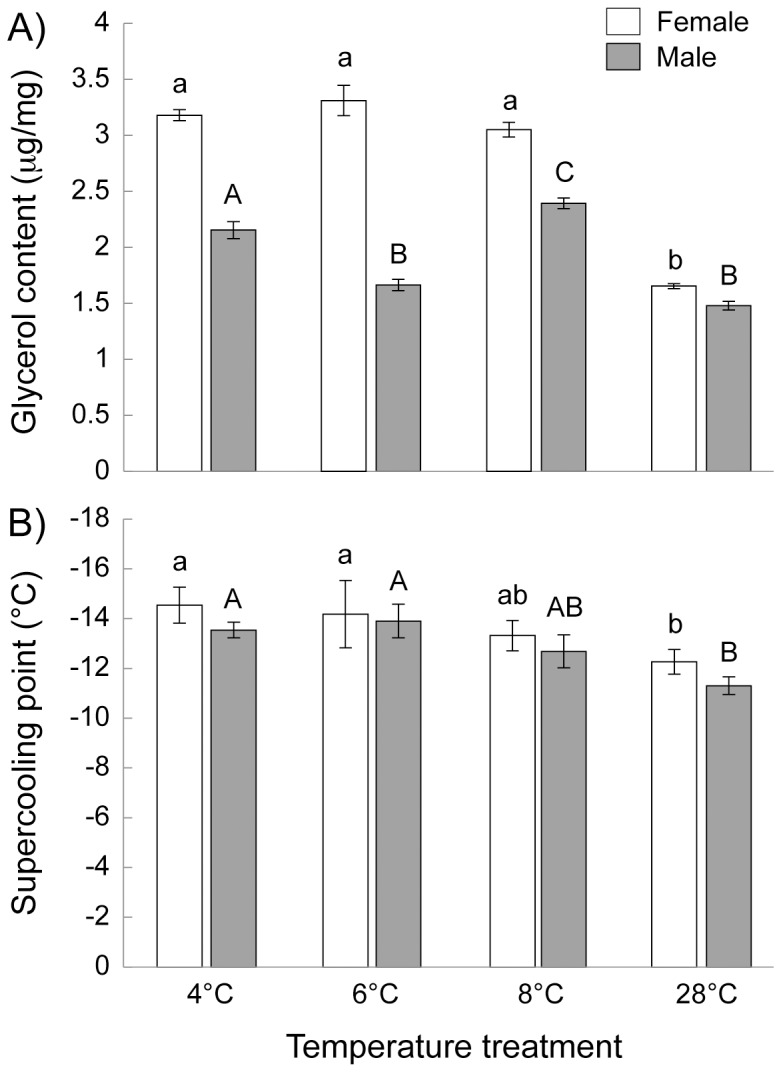
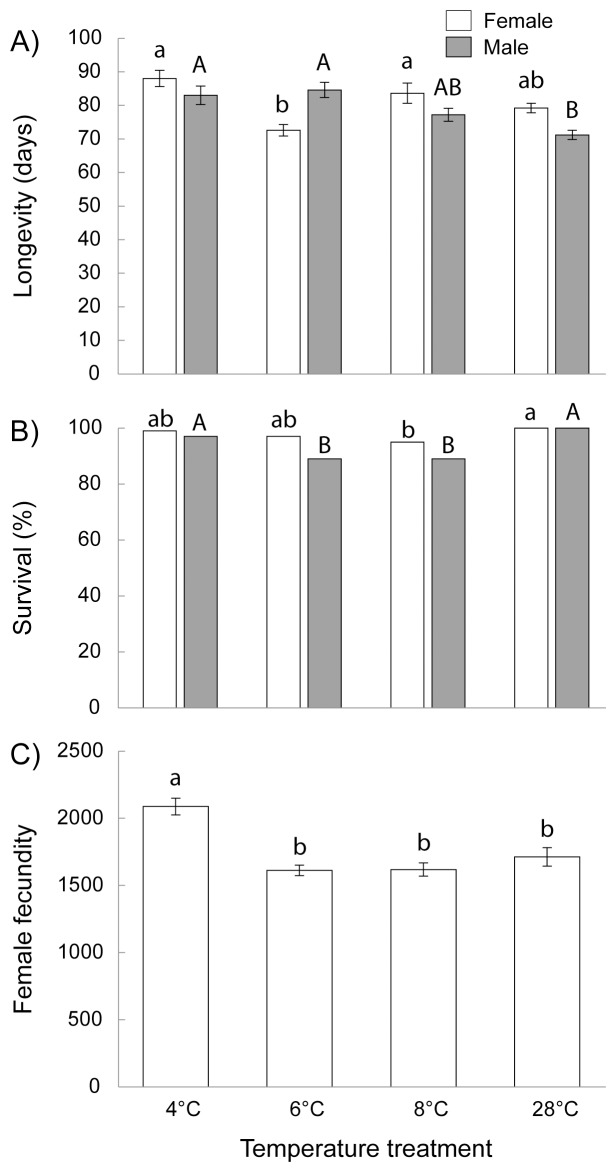
The leaf beetle, Ophraella communa, has been introduced to control the spread of the common ragweed, Ambrosia artemisiifolia, in China. We hypothesized that the beetle, to be able to track host-range expansion into colder climates, can phenotypically adapt to cold temperatures across generations. Therefore, we questioned whether parental experience of colder temperatures increases cold tolerance of the progeny. Specifically, we studied the demography, including development, fecundity, and survival, as well as physiological traits, including supercooling point (SCP), water content, and glycerol content of O. communa progeny whose parents were maintained at different temperature regimes. Overall, the entire immature stage decreased survival of about 0.2%-4.2% when parents experienced cold temperatures compared to control individuals obtained from parents raised at room temperature. However, intrinsic capacity for increase (r), net reproductive rate (R 0) and finite rate of increase (λ) of progeny O. communa were maximum when parents experienced cold temperatures. Glycerol contents of both female and male in progeny was significantly higher when maternal and paternal adults were cold acclimated as compared to other treatments. This resulted in the supercooling point of the progeny adults being significantly lower compared to beetles emerging from parents that experienced room temperatures. These results suggest that cold hardiness of O. communa can be promoted by cold acclimation in previous generation, and it might counter-balance reduced survival in the next generation, especially when insects are tracking their host-plants into colder climates.
叶甲,Ophraella communa,已被引入中国以控制豚草 Ambrosia artemisiifolia 的传播。我们假设,为了能够跟踪寄主范围向更寒冷气候的扩张,这种甲虫可以通过几代人的表型适应寒冷的温度。因此,我们质疑父母经历较低温度是否会增加后代的耐寒性。具体来说,我们研究了包括发育、繁殖力和存活率在内的人口统计学特征,以及包括超冷点(SCP)、水含量和甘油含量在内的生理特征,这些特征是指其父母处于不同温度条件下的 O. communa 后代。总的来说,与从室温下饲养的父母获得的对照个体相比,当父母经历寒冷温度时,整个未成年阶段的存活率降低了约 0.2%-4.2%。然而,当父母经历寒冷温度时,O. communa 后代的内在增长率(r)、净生殖率(R 0)和有限增长率(λ)最大。与其他处理相比,当母体和父体成虫进行冷驯化时,雌性和雄性后代的甘油含量都显著升高。这导致了与从经历室温的父母那里孵化出来的甲虫相比,后代成虫的超冷点显著降低。这些结果表明,O. communa 的耐寒性可以通过前一代的冷驯化来促进,并且当昆虫追踪其寄主植物进入更寒冷的气候时,它可能会抵消下一代的生存减少。