Department of Biological Sciences, Imperial College Silwood Park, Ascot, Berkshire, SL5 7PY, UK.
Ecol Evol. 2013 Sep;3(9):3073-82. doi: 10.1002/ece3.694. Epub 2013 Aug 1.
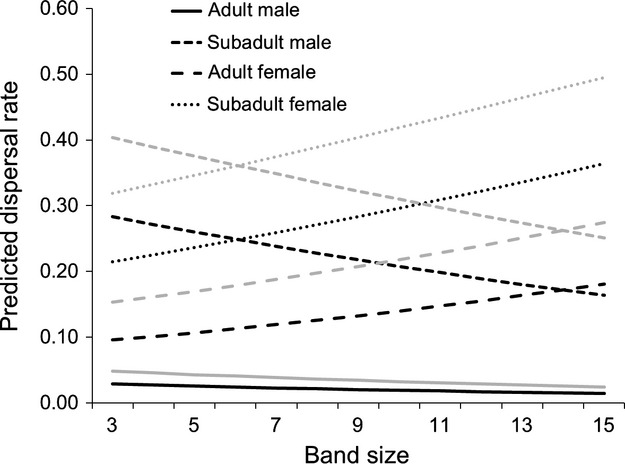
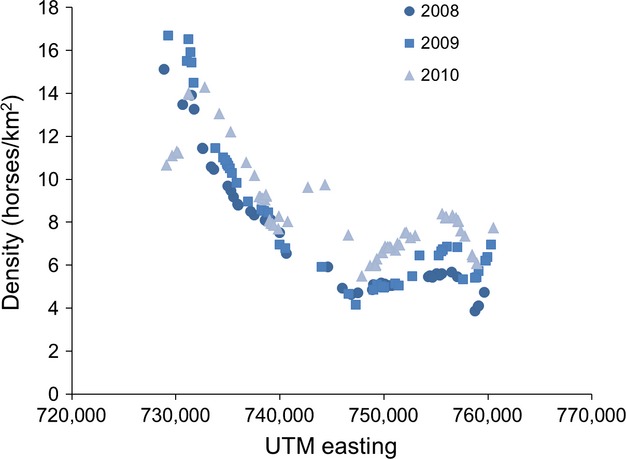
Movement away from an area or social group in response to increasing density (density-dependent dispersal) is known for most species; why it evolves is fundamental to our understanding of ecology and evolution. However, we have yet to fully appreciate how individuals of varying conditions (e.g., age and sex) might differently consider effects of density (quorum) when deciding to disperse or not, and scale dependence in their sense of quorum. We tracked movements of all individuals of a naturalized population of feral horses (Equus ferus caballus; Sable Island National Park Reserve, Nova Scotia, Canada) during a period of rapid population growth (N increased from 375 to 484 horses from 2008 to 2010). Permanent dispersal from breeding groups (bands) was positively density dependent for all age and sex categories with respect to local density (horses/km(2), bounded by the 99th percentile of individual movements [8000 m]), but was negatively and positively density dependent for males and females, respectively, in relation to group (band) size. Dispersal was generally female biased, with the exception of foals which moved with their mothers (no sex effect), and for yearlings and subadults when band sizes were smaller than average, in which case males dispersed at higher rates than females. Dispersal distance was positively related to local density. We conclude that dispersal rate can be both positively and negatively density dependent for feral horses, contingent on the state of individuals and the scale at which quorum with respect to choosing to disperse or not is assessed. Scale effects and interactions of density-dependent and sex- and age-biased dispersal may have both ecological and evolutionary consequences through effects on resource and mate competition.
个体为了应对种群密度增加而离开某一区域或群体(密度制约扩散)的现象在大多数物种中都很常见;这种现象为什么会出现,对于我们理解生态学和进化至关重要。然而,我们还没有充分认识到不同条件(如年龄和性别)的个体在决定是否扩散时,可能会如何考虑密度(群体阈值)的影响,以及它们对群体阈值的感知在不同尺度上的依赖性。我们在萨布尔岛国家公园保护区(加拿大新斯科舍省)的一个野化马群(Equus ferus caballus)自然种群中,对所有个体的移动进行了追踪,这期间该种群经历了快速的种群增长(从 2008 年到 2010 年,个体数量从 375 匹增加到 484 匹)。对于所有年龄和性别类别的个体来说,永久性离开繁殖群(马群)与当地密度(以个体运动的第 99 百分位数为界,范围为 8000 米,每平方公里的马匹数量[horses/km(2)])呈正相关,但与群体(马群)规模呈负相关和正相关,分别是雄性和雌性。除了幼驹随其母亲一起移动(没有性别效应)外,扩散总体上偏向雌性,而且在马群规模小于平均水平时,对于一岁马和亚成体,雄性的扩散率高于雌性。扩散距离与当地密度呈正相关。我们得出的结论是,野化马的扩散率可以同时受到密度的正相关和负相关影响,这取决于个体的状态以及评估是否扩散的群体阈值的尺度。密度依赖的和性别与年龄偏向的扩散的尺度效应及其相互作用,可能会通过对资源和配偶竞争的影响,产生生态和进化后果。