Ferrinho Paulo, Dramé Mohammed, Tumusiime Prosper
Department of International Public Health and Biostatistics, WHO Collaborating Centre for Health Workforce Policy and Planning, CMDT, Instituto de Higiene e Medicina Tropical, Universidade Nova de Lisboa. 1349-008, Lisbon, Portugal.
Pan Afr Med J. 2013 Jun 7;15:44. doi: 10.11604/pamj.2013.15.44.2006. eCollection 2013.
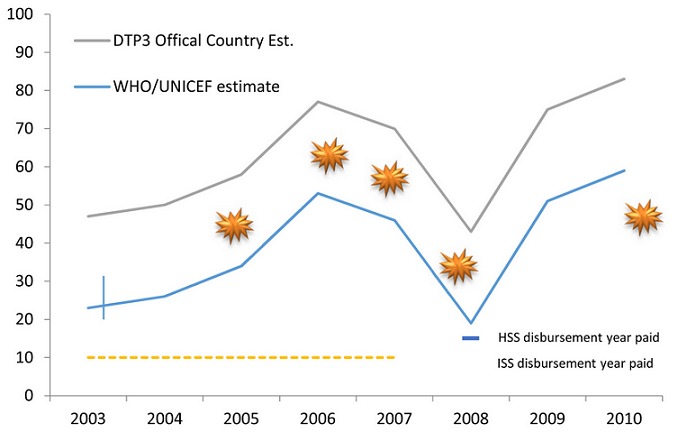
Chad is one of the countries supported by the GAVI-Alliance that remains with unsatisfactory vaccination coverage. This paper tries to understand the main barriers to better coverage.
These barriers were categorised as up or downstream against the health system building blocks as proposed by WHO and compared with barriers and activities identified by the country in its health system's strengthening grant proposal as approved by the GAVI Alliance in 2007. Data were collected using a modified Delphi system and by analysis of grant and annual report documents.
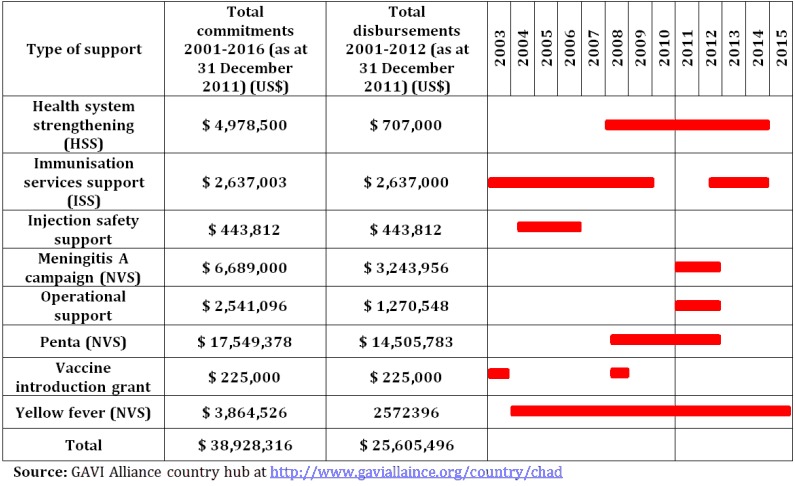
Most of the activities anticipated under the GAVI health system's strengthening proposal are activities targeting downstream barriers (the neglect of upstream issues is of major importance in a decentralised state like Chad) and aligned with, not complementary to, immunization services strengthening activities. Further, both set of cash grants are blind to important recommendations such as the need to address barriers at the level of leadership and governance and at the level of the financing system and also about initiatives to promote community demand of vaccination services.
IN CHAD SLOW VACCINATION PROGRESS IS AGGRAVATED BY SEVERAL CONTEXTUAL BARRIERS: the size of the country, the low population density, the nomadic nature of a significant part of its peoples, the recent civil war, associated with civil unrest and political instability and its geographical localization. In this situation it would be important to sustain downstream operations (the major focus of the ISS grant) while taking a long term view of the needs of the health system. The GAVI effectively supports downstream operations, but neglects the long term view.
乍得是由全球疫苗免疫联盟(GAVI-Alliance)提供支持的国家之一,但其疫苗接种覆盖率仍不尽人意。本文试图探究提高覆盖率的主要障碍。
按照世界卫生组织提出的卫生系统构建模块,将这些障碍分为上游或下游障碍,并与该国在其2007年获得GAVI联盟批准的卫生系统强化资助提案中所确定的障碍及活动进行比较。数据通过改良的德尔菲系统收集,并对资助和年度报告文件进行分析。
GAVI卫生系统强化提案中预期的大多数活动都是针对下游障碍的活动(在乍得这样的分权国家,忽视上游问题至关重要),并且与免疫服务强化活动一致,而非互补。此外,这两组现金资助都未考虑一些重要建议,比如需要解决领导力和治理层面以及融资系统层面的障碍,以及促进社区对疫苗接种服务需求的举措。
在乍得,疫苗接种进展缓慢因多种背景障碍而加剧:国家面积、人口密度低、很大一部分人口的游牧性质、近期的内战以及相关的内乱和政治不稳定及其地理位置。在这种情况下,在对卫生系统需求持长远眼光的同时维持下游业务(国际卫生支持资助的主要重点)很重要。GAVI有效地支持了下游业务,但忽视了长远眼光。