• 文献检索
  • 文档翻译
  • 深度研究
  • 学术资讯
  • Suppr Zotero 插件Zotero 插件
  • 邀请有礼
  • 套餐&价格
  • 历史记录
应用&插件
Suppr Zotero 插件Zotero 插件浏览器插件Mac 客户端Windows 客户端微信小程序
定价
高级版会员购买积分包购买API积分包
服务
文献检索文档翻译深度研究API 文档MCP 服务
关于我们
关于 Suppr公司介绍联系我们用户协议隐私条款
关注我们

Suppr 超能文献

核心技术专利:CN118964589B侵权必究
粤ICP备2023148730 号-1Suppr @ 2026

文献检索

告别复杂PubMed语法,用中文像聊天一样搜索,搜遍4000万医学文献。AI智能推荐,让科研检索更轻松。

立即免费搜索

文件翻译

保留排版,准确专业,支持PDF/Word/PPT等文件格式,支持 12+语言互译。

免费翻译文档

深度研究

AI帮你快速写综述,25分钟生成高质量综述,智能提取关键信息,辅助科研写作。

立即免费体验

特异性 IgE 对儿童临床花生过敏的预测价值:与湿疹、哮喘和环境(初级或二级保健)的关系。

Predictive value of specific IgE for clinical peanut allergy in children: relationship with eczema, asthma, and setting (primary or secondary care).

机构信息

Princess Amalia Children's Centre, Isala hospital, PO Box 10400, 8000 GK, Zwolle, the Netherlands.

出版信息

Clin Transl Allergy. 2013 Oct 10;3(1):34. doi: 10.1186/2045-7022-3-34.

DOI:10.1186/2045-7022-3-34
PMID:24112405
原文链接:https://pmc.ncbi.nlm.nih.gov/articles/PMC3852137/
Abstract

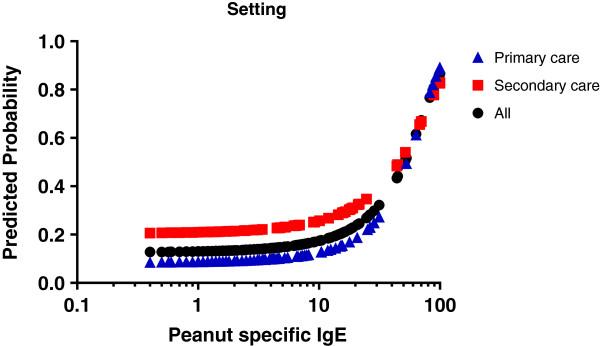
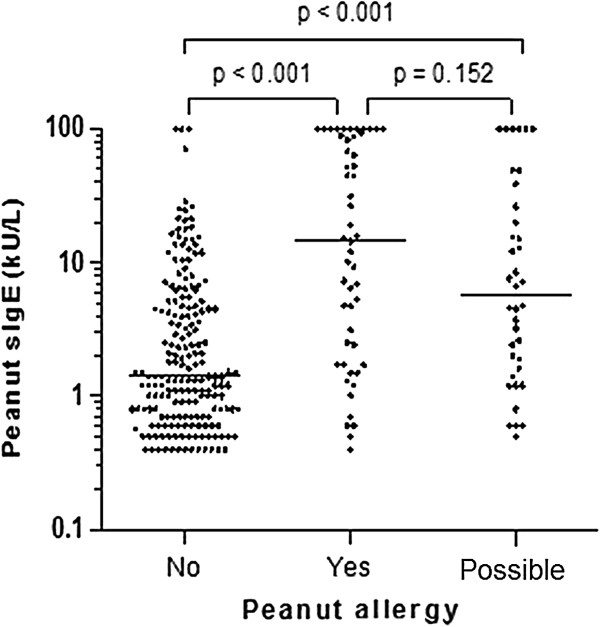
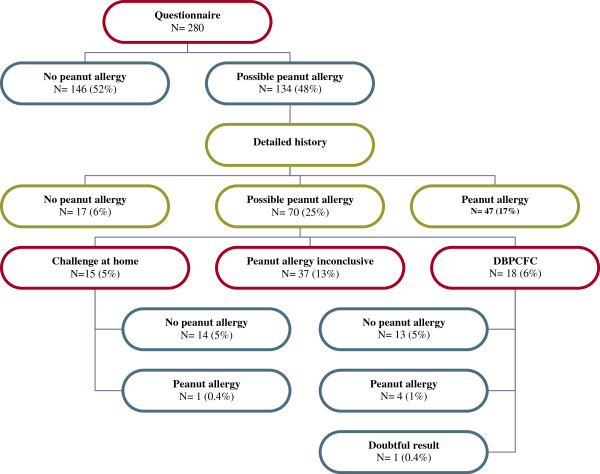
The usefulness of peanut specific IgE levels for diagnosing peanut allergy has not been studied in primary and secondary care where most cases of suspected peanut allergy are being evaluated. We aimed to determine the relationship between peanut-specific IgE levels and clinical peanut allergy in peanut-sensitized children and how this was influenced by eczema, asthma and clinical setting (primary or secondary care). We enrolled 280 children (0-18 years) who tested positive for peanut-specific IgE (> 0.35 kU/L) requested by primary and secondary physicians. We used predefined criteria to classify participants into three groups: peanut allergy, no peanut allergy, or possible peanut allergy, based on responses to a validated questionnaire, a detailed food history, and results of oral food challenges.Fifty-two participants (18.6%) were classified as peanut allergy, 190 (67.9%) as no peanut allergy, and 38 (13.6%) as possible peanut allergy. The association between peanut-specific IgE levels and peanut allergy was significant but weak (OR 1.46 for a 10.0 kU/L increase in peanut-specific IgE, 95% CI 1.28-1.67). Eczema was the strongest risk factor for peanut allergy (aOR 3.33, 95% CI 1.07-10.35), adjusted for demographic and clinical characteristics. Asthma was not significantly related to peanut allergy (aOR 1.93, 95% CI 0.90-4.13). Peanut allergy was less likely in primary than in secondary care participants (OR 0.46, 95% CI 0.25-0.86), at all levels of peanut-specific IgE.The relationship between peanut-specific IgE and peanut allergy in children is weak, is strongly dependent on eczema, and is weaker in primary compared to secondary care. This limits the usefulness of peanut-specific IgE levels in the diagnosis of peanut allergy in children.

摘要

花生特异性 IgE 水平在初级和二级保健中用于诊断花生过敏的作用尚未得到研究,而大多数疑似花生过敏的病例都在这些地方进行评估。我们旨在确定花生致敏儿童中花生特异性 IgE 水平与临床花生过敏之间的关系,以及特应性皮炎、哮喘和临床环境(初级或二级保健)对此的影响。我们招募了 280 名(0-18 岁)经初级和二级医生要求检测花生特异性 IgE(>0.35 kU/L)呈阳性的儿童。我们使用预定义的标准,根据一份经过验证的问卷、详细的食物史和口服食物挑战的结果,将参与者分为三组:花生过敏、无花生过敏或可能的花生过敏。52 名参与者(18.6%)被归类为花生过敏,190 名(67.9%)为无花生过敏,38 名(13.6%)为可能的花生过敏。花生特异性 IgE 水平与花生过敏之间存在显著但较弱的关联(花生特异性 IgE 每增加 10.0 kU/L,花生过敏的比值比为 1.46,95%CI 为 1.28-1.67)。特应性皮炎是花生过敏的最强危险因素(调整人口统计学和临床特征后的优势比为 3.33,95%CI 为 1.07-10.35)。哮喘与花生过敏无显著相关性(比值比为 1.93,95%CI 为 0.90-4.13)。与二级保健参与者相比,初级保健参与者的花生过敏可能性更低(比值比为 0.46,95%CI 为 0.25-0.86),且在所有花生特异性 IgE 水平下均如此。儿童中花生特异性 IgE 与花生过敏之间的关系较弱,强烈依赖于特应性皮炎,在初级保健中比在二级保健中更弱。这限制了花生特异性 IgE 水平在儿童花生过敏诊断中的作用。
https://cdn.ncbi.nlm.nih.gov/pmc/blobs/659c/3852137/fefb2a908e29/2045-7022-3-34-3.jpg
https://cdn.ncbi.nlm.nih.gov/pmc/blobs/659c/3852137/1e5cce1bf5c7/2045-7022-3-34-1.jpg
https://cdn.ncbi.nlm.nih.gov/pmc/blobs/659c/3852137/c247d5b6fa79/2045-7022-3-34-2.jpg
https://cdn.ncbi.nlm.nih.gov/pmc/blobs/659c/3852137/fefb2a908e29/2045-7022-3-34-3.jpg
https://cdn.ncbi.nlm.nih.gov/pmc/blobs/659c/3852137/1e5cce1bf5c7/2045-7022-3-34-1.jpg
https://cdn.ncbi.nlm.nih.gov/pmc/blobs/659c/3852137/c247d5b6fa79/2045-7022-3-34-2.jpg
https://cdn.ncbi.nlm.nih.gov/pmc/blobs/659c/3852137/fefb2a908e29/2045-7022-3-34-3.jpg

相似文献

1
Predictive value of specific IgE for clinical peanut allergy in children: relationship with eczema, asthma, and setting (primary or secondary care).特异性 IgE 对儿童临床花生过敏的预测价值:与湿疹、哮喘和环境(初级或二级保健)的关系。
Clin Transl Allergy. 2013 Oct 10;3(1):34. doi: 10.1186/2045-7022-3-34.
2
Improved screening for peanut allergy by the combined use of skin prick tests and specific IgE assays.通过联合使用皮肤点刺试验和特异性IgE检测来改进花生过敏筛查。
J Allergy Clin Immunol. 2002 Jun;109(6):1027-33. doi: 10.1067/mai.2002.124775.
3
Diagnostic Value of Specific IgE to Peanut and Ara h 2 in Korean Children with Peanut Allergy.特异性IgE对韩国花生过敏儿童花生及Ara h 2的诊断价值
Allergy Asthma Immunol Res. 2016 Mar;8(2):156-60. doi: 10.4168/aair.2016.8.2.156. Epub 2015 Nov 2.
4
Natural history of peanut allergy and predictors of resolution in the first 4 years of life: A population-based assessment.花生过敏的自然史和生命前 4 年缓解的预测因素:基于人群的评估。
J Allergy Clin Immunol. 2015 May;135(5):1257-66.e1-2. doi: 10.1016/j.jaci.2015.01.002. Epub 2015 Feb 26.
5
Identifying infants at high risk of peanut allergy: the Learning Early About Peanut Allergy (LEAP) screening study.识别花生过敏高危婴儿:学习早期关于花生过敏(LEAP)筛查研究。
J Allergy Clin Immunol. 2013 Jan;131(1):135-43.e1-12. doi: 10.1016/j.jaci.2012.09.015. Epub 2012 Nov 19.
6
Relationship between food-specific IgE concentrations and the risk of positive food challenges in children and adolescents.儿童和青少年食物特异性IgE浓度与食物激发试验阳性风险之间的关系。
J Allergy Clin Immunol. 1997 Oct;100(4):444-51. doi: 10.1016/s0091-6749(97)70133-7.
7
The natural history of peanut allergy.花生过敏的自然病史。
J Allergy Clin Immunol. 2001 Feb;107(2):367-74. doi: 10.1067/mai.2001.112129.
8
Diagnosing peanut allergy with skin prick and specific IgE testing.通过皮肤点刺试验和特异性IgE检测诊断花生过敏。
J Allergy Clin Immunol. 2005 Jun;115(6):1291-6. doi: 10.1016/j.jaci.2005.02.038.
9
Combining skin prick, immediate skin application and specific-IgE testing in the diagnosis of peanut allergy in children.联合皮肤点刺、即时皮肤涂抹及特异性IgE检测用于儿童花生过敏的诊断
Pediatr Allergy Immunol. 2007 May;18(3):231-9. doi: 10.1111/j.1399-3038.2007.00517.x.
10
Immunologic features of infants with milk or egg allergy enrolled in an observational study (Consortium of Food Allergy Research) of food allergy.在一项食物过敏观察性研究(食物过敏研究联合会)中,对患有牛奶或鸡蛋过敏的婴儿的免疫特征进行了研究。
J Allergy Clin Immunol. 2010 May;125(5):1077-1083.e8. doi: 10.1016/j.jaci.2010.02.038.

引用本文的文献

1
Oral Food Challenge in Children with Tree Nut and Peanut Allergy: The Predictive Value of Diagnostic Tests.坚果和花生过敏儿童的口服食物激发试验:诊断试验的预测价值。
Diagnostics (Basel). 2024 Sep 19;14(18):2069. doi: 10.3390/diagnostics14182069.
2
Epitope-Specific IgE at 1 Year of Age Can Predict Peanut Allergy Status at 5 Years.1 岁时的表位特异性 IgE 可预测 5 岁时的花生过敏状态。
Int Arch Allergy Immunol. 2023;184(3):273-278. doi: 10.1159/000526364. Epub 2022 Dec 9.
3
Prevalence of sensitization to food allergens and challenge proven food allergy in patients visiting allergy centers in Rawalpindi and Islamabad, Pakistan.

本文引用的文献

1
ICON: food allergy.图标:食物过敏。
J Allergy Clin Immunol. 2012 Apr;129(4):906-20. doi: 10.1016/j.jaci.2012.02.001. Epub 2012 Feb 23.
2
How to use serum-specific IgE measurements in diagnosing and monitoring food allergy.
Arch Dis Child Educ Pract Ed. 2012 Feb;97(1):29-36; quiz 34. doi: 10.1136/archdischild-2011-300569.
3
[Summary of the Dutch College of General Practitioners' practice guideline on food hypersensitivity].[荷兰全科医生学院食物过敏实践指南总结]
巴基斯坦拉瓦尔品第和伊斯兰堡过敏症中心就诊患者对食物过敏原的致敏率及激发试验确诊的食物过敏情况。
Springerplus. 2016 Aug 11;5(1):1330. doi: 10.1186/s40064-016-2980-0. eCollection 2016.
Ned Tijdschr Geneeskd. 2011;155(18):A3063.
4
Loss-of-function variants in the filaggrin gene are a significant risk factor for peanut allergy.编码丝聚蛋白的基因突变是导致花生过敏的重要危险因素。
J Allergy Clin Immunol. 2011 Mar;127(3):661-7. doi: 10.1016/j.jaci.2011.01.031.
5
Highly accurate prediction of food challenge outcome using routinely available clinical data.使用常规临床数据对食物挑战结果进行高度准确的预测。
J Allergy Clin Immunol. 2011 Mar;127(3):633-9.e1-3. doi: 10.1016/j.jaci.2010.12.004.
6
Guidelines for the Diagnosis and Management of Food Allergy in the United States: Summary of the NIAID-Sponsored Expert Panel Report.美国食物过敏诊断与管理指南:美国国立过敏与传染病研究所资助的专家小组报告摘要
J Allergy Clin Immunol. 2010 Dec;126(6):1105-18. doi: 10.1016/j.jaci.2010.10.008.
7
National prevalence and risk factors for food allergy and relationship to asthma: results from the National Health and Nutrition Examination Survey 2005-2006.全国食物过敏的流行情况和危险因素及其与哮喘的关系:来自 2005-2006 年全国健康和营养调查的结果。
J Allergy Clin Immunol. 2010 Oct;126(4):798-806.e13. doi: 10.1016/j.jaci.2010.07.026.
8
Sensitization patterns to food and inhalant allergens in childhood: a comparison of non-sensitized, monosensitized, and polysensitized children.儿童时期食物和吸入性过敏原致敏模式:非致敏、单致敏和多致敏儿童的比较。
Pediatr Allergy Immunol. 2011 Mar;22(2):166-71. doi: 10.1111/j.1399-3038.2010.00993.x.
9
Food allergy knowledge, attitudes, and beliefs of parents with food-allergic children in the United States.美国有食物过敏儿童的父母的食物过敏知识、态度和信念。
Pediatr Allergy Immunol. 2010 Sep;21(6):927-34. doi: 10.1111/j.1399-3038.2010.01005.x. Epub 2010 May 14.
10
Diagnosing and managing common food allergies: a systematic review.诊断和管理常见食物过敏:系统评价。
JAMA. 2010 May 12;303(18):1848-56. doi: 10.1001/jama.2010.582.