Institute of Molecular Biophysics, Florida State University, Tallahassee, FL 32306, USA.
Mol Cell. 2013 Oct 10;52(1):146-52. doi: 10.1016/j.molcel.2013.09.008.
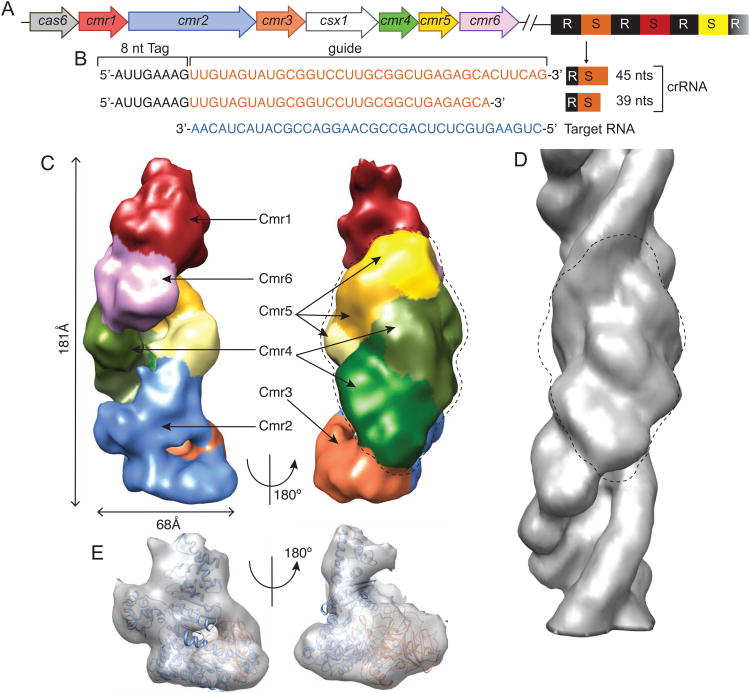
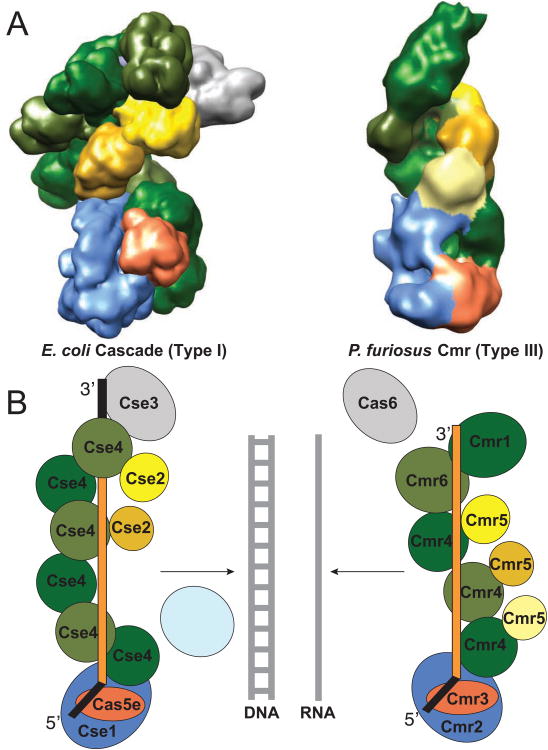
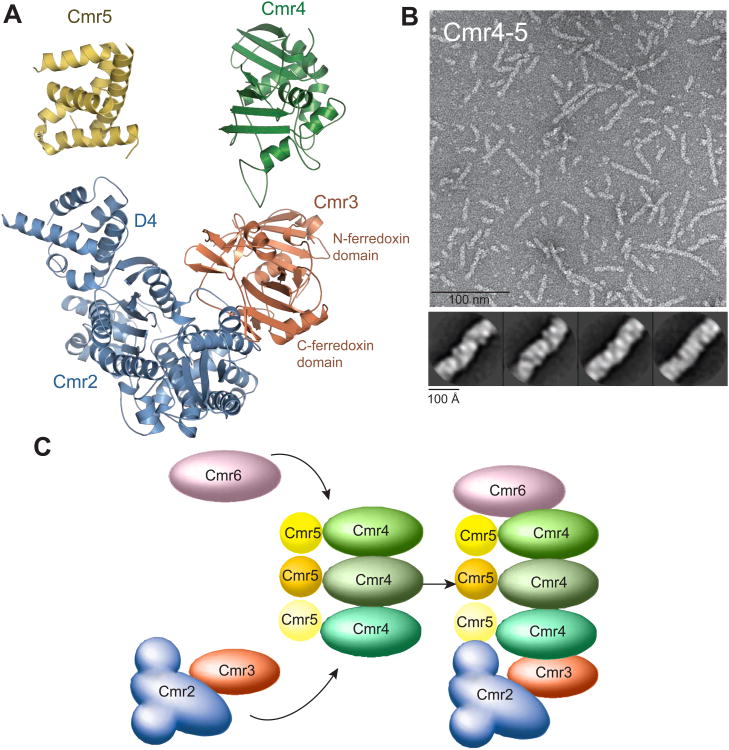
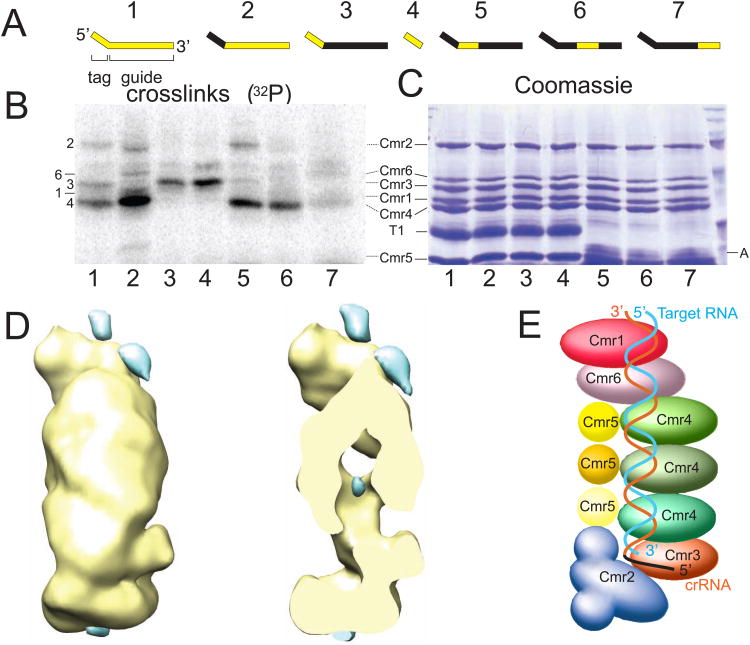
Bacterial and archaeal clustered regularly interspaced short palindromic repeat (CRISPR) loci capture virus and plasmid sequences and use them to recognize and eliminate these invaders. CRISPR RNAs (crRNAs) containing the acquired sequences are incorporated into effector complexes that destroy matching invader nucleic acids. The multicomponent Cmr effector complex cleaves RNA targets complementary to the crRNAs. Here, we report cryoelectron microscopy reconstruction of a functional Cmr complex bound with a target RNA at ~12 Å. Pairs of the Cmr4 and Cmr5 proteins form a helical core that is asymmetrically capped on each end by distinct pairs of the four remaining subunits: Cmr2 and Cmr3 at the conserved 5' crRNA tag sequence and Cmr1 and Cmr6 near the 3' end of the crRNA. The shape and organization of the RNA-targeting Cmr complex is strikingly similar to the DNA-targeting Cascade complex. Our results reveal a remarkably conserved architecture among very distantly related CRISPR-Cas complexes.
细菌和古菌的成簇规律间隔短回文重复(CRISPR)基因座捕获病毒和质粒序列,并利用这些序列识别和消除这些入侵物。含有获得序列的 CRISPR RNA(crRNA)被整合到效应复合物中,破坏匹配的入侵核酸。多组分 Cmr 效应复合物切割与 crRNA 互补的 RNA 靶标。在这里,我们报告了在~12 Å分辨率下与靶 RNA 结合的功能 Cmr 复合物的冷冻电镜重建。Cmr4 和 Cmr5 蛋白对形成一个螺旋核心,每个末端由四个剩余亚基的不同对不对称地封顶:Cmr2 和 Cmr3 在保守的 5' crRNA 标签序列处,Cmr1 和 Cmr6 在 crRNA 的 3' 末端附近。靶向 RNA 的 Cmr 复合物的形状和组织与靶向 DNA 的 Cascade 复合物非常相似。我们的结果揭示了非常远缘的 CRISPR-Cas 复合物之间存在惊人保守的结构。