Department of Pathology, Samsung Medical Center, Sungkyunkwan University School of Medicine, Seoul, Korea.
PLoS One. 2013 Oct 4;8(10):e77219. doi: 10.1371/journal.pone.0077219. eCollection 2013.
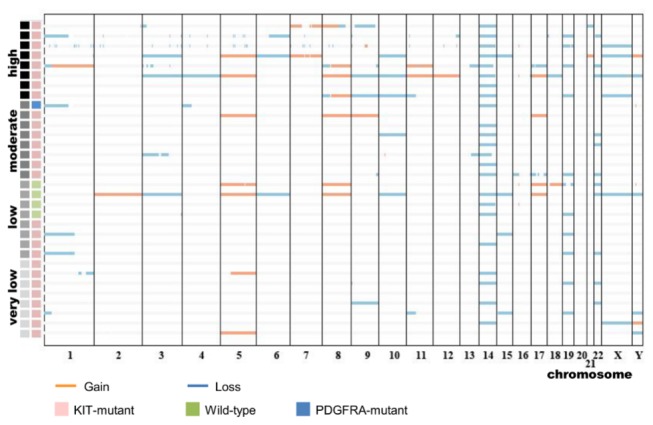
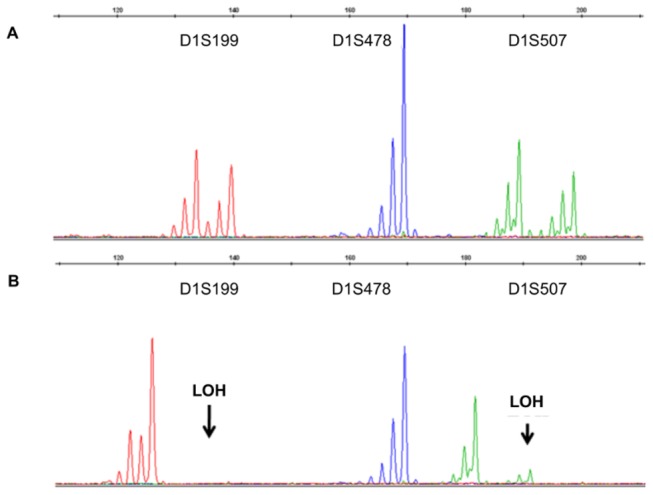
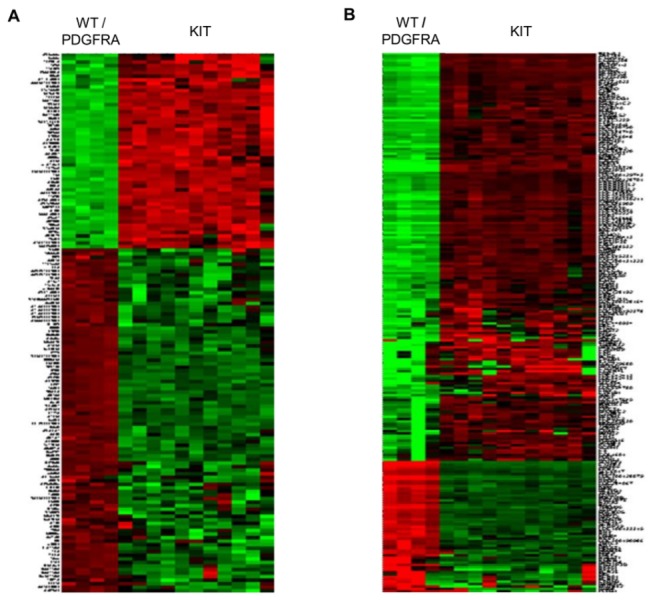
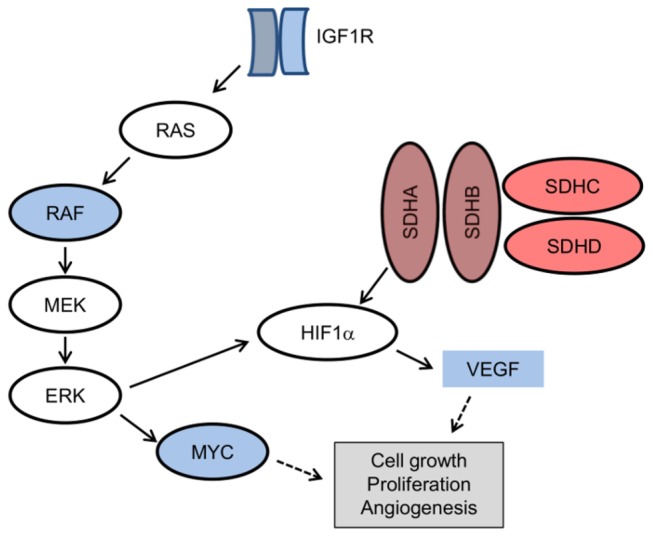
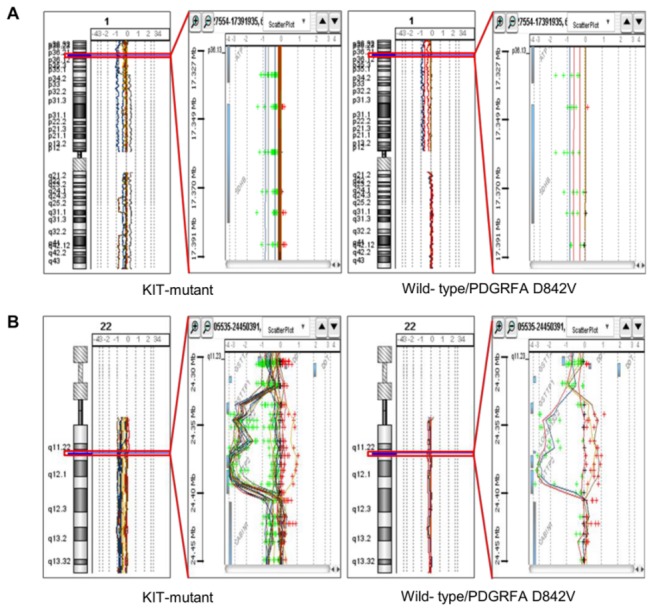
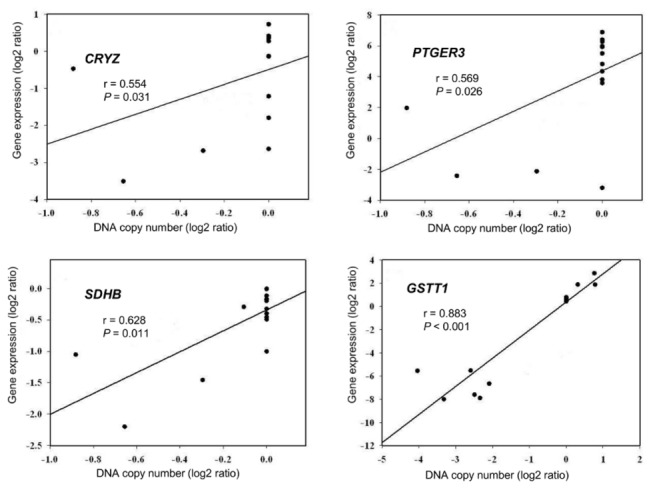
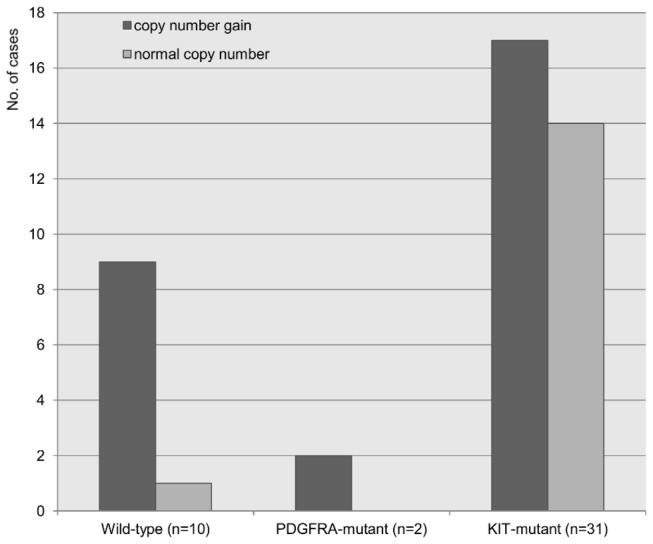
Oncogenic mutations in gastrointestinal stromal tumors (GISTs) predict prognosis and therapeutic responses to imatinib. In wild-type GISTs, the tumor-initiating events are still unknown, and wild-type GISTs are resistant to imatinib therapy. We performed an association study between copy number alterations (CNAs) identified from array CGH and gene expression analyses results for four wild-type GISTs and an imatinib-resistant PDGFRA D842V mutant GIST, and compared the results to those obtained from 27 GISTs with KIT mutations. All wild-type GISTs had multiple CNAs, and CNAs in 1p and 22q that harbor the SDHB and GSTT1 genes, respectively, correlated well with expression levels of these genes. mRNA expression levels of all SDH gene subunits were significantly lower (P≤0.041), whereas mRNA expression levels of VEGF (P=0.025), IGF1R (P=0.026), and ZNFs (P<0.05) were significantly higher in GISTs with wild-type/PDGFRA D842V mutations than GISTs with KIT mutations. qRT-PCR validation of the GSTT1 results in this cohort and 11 additional malignant GISTs showed a significant increase in the frequency of GSTT1 CN gain and increased mRNA expression of GSTT1 in wild-type/PDGFRA D842V GISTs than KIT-mutant GISTs (P=0.033). Surprisingly, all four malignant GISTs with KIT exon 11 deletion mutations with primary resistance to imatinib had an increased GSTT1 CN and mRNA expression level of GSTT1. Increased mRNA expression of GSTT1 and ZNF could be predictors of a poor response to imatinib. Our integrative approach reveals that for patients with wild-type (or imatinib-resistant) GISTs, attempts to target VEGFRs and IGF1R may be reasonable options.
胃肠道间质瘤(GISTs)中的致癌突变可预测预后和对伊马替尼的治疗反应。在野生型 GISTs 中,肿瘤起始事件仍不清楚,并且野生型 GISTs 对伊马替尼治疗有抗性。我们对来自 array CGH 和基因表达分析结果的四个野生型 GIST 和一个伊马替尼耐药的 PDGFRA D842V 突变 GIST 的拷贝数改变(CNAs)进行了关联研究,并将结果与 27 个具有 KIT 突变的 GIST 进行了比较。所有野生型 GIST 都有多个 CNA,分别位于 1p 和 22q 上的 SDHB 和 GSTT1 基因的 CNA 与这些基因的表达水平密切相关。所有 SDH 基因亚基的 mRNA 表达水平均显著降低(P≤0.041),而具有野生型/PDGFRA D842V 突变的 GIST 中 VEGF(P=0.025)、IGF1R(P=0.026)和 ZNFs(P<0.05)的 mRNA 表达水平显著升高。在该队列和另外 11 个恶性 GIST 中对 GSTT1 结果进行 qRT-PCR 验证表明,在野生型/PDGFRA D842V GIST 中 GSTT1 的 CN 增益频率显著增加,GSTT1 的 mRNA 表达水平增加,而 KIT 突变的 GIST 则没有(P=0.033)。令人惊讶的是,所有对伊马替尼具有原发性耐药的 KIT 外显子 11 缺失突变的四个恶性 GIST 均具有增加的 GSTT1 CN 和 GSTT1 的 mRNA 表达水平。GSTT1 和 ZNF 的 mRNA 表达增加可能是对伊马替尼反应不佳的预测指标。我们的综合方法表明,对于具有野生型(或伊马替尼耐药)GIST 的患者,尝试靶向 VEGFR 和 IGF1R 可能是合理的选择。