Zoologisches Forschungsmuseum Alexander Koenig, Bonn, Germany.
PLoS One. 2013 Oct 9;8(10):e72855. doi: 10.1371/journal.pone.0072855. eCollection 2013.
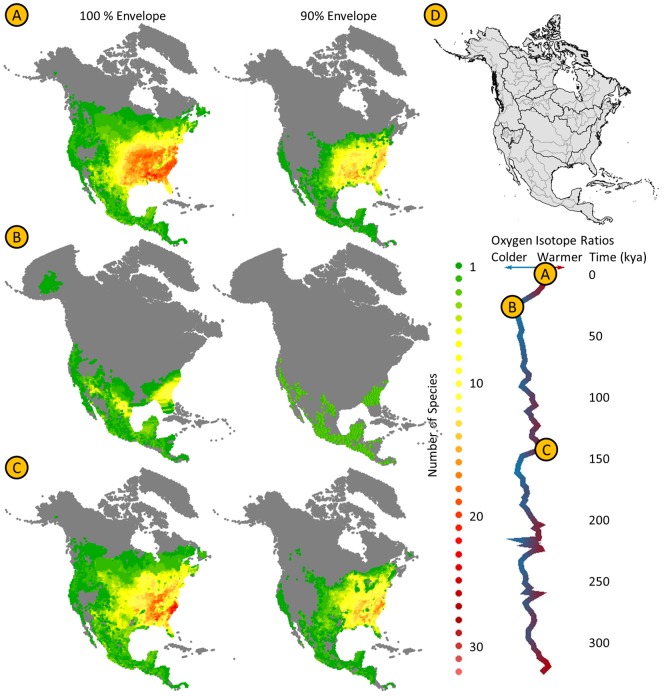
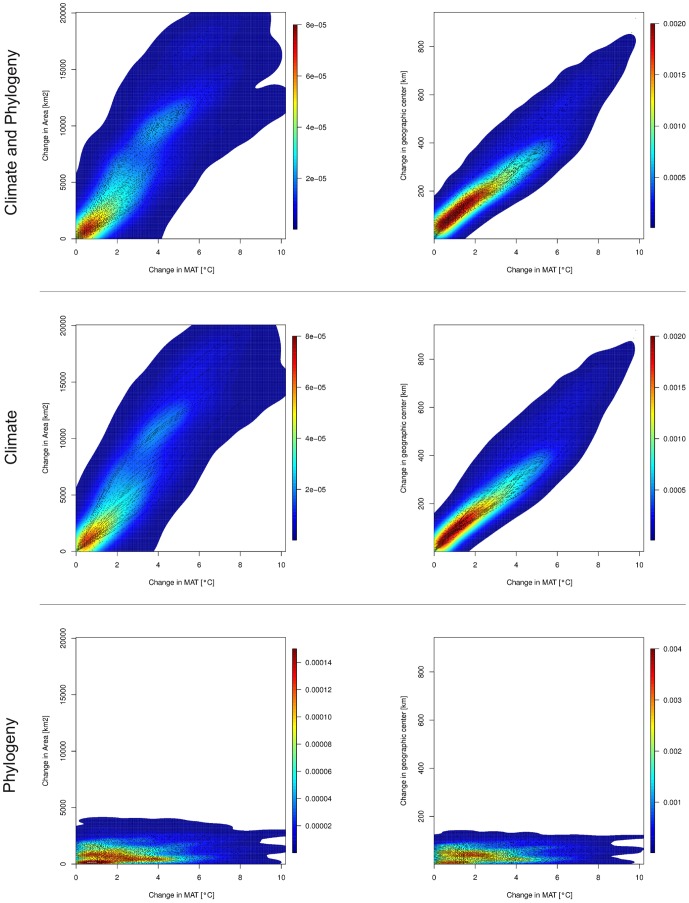
The climatic cycles of the Quaternary, during which global mean annual temperatures have regularly changed by 5-10°C, provide a special opportunity for studying the rate, magnitude, and effects of geographic responses to changing climates. During the Quaternary, high- and mid-latitude species were extirpated from regions that were covered by ice or otherwise became unsuitable, persisting in refugial retreats where the environment was compatible with their tolerances. In this study we combine modern geographic range data, phylogeny, Pleistocene paleoclimatic models, and isotopic records of changes in global mean annual temperature, to produce a temporally continuous model of geographic changes in potential habitat for 59 species of North American turtles over the past 320 Ka (three full glacial-interglacial cycles). These paleophylogeographic models indicate the areas where past climates were compatible with the modern ranges of the species and serve as hypotheses for how their geographic ranges would have changed in response to Quaternary climate cycles. We test these hypotheses against physiological, genetic, taxonomic and fossil evidence, and we then use them to measure the effects of Quaternary climate cycles on species distributions. Patterns of range expansion, contraction, and fragmentation in the models are strongly congruent with (i) phylogeographic differentiation; (ii) morphological variation; (iii) physiological tolerances; and (iv) intraspecific genetic variability. Modern species with significant interspecific differentiation have geographic ranges that strongly fluctuated and repeatedly fragmented throughout the Quaternary. Modern species with low genetic diversity have geographic distributions that were highly variable and at times exceedingly small in the past. Our results reveal the potential for paleophylogeographic models to (i) reconstruct past geographic range modifications, (ii) identify geographic processes that result in genetic bottlenecks; and (iii) predict threats due to anthropogenic climate change in the future.
第四纪的气候循环,全球年平均温度定期变化 5-10°C,为研究地理对气候变化的响应速度、幅度和影响提供了特殊机会。在第四纪期间,高纬度和中纬度物种从被冰覆盖或其他变得不适宜的地区灭绝,在与它们的耐受性兼容的避难所退缩中幸存下来。在这项研究中,我们结合了现代地理范围数据、系统发育、更新世古气候模型以及全球年平均温度变化的同位素记录,为 59 种北美龟在过去 320 Ka(三个完整的冰期-间冰期循环)中的潜在栖息地地理变化制作了一个时间连续的模型。这些古生物地理模型表明了过去气候与物种现代范围相适应的区域,并为物种的地理范围如何响应第四纪气候循环而变化提供了假设。我们根据生理、遗传、分类学和化石证据对这些假设进行了检验,然后利用这些假设来衡量第四纪气候循环对物种分布的影响。模型中范围扩展、收缩和破碎化的模式与(i)系统发育分化;(ii)形态变异;(iii)生理耐受性;和(iv)种内遗传变异性强烈一致。具有显著种间分化的现代物种的地理范围在整个第四纪中强烈波动并反复破碎。遗传多样性低的现代物种在过去的地理分布具有高度的可变性,有时非常小。我们的研究结果揭示了古生物地理模型的潜力:(i)重建过去的地理范围变化;(ii)识别导致遗传瓶颈的地理过程;以及(iii)预测未来人为气候变化造成的威胁。