Duarte Jose M, Biyani Nikhil, Baskaran Kumaran, Capitani Guido
Laboratory of Biomolecular Research, Paul Scherrer Institut, Villigen, 5232, Switzerland.
BMC Struct Biol. 2013 Oct 17;13:21. doi: 10.1186/1472-6807-13-21.
The amount of transmembrane protein (TM) structures solved to date is now large enough to attempt large scale analyses. In particular, extensive studies of oligomeric interfaces in the transmembrane region are now possible.
We have compiled the first fully comprehensive set of validated transmembrane protein interfaces in order to study their features and assess what differentiates them from their soluble counterparts.
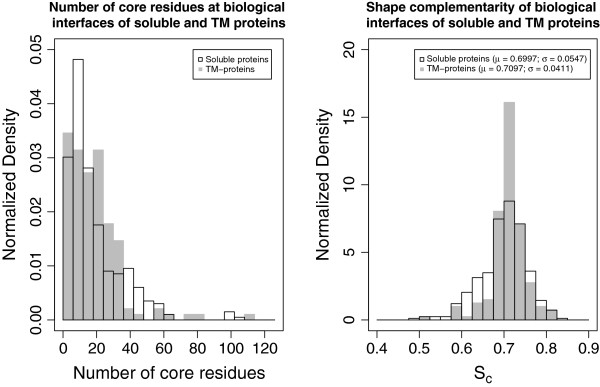
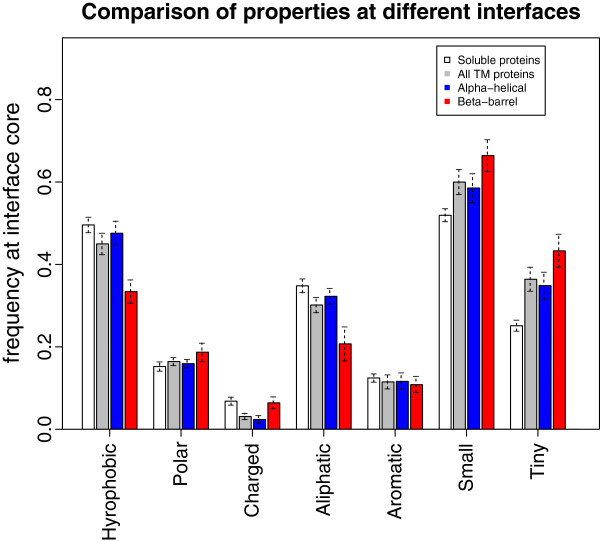
The general features of TM interfaces do not differ much from those of soluble proteins: they are large, tightly packed and possess many interface core residues. In our set, membrane lipids were not found to significantly mediate protein-protein interfaces. Although no G protein-coupled receptor (GPCR) was included in the validated set, we analyzed the crystallographic dimerization interfaces proposed in the literature. We found that the putative dimer interfaces proposed for class A GPCRs do not show the usual patterns of stable biological interfaces, neither in terms of evolution nor of packing, thus they likely correspond to crystal interfaces. We cannot however rule out the possibility that they constitute transient or weak interfaces. In contrast we do observe a clear signature of biological interface for the proposed dimer of the class F human Smoothened receptor.
迄今为止解析出的跨膜蛋白(TM)结构数量已足够多,能够尝试进行大规模分析。特别是,现在对跨膜区域寡聚体界面进行广泛研究成为可能。
我们汇编了第一套完整且经过验证的跨膜蛋白界面,以便研究其特征并评估它们与可溶性对应物的差异。
跨膜界面的一般特征与可溶性蛋白的特征差异不大:它们面积大、紧密堆积且有许多界面核心残基。在我们的数据集中,未发现膜脂能显著介导蛋白质 - 蛋白质界面。尽管经过验证的数据集中未包含G蛋白偶联受体(GPCR),但我们分析了文献中提出的晶体学二聚化界面。我们发现,文献中为A类GPCR提出的假定二聚体界面,在进化和堆积方面都未显示出稳定生物界面的常见模式,因此它们可能对应于晶体界面。然而,我们不能排除它们构成瞬时或弱界面的可能性。相比之下,我们确实观察到了F类人类平滑受体提议的二聚体具有明显的生物界面特征。