John and Willie Leone Family Department of Energy and Mineral Engineering, The Pennsylvania State University, University Park, PA 16802, USA.
Geochem Trans. 2013 Oct 20;14(1):4. doi: 10.1186/1467-4866-14-4.
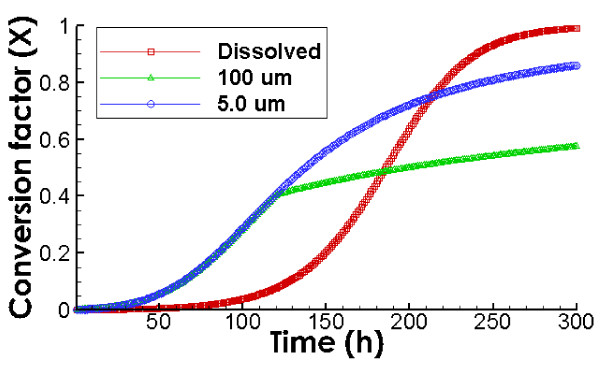
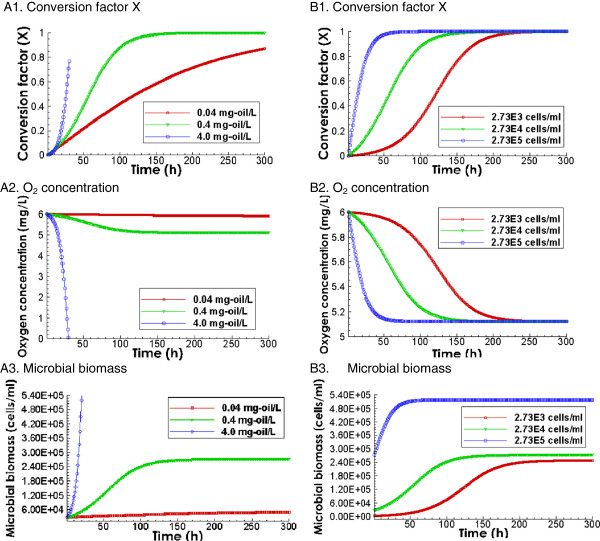
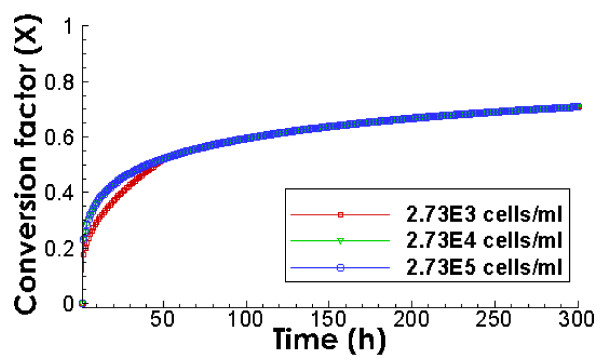
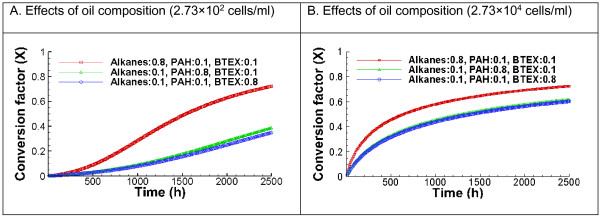
Oil biodegradation by native bacteria is one of the most important natural processes that can attenuate the environmental impacts of marine oil spills. Existing models for oil biodegradation kinetics are mostly for dissolved oil. This work developed a new mathematical model for the biodegradation of oil droplets and applied the model to estimate the time scale for oil biodegradation under conditions relevant to the Deepwater Horizon oil spill in the Gulf of Mexico. In the model, oil is composed of droplets of various sizes following the gamma function distribution. Each oil droplet shrinks during the microbe-mediated degradation at the oil-water interface. Using our developed model, we find that the degradation of oil droplets typically goes through two stages. The first stage is characterized by microbial activity unlimited by oil-water interface with higher biodegradation rates than that of the dissolved oil. The second stage is governed by the availability of the oil-water interface, which results in much slower rates than that of soluble oil. As a result, compared to that of the dissolved oil, the degradation of oil droplets typically starts faster and then quickly slows down, ultimately reaching a smaller percentage of degraded oil in longer time. The availability of the water-oil interface plays a key role in determining the rates and extent of degradation. We find that several parameters control biodegradation rates, including size distribution of oil droplets, initial microbial concentrations, initial oil concentration and composition. Under conditions relevant to the Deepwater Horizon spill, we find that the size distribution of oil droplets (mean and coefficient of variance) is the most important parameter because it determines the availability of the oil-water interface. Smaller oil droplets with larger variance leads to faster and larger extent of degradation. The developed model will be useful for evaluating transport and fate of spilled oil, different remediation strategies, and risk assessment.
土著细菌对石油的生物降解是一种最重要的自然过程,可以减轻海洋溢油对环境的影响。现有的石油生物降解动力学模型大多是针对溶解油的。本研究开发了一种新的油滴生物降解数学模型,并将该模型应用于估算墨西哥湾深水地平线溢油条件下油生物降解的时间尺度。在该模型中,油由遵循伽马函数分布的各种大小的油滴组成。在油-水界面处的微生物介导的降解过程中,每个油滴都会收缩。利用我们开发的模型,我们发现油滴的降解通常经历两个阶段。第一阶段的特征是微生物活性不受油-水界面限制,生物降解率高于溶解油。第二阶段受油-水界面的可用性控制,导致比可溶性油慢得多的速率。因此,与溶解油相比,油滴的降解通常更快开始,然后迅速减慢,最终在更长的时间内达到更小比例的降解油。油水界面的可用性在决定降解速率和程度方面起着关键作用。我们发现,有几个参数控制生物降解速率,包括油滴的大小分布、初始微生物浓度、初始油浓度和组成。在与深水地平线溢油相关的条件下,我们发现油滴的大小分布(平均值和变异系数)是最重要的参数,因为它决定了油水界面的可用性。具有较大变异系数的较小油滴会导致更快和更大程度的降解。所开发的模型将有助于评估溢油的输运和归宿、不同的修复策略以及风险评估。