Division of Biophysical Chemistry, Center of Chemistry and Chemical Engineering, Lund University, Lund, Sweden.
PLoS One. 2013 Oct 11;8(10):e77235. doi: 10.1371/journal.pone.0077235. eCollection 2013.
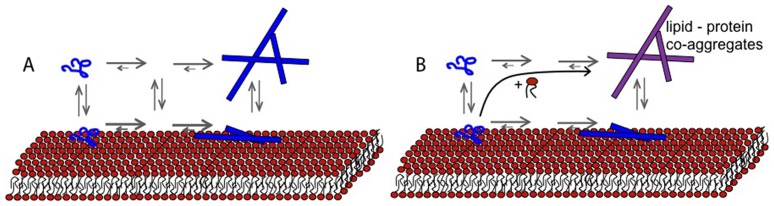
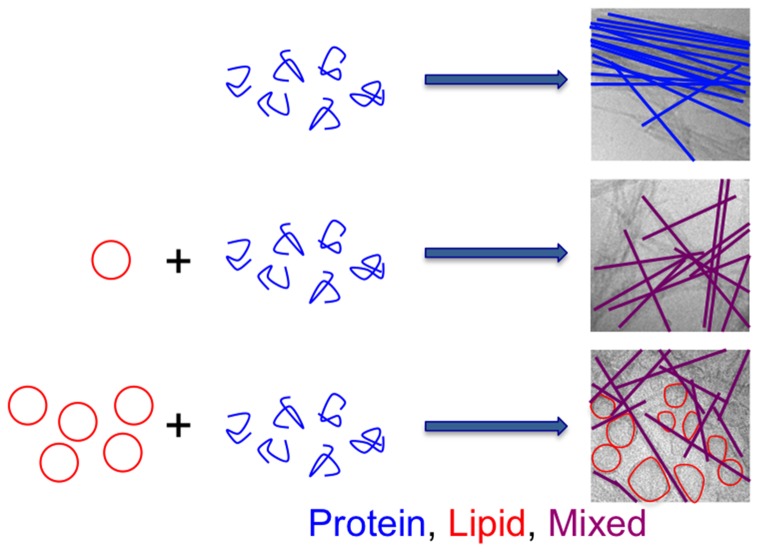
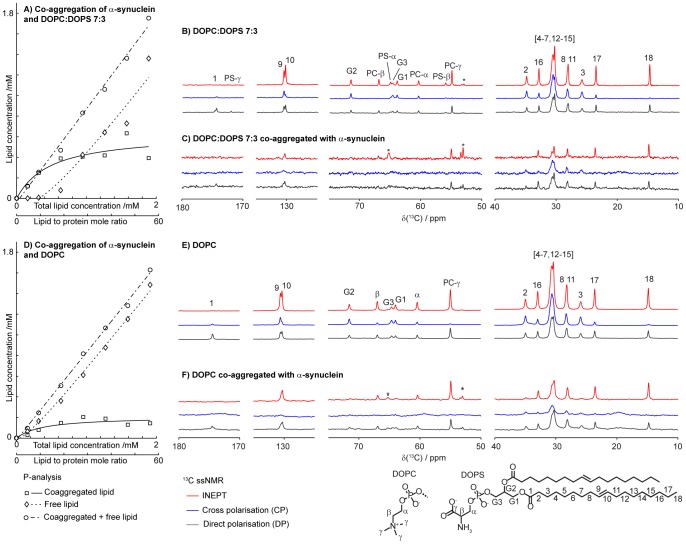
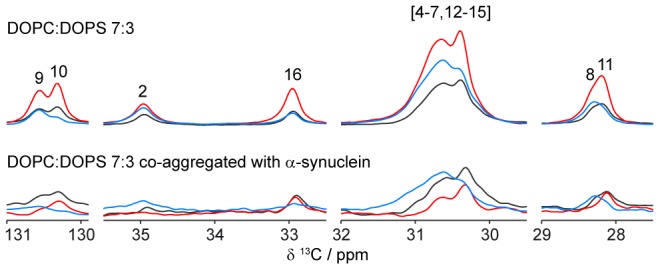
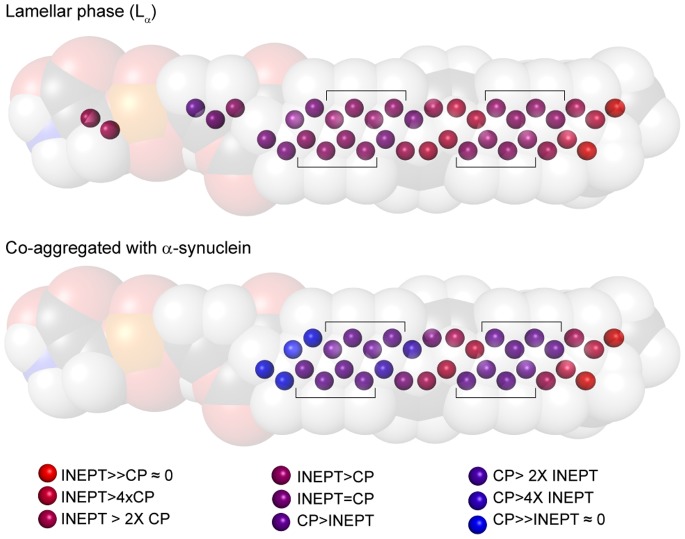
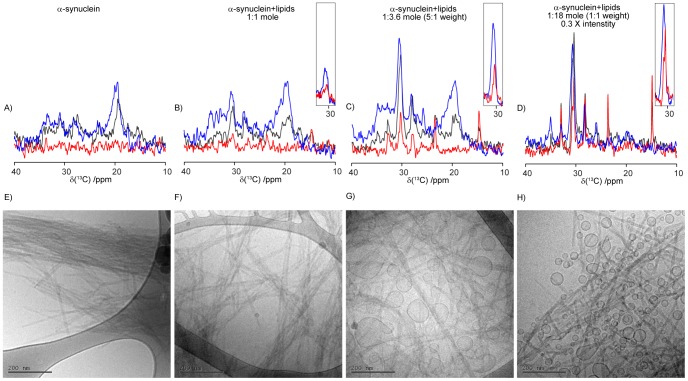
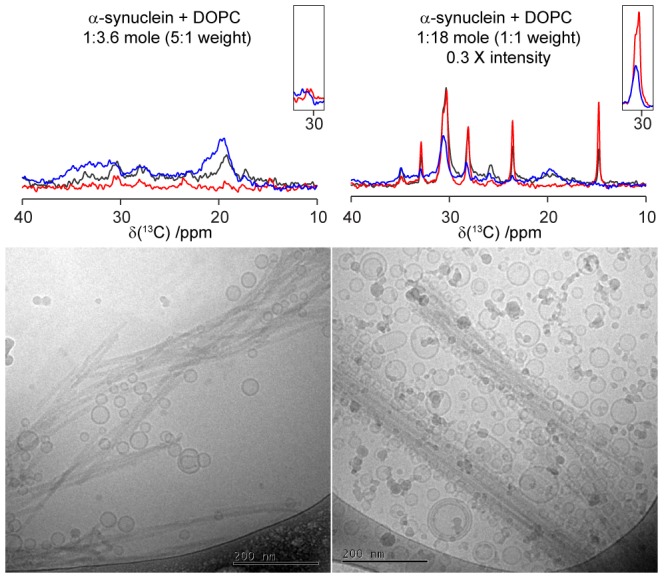
Amyloid deposits from several human diseases have been found to contain membrane lipids. Co-aggregation of lipids and amyloid proteins in amyloid aggregates, and the related extraction of lipids from cellular membranes, can influence structure and function in both the membrane and the formed amyloid deposit. Co-aggregation can therefore have important implications for the pathological consequences of amyloid formation. Still, very little is known about the mechanism behind co-aggregation and molecular structure in the formed aggregates. To address this, we study in vitro co-aggregation by incubating phospholipid model membranes with the Parkinson's disease-associated protein, α-synuclein, in monomeric form. After aggregation, we find spontaneous uptake of phospholipids from anionic model membranes into the amyloid fibrils. Phospholipid quantification, polarization transfer solid-state NMR and cryo-TEM together reveal co-aggregation of phospholipids and α-synuclein in a saturable manner with a strong dependence on lipid composition. At low lipid to protein ratios, there is a close association of phospholipids to the fibril structure, which is apparent from reduced phospholipid mobility and morphological changes in fibril bundling. At higher lipid to protein ratios, additional vesicles adsorb along the fibrils. While interactions between lipids and amyloid-protein are generally discussed within the perspective of different protein species adsorbing to and perturbing the lipid membrane, the current work reveals amyloid formation in the presence of lipids as a co-aggregation process. The interaction leads to the formation of lipid-protein co-aggregates with distinct structure, dynamics and morphology compared to assemblies formed by either lipid or protein alone.
已经发现,几种人类疾病的淀粉样沉积物中含有膜脂。脂质和淀粉样蛋白在淀粉样聚集体中的共同聚集,以及相关的细胞膜脂质的提取,可以影响膜和形成的淀粉样沉积物中的结构和功能。因此,共同聚集可能对淀粉样形成的病理后果有重要影响。尽管如此,对于共同聚集的机制以及形成的聚集体中的分子结构,我们知之甚少。为了解决这个问题,我们通过在单体形式下将磷脂模型膜与帕金森病相关蛋白α-突触核蛋白孵育来研究体外共同聚集。在聚集后,我们发现阴离子模型膜中的磷脂自发地被摄取到淀粉样纤维中。磷脂定量、极化转移固态 NMR 和 cryo-TEM 一起揭示了磷脂和 α-突触核蛋白以可饱和的方式共同聚集,并且强烈依赖于脂质组成。在低脂质与蛋白质的比例下,磷脂与纤维结构密切相关,这从磷脂流动性降低和纤维束状结构的形态变化中可以明显看出。在更高的脂质与蛋白质比例下,额外的囊泡沿纤维吸附。虽然脂质与淀粉样蛋白之间的相互作用通常在不同蛋白质种类吸附到脂质膜并扰乱脂质膜的角度进行讨论,但目前的工作揭示了在存在脂质的情况下淀粉样形成是一种共同聚集过程。这种相互作用导致形成具有独特结构、动力学和形态的脂质-蛋白质共聚集体,与单独由脂质或蛋白质形成的聚集体相比有所不同。