Nisula Sara, Vaara Suvi T, Kaukonen Kirsi-Maija, Reinikainen Matti, Koivisto Simo-Pekka, Inkinen Outi, Poukkanen Meri, Tiainen Pekka, Pettilä Ville, Korhonen Anna-Maija
Crit Care. 2013 Oct 22;17(5):R250. doi: 10.1186/cc13076.
Acute kidney injury (AKI) has high incidence among the critically ill and associates with dismal outcome. Not only the long-term survival, but also the quality of life (QOL) of patients with AKI is relevant due to substantial burden of care regarding these patients. We aimed to study the long-term outcome and QOL of patients with AKI treated in intensive care units.
We conducted a predefined six-month follow-up of adult intensive care unit (ICU) patients from the prospective, observational, multi-centre FINNAKI study. We evaluated the QOL of survivors with the EuroQol (EQ-5D) questionnaire. We included all participating sites with at least 70% rate of QOL measurements in the analysis.
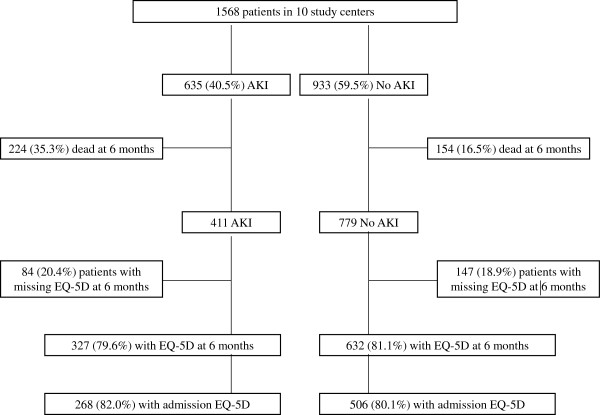
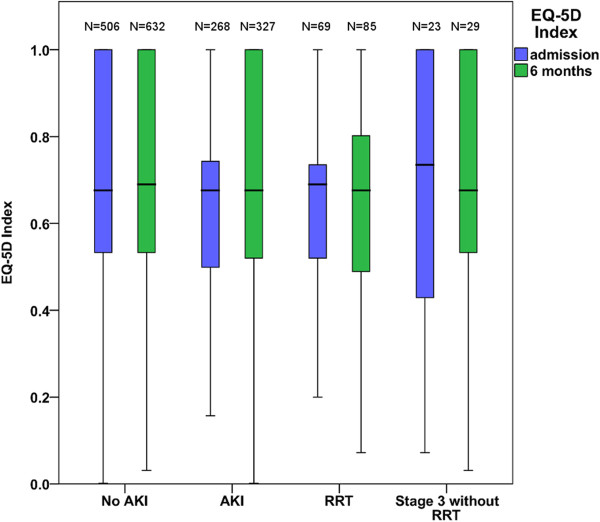
Of the 1,568 study patients, 635 (40.5%, 95% confidence interval (CI) 38.0-43.0%) had AKI according to the Kidney Disease Improving Global Outcomes (KDIGO) criteria. Of the 635 AKI patients, 224 (35.3%), as compared to 154/933 (16.5%) patients without AKI, died within six months. Of the 1,190 survivors, 959 (80.6%) answered the EQ-5D questionnaire at six months. The QOL (median with Interquartile range, IQR) measured with the EQ-5D index and compared to age- and sex-matched general population was: 0.676 (0.520-1.00) versus 0.826 (0.812-0.859) for AKI patients, and 0.690 (0.533-1.00) versus 0.845 (0.812-0.882) for patients without AKI (P <0.001 in both). The EQ-5D at the time of ICU admission was available for 774 (80.7%) of the six-month respondents. We detected a mean increase of 0.017 for non-AKI and of 0.024 for AKI patients in the EQ-5D index (P = 0.728). The EQ-5D visual analogue scores (median with IQR) of patients with AKI (70 (50-83)) and patients without AKI (75 (60-87)) were not different from the age- and sex-matched general population (69 (68-73) and 70 (68-77)).
The health-related quality of life of patients with and without AKI was already lower on ICU admission than that of the age- and sex-matched general population, and did not change significantly during critical illness. Patients with and without AKI rate their subjective health to be as good as age and sex-matched general population despite statistically significantly lower QOL indexes measured by EQ-5D.
急性肾损伤(AKI)在危重症患者中发病率较高,且与不良预后相关。由于对这些患者的护理负担较重,AKI患者的长期生存率以及生活质量(QOL)都受到关注。我们旨在研究在重症监护病房接受治疗的AKI患者的长期预后和生活质量。
我们对前瞻性、观察性、多中心FINNAKI研究中的成年重症监护病房(ICU)患者进行了为期六个月的预设随访。我们使用欧洲五维度健康量表(EQ-5D)问卷评估幸存者的生活质量。分析中纳入了所有参与站点,这些站点的生活质量测量率至少为70%。
在1568名研究患者中,根据改善全球肾脏病预后组织(KDIGO)标准,635名(40.5%,95%置信区间(CI)38.0 - 43.0%)患有AKI。在635名AKI患者中,224名(35.3%)在六个月内死亡,而未患AKI的患者中这一比例为154/933(16.5%)。在1190名幸存者中,959名(80.6%)在六个月时回答了EQ-5D问卷。用EQ-5D指数测量的生活质量(中位数及四分位间距,IQR)与年龄和性别匹配的普通人群相比:AKI患者为0.676(0.520 - 1.00),普通人群为0.826(0.812 - 0.859);未患AKI的患者为0.690(0.533 - 1.00),普通人群为0.845(0.812 - 0.882)(两者P均<0.001)。在六个月的受访者中,774名(80.7%)在ICU入院时的EQ-5D数据可用。我们发现非AKI患者的EQ-5D指数平均增加0.017,AKI患者平均增加0.024(P = 0.728)。AKI患者(70(50 - 83))和未患AKI患者(75(60 - 87))的EQ-5D视觉模拟评分(中位数及IQR)与年龄和性别匹配的普通人群(69(68 - 73)和70(68 - 77))无差异。
无论是否患有AKI,患者在ICU入院时与健康相关的生活质量就已低于年龄和性别匹配的普通人群,且在危重症期间没有显著变化。尽管通过EQ-5D测量的生活质量指数在统计学上显著较低,但患有和未患AKI的患者对其主观健康状况的评价与年龄和性别匹配的普通人群一样好。