Ylipalosaari Pekka, Ala-Kokko Tero I, Laurila Jouko, Ohtonen Pasi, Syrjälä Hannu
Department of Infection Control, Oulu University Hospital, P,O, Box 22, FIN-90029 OYS, Finland.
Crit Care. 2007;11(2):R35. doi: 10.1186/cc5718.
The aim of this study was to evaluate the impact of intensive care unit (ICU)-acquired infection on long-term survival and quality of life.
Long-term survival was prospectively evaluated among hospital survivors who had stayed in a mixed, university-level ICU for longer than 48 hours during a 14-month study period during 2002 to 2003. Health-related quality of life was assessed using the five-dimensional EuroQol (EQ-5D) questionnaire in January 2005.
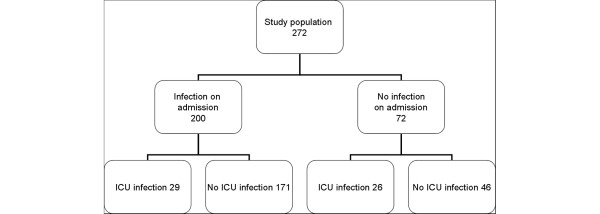
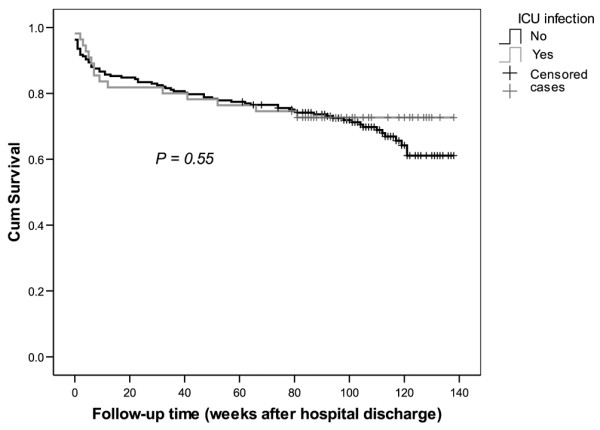
Of the 272 hospital survivors, 83 (30.5%) died after discharge during the follow-up period. The median follow-up time after hospital discharge was 22 months. Among patients without infection on admission, long-term mortality did not differ between patients who developed and those who did not develop an ICU-acquired infection (21.7% versus 26.9%; P = 0.41). Also, among patients with infection on admission, there was no difference in long-term mortality between patients who developed a superimposed (35.1%) and those who did not develop a superimposed (27.6%) ICU-acquired infection (P = 0.40). The EQ-5D response rate was 75 %. The patients who developed an ICU-acquired infection had significantly more problems with self-care (50%) than did those without an ICU-acquired infection (32%; P = 0.004), whereas multivariate analysis did not show ICU-acquired infection to be a significant risk factor for diminished self-care (odds ratio = 1.71, 95% confidence interval = 0.65-4.54; P = 0.28). General health status did not differ between those with and those without an ICU-acquired infection, as measured using the EuroQol visual-analogue scale (mean +/- standard deviation EuroQol visual-analogue scale value: 60.2 +/- 21 in patients without ICU-acquired infection versus 60.6 +/- 22 in those with ICU-acquired infection). The current general level of health compared with status before ICU admission did not differ between the groups either. Only 36% of those employed resumed their previous jobs.
ICU-acquired infection had no impact on long-term survival. The patients with ICU-acquired infection more frequently experienced problems with self-care than did those without ICU infection, but ICU-acquired infection was not a significant risk factor for diminished self-care in multivariate analysis.
本研究旨在评估重症监护病房(ICU)获得性感染对长期生存及生活质量的影响。
对2002年至2003年为期14个月的研究期间,在一所大学附属医院综合ICU住院超过48小时的医院幸存者进行长期生存的前瞻性评估。于2005年1月使用五维度欧洲生活质量量表(EQ-5D)对健康相关生活质量进行评估。
272例医院幸存者中,83例(30.5%)在随访期间出院后死亡。出院后的中位随访时间为22个月。在入院时无感染的患者中,发生与未发生ICU获得性感染的患者长期死亡率无差异(21.7%对26.9%;P = 0.41)。同样,在入院时有感染的患者中,发生与未发生叠加性ICU获得性感染的患者长期死亡率也无差异(35.1%对27.6%;P = 0.40)。EQ-5D的应答率为75%。发生ICU获得性感染的患者在自我护理方面存在问题的比例(50%)显著高于未发生ICU获得性感染的患者(32%;P = 0.004),而多因素分析未显示ICU获得性感染是自我护理能力下降的显著危险因素(比值比 = 1.71,95%置信区间 = 0.65 - 4.54;P = 0.28)。使用欧洲生活质量视觉模拟量表测量,有与无ICU获得性感染患者的总体健康状况无差异(欧洲生活质量视觉模拟量表值的均值±标准差:无ICU获得性感染患者为60.2±21,有ICU获得性感染患者为60.6±22)。两组患者目前的总体健康水平与ICU入院前状态相比也无差异。仅有36%的就业者恢复了之前的工作。
ICU获得性感染对长期生存无影响。发生ICU获得性感染的患者比未发生ICU感染的患者在自我护理方面更常出现问题,但在多因素分析中,ICU获得性感染并非自我护理能力下降的显著危险因素。