aDepartment of Stem Cell Biology and Regenerative Medicine, Lerner Research Institute, Cleveland Clinic bCase Western Reserve University School of Medicine cDepartment of Cell Biology, Case Western Reserve University dCleveland Clinic Lerner College of Medicine, Case Western Reserve University, Cleveland, Ohio, USA.
Curr Opin Neurol. 2013 Dec;26(6):701-7. doi: 10.1097/WCO.0000000000000032.
Recent advances in the role of cancer stem cells (CSCs) in glioblastoma will be reviewed.
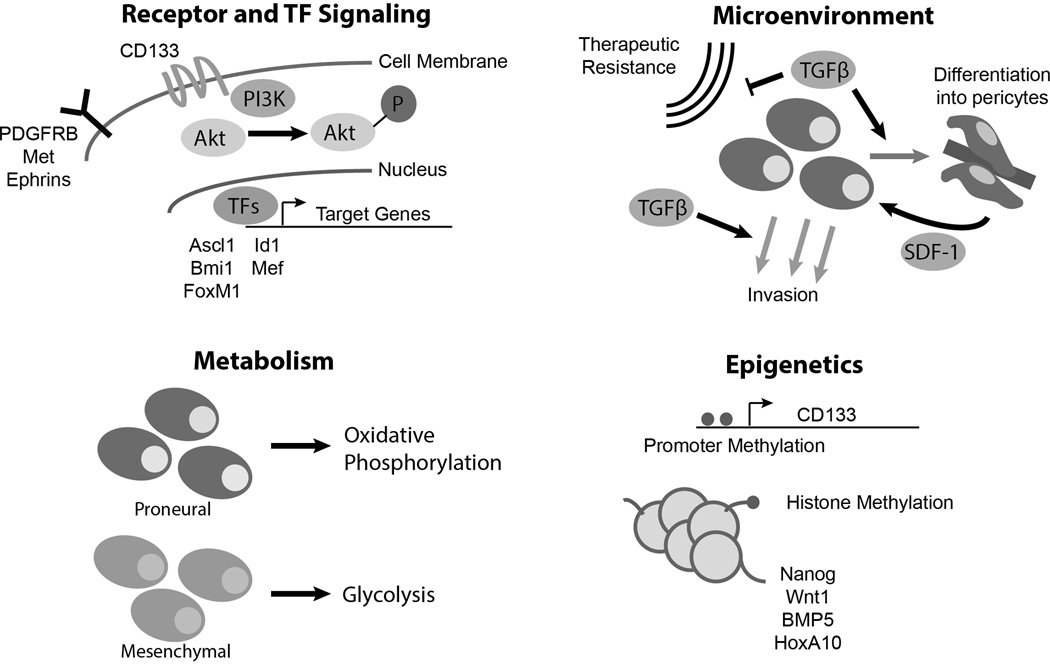
In the decade since the description of brain tumor CSCs, the potential significance of these cells in tumor growth, therapeutic resistance, and spread has become evident. Most recently, the interplay between CSCs, tumor genetics, and the microenvironment has offered potential nodes of fragility under therapeutic development. The CSC phenotype is informed by specific receptor signaling, and study of the regulation of stem cell genes by transcription factors and microRNAs has identified a number of new targets amenable to treatment. Like normal stem cells, CSCs display specific epigenetic landscapes and metabolic profiles.
Brain cancers activate core stem cell regulatory pathways to empower self-renewal, maintenance of an organ system (albeit an aberrant one), and survival under stress that collectively permits tumor growth, therapeutic resistance, invasion, and angiogenesis. These properties have implicated CSCs as contributors in GBM progression and recurrence, spurring a search for anti-CSC therapies that do not disrupt normal stem cell maintenance. The last year has witnessed a rapid evolution in the understanding of CSC biology to inform preclinical targeting.
本文将综述近年来癌症干细胞(CSC)在脑胶质瘤中作用的研究进展。
自脑肿瘤 CSC 被描述以来的十年间,这些细胞在肿瘤生长、治疗耐药性和扩散中的潜在意义已变得明显。最近,CSC 与肿瘤遗传学和微环境之间的相互作用为治疗开发提供了潜在的脆弱性节点。CSC 表型受特定受体信号的影响,对转录因子和 microRNAs 调节干细胞基因的研究确定了一些新的、可治疗的靶点。与正常干细胞一样,CSC 表现出特定的表观遗传景观和代谢特征。
脑癌激活核心干细胞调控途径,赋予自我更新、器官系统(尽管是异常的)维持和应激下生存的能力,这些共同促进肿瘤生长、治疗耐药性、侵袭和血管生成。这些特性使 CSC 成为 GBM 进展和复发的参与者,促使人们寻找不破坏正常干细胞维持的抗 CSC 治疗方法。过去一年,人们对 CSC 生物学的理解迅速发展,为临床前靶向治疗提供了信息。