Brain Development Imaging Laboratory, Department of Psychology, San Diego State University San Diego, CA, USA.
Front Hum Neurosci. 2013 Oct 8;7:605. doi: 10.3389/fnhum.2013.00605. eCollection 2013.
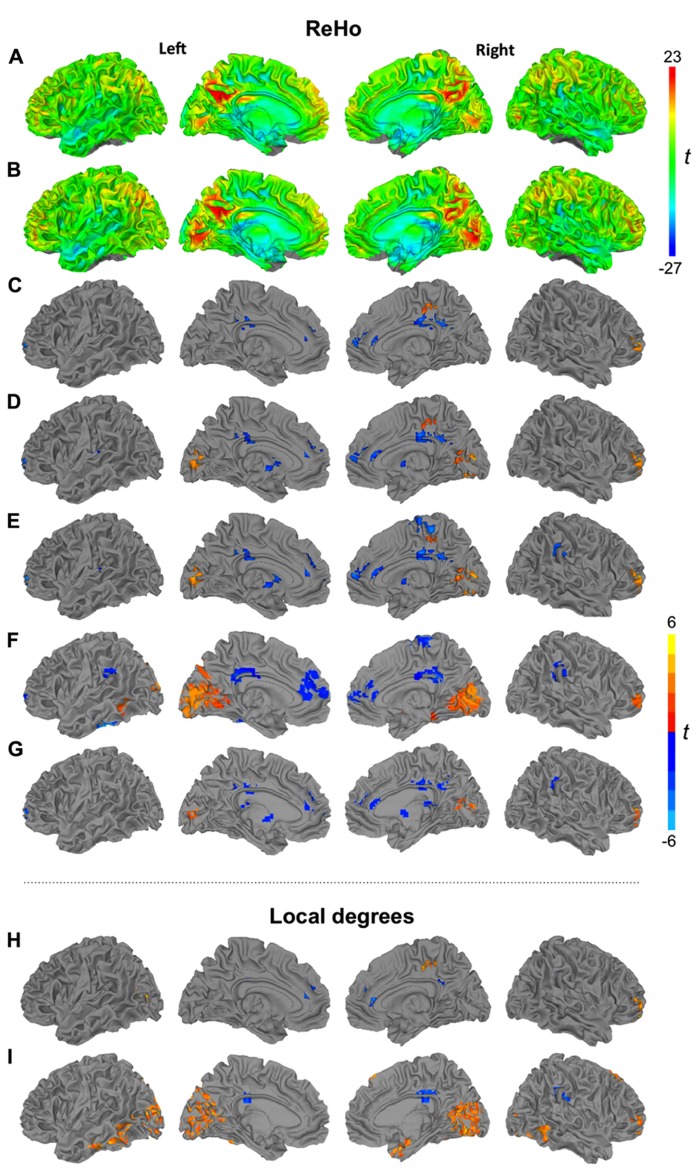
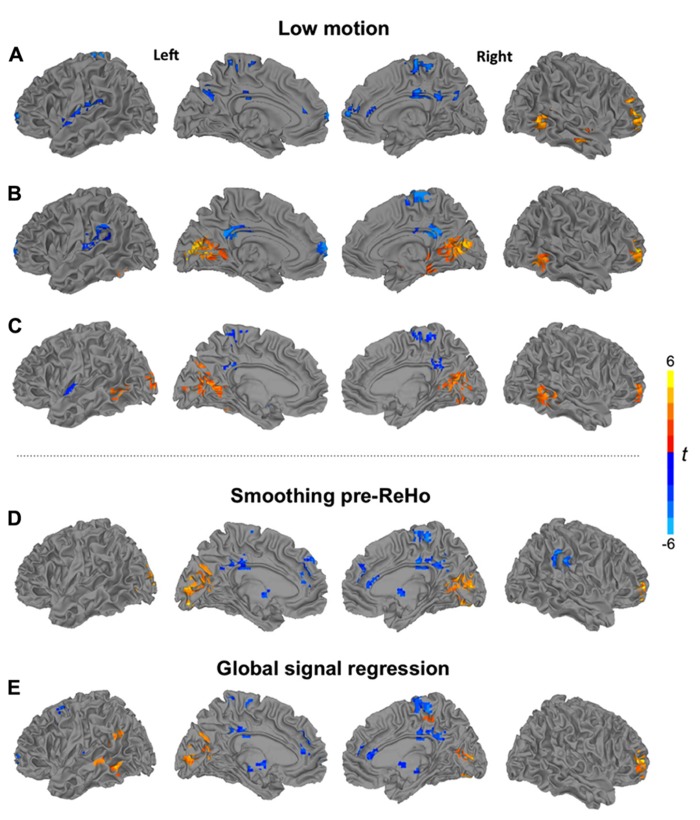
While the literature on aberrant long-distance connectivity in autism spectrum disorder (ASD) has grown fast over the past decade, little is known about local connectivity. We used regional homogeneity and local density approaches at different spatial scales to examine local connectivity in 29 children and adolescents with ASD and 29 matched typically developing participants, using resting state functional magnetic resonance imaging data. Across a total of 12 analysis pipelines, the gross pattern of between-group findings was overall stable, with local overconnectivity in the ASD group in occipital and posterior temporal regions and underconnectivity in middle/posterior cingulate, and medial prefrontal regions. This general pattern was confirmed in secondary analyses for low-motion subsamples (n = 20 per group), in which time series segments with >0.25 mm head motion were censored, as well as in an analysis including global signal regression. Local overconnectivity in visual regions appears consistent with preference for local over global visual processing previously reported in ASD, whereas cingulate and medial frontal underconnectivity may relate to aberrant function within the default mode network.
尽管过去十年中,自闭症谱系障碍(ASD)中异常长程连接的文献增长迅速,但对局部连接的了解甚少。我们使用静息态功能磁共振成像数据,使用区域同质性和局部密度方法在不同的空间尺度上检查了 29 名 ASD 儿童和青少年以及 29 名匹配的正常发育参与者的局部连接。在总共 12 个分析管道中,组间发现的总体模式总体上是稳定的,ASD 组在枕叶和颞叶后部区域存在局部过度连接,而在后扣带回和内侧前额叶区域存在局部连接不足。在对低运动子样本(每组 20 名)的二次分析中,以及在包括全局信号回归的分析中,都证实了这一总体模式。视觉区域的局部过度连接似乎与先前在 ASD 中报道的对局部而非全局视觉处理的偏好一致,而扣带回和内侧额部连接不足可能与默认模式网络中的异常功能有关。