Kang Eunyoung, Kim Sung-Won
Department of Surgery, Seoul National University Bundang Hospital, Seoul National University College of Medicine, Seongnam, Korea.
J Breast Cancer. 2013 Sep;16(3):245-53. doi: 10.4048/jbc.2013.16.3.245. Epub 2013 Sep 30.
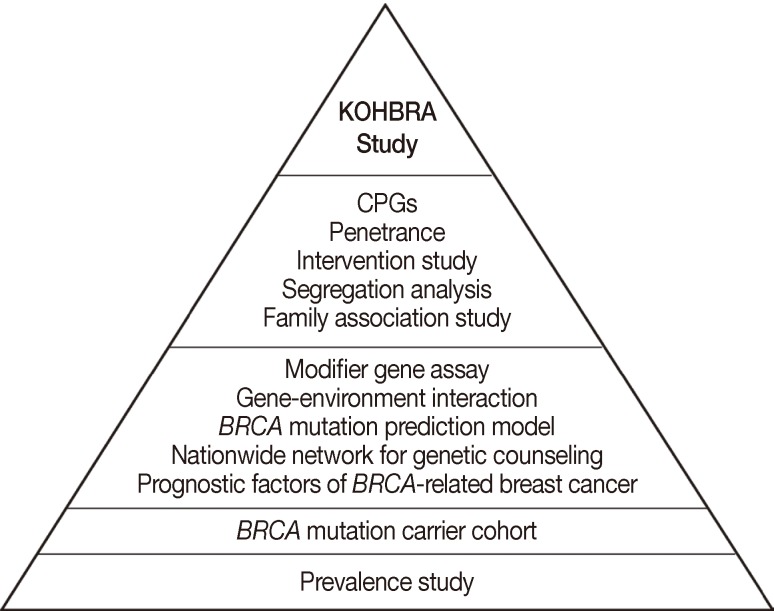
Most studies related to BRCA mutations have been performed in Western populations, and only a few small studies have been conducted in Korean populations. In 2007, the Korean Hereditary Breast Cancer (KOHBRA) Study was established to obtain evidence for the accurate risk assessment and management of hereditary breast and ovarian cancer (HBOC) in Korea. Between May 2007 and May 2010, the first phase of the KOHBRA Study was performed to estimate the prevalence of BRCA1/2 mutations among patients and their families at risk for HBOC. Between June 2010 and May 2013, the second phase of the KOHBRA Study was performed to identify the clinical characteristics and prognostic indicators of BRCA-related breast cancer and environmental and genetic modifiers of BRCA mutations and to develop a Korean BRCA risk calculator and nationwide genetic counseling network for HBOC. Herein, we review the results of the KOHBRA Study and describe the future perspectives of the study.
大多数与BRCA突变相关的研究是在西方人群中进行的,而在韩国人群中仅开展了少数小型研究。2007年,韩国遗传性乳腺癌(KOHBRA)研究得以开展,目的是获取有关韩国遗传性乳腺癌和卵巢癌(HBOC)准确风险评估及管理的证据。2007年5月至2010年5月,KOHBRA研究的第一阶段开展,旨在估计HBOC风险患者及其家族中BRCA1/2突变的患病率。2010年6月至2013年5月,KOHBRA研究的第二阶段开展,以确定BRCA相关乳腺癌的临床特征和预后指标、BRCA突变的环境和基因修饰因素,并开发韩国BRCA风险计算器以及全国性的HBOC遗传咨询网络。在此,我们回顾KOHBRA研究的结果并描述该研究的未来展望。