O'Brien Katie M, Orlow Irene, Antonescu Cristina R, Ballman Karla, McCall Linda, Dematteo Ronald, Engel Lawrence S
Department of Epidemiology, Gillings School of Global Public Health, University of North Carolina, Chapel Hill, NC, USA.
Clin Sarcoma Res. 2013 Oct 26;3(1):12. doi: 10.1186/2045-3329-3-12.
Gastrointestinal stromal tumors are rare soft tissue sarcomas that typically develop from mesenchymal cells with acquired gain-in-function mutations in KIT or PDGFRA oncogenes. These somatic mutations have been well-characterized, but little is known about inherited genetic risk factors. Given evidence that certain susceptibility loci and carcinogens are associated with characteristic mutations in other cancers, we hypothesized that these signature KIT or PDGFRA mutations may be similarly fundamental to understanding gastrointestinal stromal tumor etiology. Therefore, we examined associations between 522 single nucleotide polymorphisms and seven KIT or PDGFRA tumor mutations types. Candidate pathways included dioxin response, toxin metabolism, matrix metalloproteinase production, and immune and inflammatory response.
We estimated odds ratios and 95% confidence intervals for associations between each candidate SNP and tumor mutation type in 279 individuals from a clinical trial of adjuvant imatinib mesylate. We used sequence kernel association tests to look for pathway-level associations.
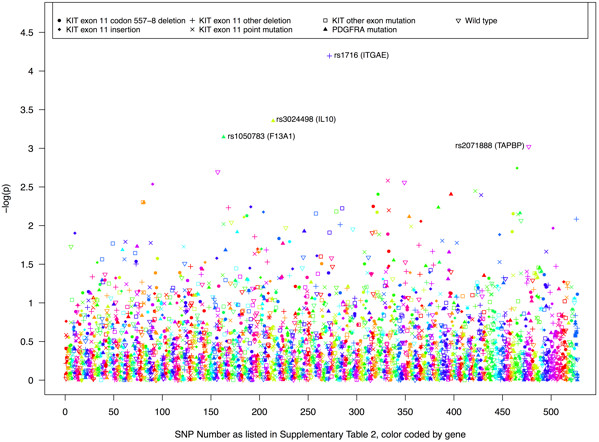
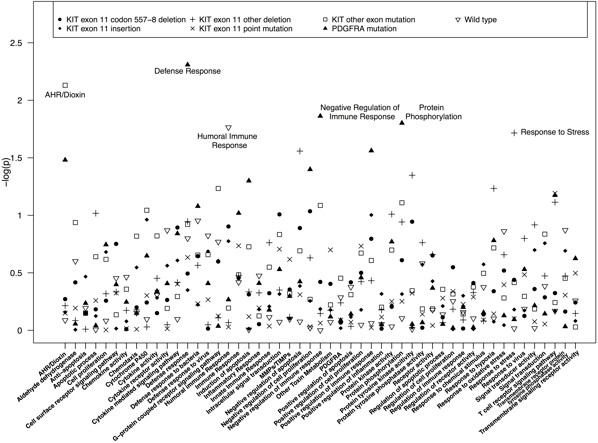
One variant, rs1716 on ITGAE, was significantly associated with KIT exon 11 non-codon 557-8 deletions (odds ratio = 2.86, 95% confidence interval: 1.71-4.78) after adjustment for multiple comparisons. Other noteworthy associations included rs3024498 (IL10) and rs1050783 (F13A1) with PDGFRA mutations, rs2071888 (TAPBP) with wild type tumors and several matrix metalloproteinase SNPs with KIT exon 11 codon 557-558 deletions. Several pathways were strongly associated with somatic mutations in PDGFRA, including defense response (p = 0.005) and negative regulation of immune response (p = 0.01).
This exploratory analysis offers novel insights into gastrointestinal stromal tumor etiology and provides a starting point for future studies of genetic and environmental risk factors for the disease.
胃肠道间质瘤是罕见的软组织肉瘤,通常由间充质细胞发展而来,这些细胞在KIT或血小板衍生生长因子受体α(PDGFRA)致癌基因中发生获得性功能突变。这些体细胞突变已得到充分表征,但对于遗传风险因素知之甚少。鉴于有证据表明某些易感基因座和致癌物与其他癌症的特征性突变相关,我们推测这些标志性的KIT或PDGFRA突变对于理解胃肠道间质瘤病因可能同样至关重要。因此,我们研究了522个单核苷酸多态性与七种KIT或PDGFRA肿瘤突变类型之间的关联。候选通路包括二噁英反应、毒素代谢、基质金属蛋白酶产生以及免疫和炎症反应。
在一项甲磺酸伊马替尼辅助治疗的临床试验中,我们估计了279名个体中每个候选单核苷酸多态性与肿瘤突变类型之间关联的比值比和95%置信区间。我们使用序列核关联检验来寻找通路水平的关联。
在进行多重比较校正后,整合素αE(ITGAE)上的一个变异体rs1716与KIT外显子11非密码子557 - 558缺失显著相关(比值比 = 2.86,95%置信区间:1.71 - 4.78)。其他值得注意的关联包括rs3024498(白细胞介素10,IL10)和rs1050783(凝血因子XIII A1,F13A1)与PDGFRA突变相关,rs2071888(TAP结合蛋白,TAPBP)与野生型肿瘤相关,以及几个基质金属蛋白酶单核苷酸多态性与KIT外显子11密码子557 - 558缺失相关。几个通路与PDGFRA中的体细胞突变密切相关,包括防御反应(p = 0.005)和免疫反应的负调控(p = 0.01)。
这项探索性分析为胃肠道间质瘤病因提供了新的见解,并为该疾病遗传和环境风险因素的未来研究提供了一个起点。