
盆腔子宫内膜异位症的超声图谱:病灶位置和数量是否影响诊断准确性?一项多中心诊断准确性研究。
Ultrasound mapping of pelvic endometriosis: does the location and number of lesions affect the diagnostic accuracy? A multicentre diagnostic accuracy study.
机构信息
Early Pregnancy and Gynaecology Assessment Unit, Department of Obstetrics and Gynaecology, Suite 8, Golden Jubilee Wing, King's College Hospital, London SE5 8RX, UK.
出版信息
BMC Womens Health. 2013 Oct 29;13:43. doi: 10.1186/1472-6874-13-43.
BACKGROUND
Endometriosis is a common condition which causes pain and reduced fertility. Treatment can be difficult, especially for severe disease, and an accurate preoperative assessment would greatly help in the managment of these patients. The objective of this study is to assess the accuracy of pre-operative transvaginal ultrasound scanning (TVS) in identifying the specific features of pelvic endometriosis and pelvic adhesions in comparison with laparoscopy.
METHODS
Consecutive women with clinically suspected or proven pelvic endometriosis, who were booked for laparoscopy, were invited to join the study. They all underwent a systematic transvaginal ultrasound examination in order to identify discrete endometriotic lesions and pelvic adhesions. The accuracy of ultrasound diagnosis was determined by comparing pre-operative ultrasound to laparoscopy findings.
RESULTS
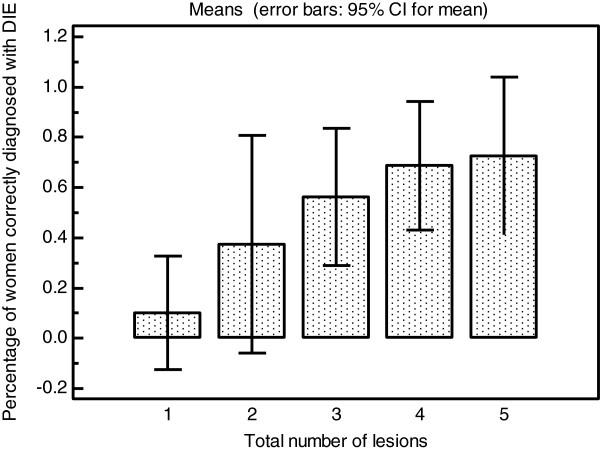
198 women who underwent preoperative TVS and laparoscopy were included in the final analysis. At laparoscopy 126/198 (63.6%) women had evidence of pelvic endometriosis. 28/126 (22.8%) of them had endometriosis in a single location whilst the remaining 98/126 (77.2%) had endometriosis in two or more locations. Positive likelihood ratios (LR+) for the ultrasound diagnosis of ovarian endometriomas, moderate or severe ovarian adhesions, pouch of Douglas adhesions, and bladder deeply infiltrating endometriosis (DIE), recto-sigmoid colon DIE, rectovaginal DIE, uterovesical fold DIE and uterosacral ligament DIE were >10, whilst for pelvic side wall DIE and any ovarian adhesions the + LH was 8.421 and 9.81 respectively.The negative likelihood ratio (LR-) was: <0.1 for bladder DIE; 0.1-0.2 for ovarian endometriomas, moderate or severe ovarian adhesions, and pouch of Douglas adhesions; 0.5-1 for rectovaginal, uterovesical fold, pelvic side wall and uterosacral ligament DIE. The accuracy of TVS for the diagnosis of both total number of endometriotic lesions and DIE lesions significantly improved with increasing total number of lesions.
CONCLUSIONS
Our study has shown that the TVS diagnosis of endometriotic lesion is very specific and false positive results are rare. Negative findings are less reliable and women with significant symptoms may still benefit from further investigation even if TVS findings are normal. The accuracy of ultrasound diagnosis is significantly affected by the location and number of endometriotic lesions.
背景
子宫内膜异位症是一种常见的疾病,会导致疼痛和生育能力下降。治疗可能很困难,尤其是对于严重的疾病,准确的术前评估将极大地帮助这些患者的治疗。本研究的目的是评估术前经阴道超声(TVS)在识别盆腔子宫内膜异位症和盆腔粘连的具体特征方面的准确性,并将其与腹腔镜检查进行比较。
方法
连续招募临床疑似或确诊为盆腔子宫内膜异位症并预约行腹腔镜检查的女性,邀请其参加本研究。所有患者均行系统的经阴道超声检查,以识别离散的子宫内膜异位病灶和盆腔粘连。通过比较术前超声与腹腔镜检查结果,确定超声诊断的准确性。
结果
最终纳入 198 例行术前 TVS 和腹腔镜检查的女性进行分析。腹腔镜检查发现 126/198(63.6%)例女性有盆腔子宫内膜异位症证据。其中 28/126(22.8%)例女性的子宫内膜异位症位于单一部位,而其余 98/126(77.2%)例女性的子宫内膜异位症位于两个或更多部位。卵巢子宫内膜异位囊肿、中重度卵巢粘连、Douglas 窝粘连、膀胱深部浸润性子宫内膜异位症(DIE)、直肠乙状结肠 DIE、直肠阴道 DIE、子宫-膀胱折叠 DIE 和子宫骶骨韧带 DIE 的超声诊断阳性似然比(LR+)均大于 10,而对于盆腔侧壁 DIE 和任何卵巢粘连,LR+分别为 8.421 和 9.81。阴性似然比(LR-)为:膀胱 DIE 为<0.1;卵巢子宫内膜异位囊肿、中重度卵巢粘连和 Douglas 窝粘连为 0.1-0.2;直肠阴道、子宫-膀胱折叠、盆腔侧壁和子宫骶骨韧带 DIE 为 0.5-1。TVS 对诊断总子宫内膜异位病灶数和 DIE 病灶数的诊断准确性随着病灶总数的增加而显著提高。
结论
本研究表明,TVS 对子宫内膜异位症病变的诊断具有很高的特异性,假阳性结果很少见。阴性结果不太可靠,即使 TVS 检查结果正常,有明显症状的女性仍可能受益于进一步检查。超声诊断的准确性受到子宫内膜异位症病变位置和数量的显著影响。


 Zotero 插件