Institute for Women's Health, Faculty of Population Health Sciences, University College London, London, UK.
Department of Gynecology, Oslo University Hospital, Oslo, Norway.
Ultrasound Obstet Gynecol. 2023 Jan;61(1):99-108. doi: 10.1002/uog.26073.
To study the reproductive outcomes of women with a unicornuate uterus and compare them to those of women with no congenital uterine anomaly.
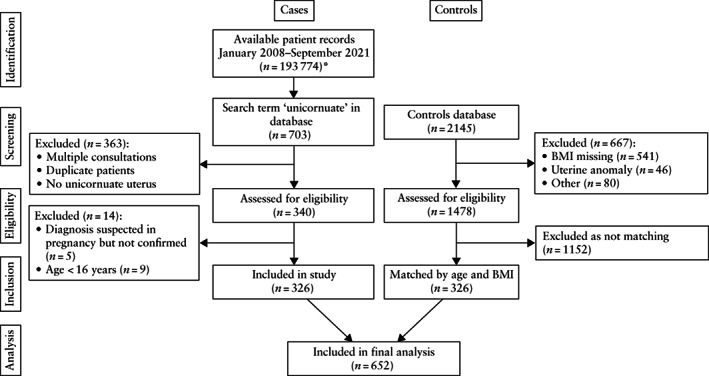
This was a single-center, retrospective cohort study. Cases were women aged at least 16 years who were diagnosed with a unicornuate uterus on transvaginal/transrectal ultrasound between January 2008 and September 2021. Controls were women with no congenital uterine anomaly matched 1:1 by age and body mass index. The primary outcome was live-birth rate. Secondary outcomes were pregnancy loss (miscarriage, ectopic pregnancy, termination of pregnancy), preterm delivery, mode of delivery and concomitant gynecological abnormalities (endometriosis, adenomyosis, fibroids).
Included in the study were 326 cases and 326 controls. Women with a unicornuate uterus had a significantly lower live-birth rate (184/388 (47.4%) vs 229/396 (57.8%); P = 0.004) and higher rates of overall miscarriage (178/424 (42.0%) vs 155/465 (33.3%); adjusted odds ratio (aOR), 2.21 (95% CI, 1.42-3.42), P < 0.001), ectopic pregnancy (26/424 (6.1%) vs 11/465 (2.4%); aOR, 2.52 (95% CI, 1.22-5.22), P = 0.01), preterm delivery (45/184 (24.5%) vs 17/229 (7.4%); aOR, 3.04 (95% CI, 1.52-5.97), P = 0.001) and Cesarean delivery (116/184 (63.0%) vs 70/229 (30.6%); aOR, 2.54 (95% CI, 1.67-3.88), P < 0.001). Rudimentary-horn pregnancies accounted for 7/26 (26.9%) ectopic pregnancies in the study group. Women with a unicornuate uterus were more likely to have endometriosis (17.5% vs 10.7%; P = 0.018) and adenomyosis (26.7% vs 15.6%; P = 0.001), but were not more likely to have fibroids compared with controls. Women with a functional rudimentary horn were more likely to have pelvic endometriosis compared to those without (odds ratio, 2.4 (95% CI, 1.4-4.1), P = 0.002).
Pregnant women with a unicornuate uterus should be classified as high risk. Removal of a functional rudimentary horn should be discussed with the patient to prevent a rudimentary-horn ectopic pregnancy. © 2022 The Authors. Ultrasound in Obstetrics & Gynecology published by John Wiley & Sons Ltd on behalf of International Society of Ultrasound in Obstetrics and Gynecology.
研究单角子宫女性的生殖结局,并与无先天性子宫异常的女性进行比较。
这是一项单中心、回顾性队列研究。病例为 2008 年 1 月至 2021 年 9 月期间经阴道/直肠超声诊断为单角子宫的至少 16 岁女性。对照组为年龄和体重指数匹配的无先天性子宫异常的女性。主要结局是活产率。次要结局为妊娠丢失(流产、异位妊娠、终止妊娠)、早产、分娩方式和伴发的妇科异常(子宫内膜异位症、子宫腺肌病、肌瘤)。
研究纳入 326 例病例和 326 例对照。单角子宫女性的活产率显著降低(184/388(47.4%) vs 229/396(57.8%);P=0.004),总体流产率更高(178/424(42.0%) vs 155/465(33.3%);调整后的优势比(aOR),2.21(95%CI,1.42-3.42),P<0.001)、异位妊娠(26/424(6.1%) vs 11/465(2.4%);aOR,2.52(95%CI,1.22-5.22),P=0.01)、早产(45/184(24.5%) vs 17/229(7.4%);aOR,3.04(95%CI,1.52-5.97),P=0.001)和剖宫产(116/184(63.0%) vs 70/229(30.6%);aOR,2.54(95%CI,1.67-3.88),P<0.001)。研究组中 7/26(26.9%)的异位妊娠为残角妊娠。单角子宫女性更易发生子宫内膜异位症(17.5% vs 10.7%;P=0.018)和子宫腺肌病(26.7% vs 15.6%;P=0.001),但与对照组相比,肌瘤的发生率无差异。有功能残角的女性发生盆腔子宫内膜异位症的可能性是没有残角的女性的 2.4 倍(比值比,2.4(95%CI,1.4-4.1),P=0.002)。
单角子宫妊娠女性应被归类为高危人群。应与患者讨论切除有功能残角,以预防残角异位妊娠。