Segatto Majoriê Mergen, Dornelles Sérgio Ivan Torres, Silveira Vera Bauer, Frantz Gabriela de Oliveira
Federal University of Health Sciences of Porto Alegre, Porto AlegreRS, Brazil.
An Bras Dermatol. 2013 Sep-Oct;88(5):732-8. doi: 10.1590/abd1806-4841.20132083.
Actinic keratosis is a frequent lesion which occurs in sunlight exposed areas. Diclofenac sodium and 5-Fluorouracil are effective, non-invasive and easy-to-apply topical treatment options.
To assess and compare the effectiveness of 3% diclofenac sodium associated with 2.5% hyaluronic acid and of 5% 5-Fluorouracil for the treatment of actinic keratosis, as well as the patient's degree of satisfaction and tolerability.
28 patients with a clinical diagnosis of actinic keratosis were randomized to receive diclofenac sodium or 5-Fluorouracil and were clinically assessed before and after treatment as well as 8 weeks after the end of treatment. Modified versions of the Investigator and Patient Global Improvement Scores were used.
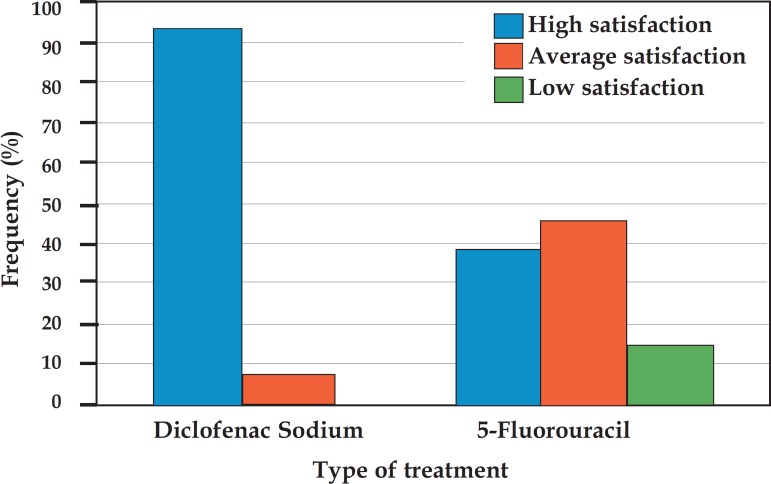
The average number of lesions in the diclofenac sodium group before and after treatment was 13.6 and 6.6 (p<0,001), respectively, while it was 17.4 and 3.15 (p<0.001) in the 5-Fluorouracil group. There was a significant reduction in the number of lesions in the 5-Fluorouracil group in relation to the diclofenac sodium group (p<0.001). To the non-blinded physician, there was a higher satisfactory therapeutic response in the 5-Fluorouracil group (p<0.001); to the blinded physician, there was a higher satisfactory response in this same group, although not statistically significant (p=0.09). There was a high degree of satisfaction in both groups (73% in the diclofenac sodium group and 77% in the 5-Fluorouracil group; p=0.827). Regarding adverse effects, the diclofenac sodium group presented a higher degree of satisfaction (93.3% vs 38.4%; p=0.008). Erythema, edema, crusts and itching were significantly higher in the 5-Fluorouracil group.
We concluded that 5-Fluorouracil was more effective; however, it showed lower tolerability than diclofenac sodium.
光化性角化病是一种常见于阳光暴露部位的病变。双氯芬酸钠和5-氟尿嘧啶是有效、非侵入性且易于应用的局部治疗选择。
评估并比较3%双氯芬酸钠联合2.5%透明质酸与5% 5-氟尿嘧啶治疗光化性角化病的有效性,以及患者的满意度和耐受性。
28例临床诊断为光化性角化病的患者被随机分为接受双氯芬酸钠或5-氟尿嘧啶治疗,并在治疗前后以及治疗结束后8周进行临床评估。使用了研究者和患者整体改善评分的修改版。
双氯芬酸钠组治疗前后的平均皮损数量分别为13.6和6.6(p<0.001),而5-氟尿嘧啶组为17.4和3.15(p<0.001)。与双氯芬酸钠组相比,5-氟尿嘧啶组的皮损数量有显著减少(p<0.001)。对于未设盲的医生而言,5-氟尿嘧啶组有更高的满意治疗反应(p<0.001);对于设盲的医生而言,同一组有更高的满意反应,尽管无统计学意义(p=0.09)。两组的满意度都很高(双氯芬酸钠组为(73%),5-氟尿嘧啶组为(77%);p=0.827)。关于不良反应,双氯芬酸钠组的满意度更高((93.3%)对(38.4%);p=0.008)。5-氟尿嘧啶组的红斑、水肿、结痂和瘙痒明显更严重。
我们得出结论,5-氟尿嘧啶更有效;然而,它的耐受性低于双氯芬酸钠。