Pulcu E, Trotter P D, Thomas E J, McFarquhar M, Juhasz G, Sahakian B J, Deakin J F W, Zahn R, Anderson I M, Elliott R
School of Medicine, Neuroscience and Psychiatry Unit,University of Manchester and Manchester Academic Health Science Centre,Manchester,UK.
Department of Psychiatry,University of Cambridge, and MRC Wellcome Trust Behavioural and Clinical Neuroscience Institute,Cambridge,UK.
Psychol Med. 2014 Jul;44(9):1825-34. doi: 10.1017/S0033291713002584. Epub 2013 Nov 1.
Major depressive disorder (MDD) is associated with abnormalities in financial reward processing. Previous research suggests that patients with MDD show reduced sensitivity to frequency of financial rewards. However, there is a lack of conclusive evidence from studies investigating the evaluation of financial rewards over time, an important aspect of reward processing that influences the way people plan long-term investments. Beck's cognitive model posits that patients with MDD hold a negative view of the future that may influence the amount of resources patients are willing to invest into their future selves.
We administered a delay discounting task to 82 participants: 29 healthy controls, 29 unmedicated participants with fully remitted MDD (rMDD) and 24 participants with current MDD (11 on medication).
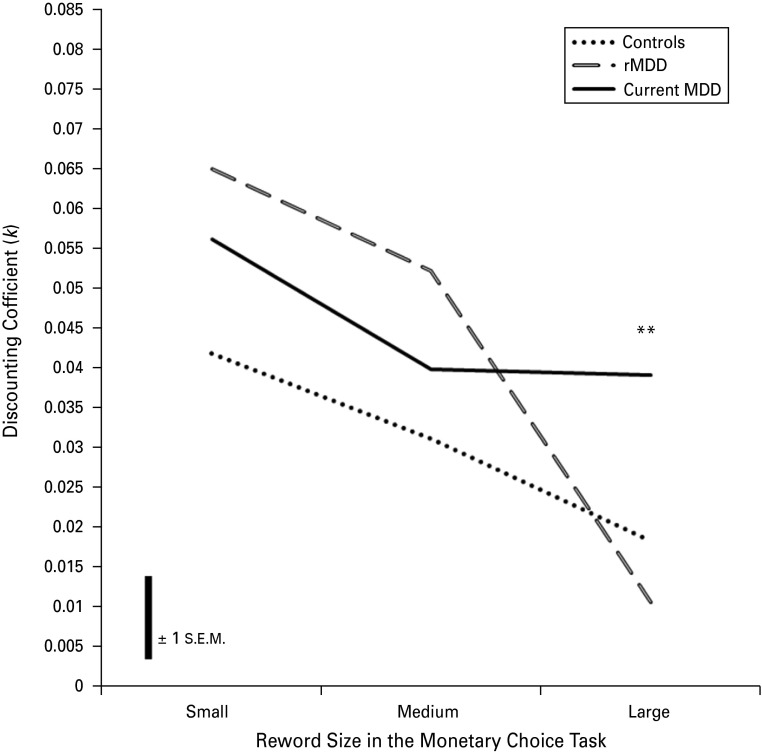
Patients with current MDD, relative to remitted patients and healthy subjects, discounted large-sized future rewards at a significantly higher rate and were insensitive to changes in reward size from medium to large. There was a main effect of clinical group on discounting rates for large-sized rewards, and discounting rates for large-sized rewards correlated with severity of depressive symptoms, particularly hopelessness.
Higher discounting of delayed rewards in MDD seems to be state dependent and may be a reflection of depressive symptoms, specifically hopelessness. Discounting distant rewards at a higher rate means that patients are more likely to choose immediate financial options. Such impairments related to long-term investment planning may be important for understanding value-based decision making in MDD, and contribute to ongoing functional impairment.
重度抑郁症(MDD)与财务奖励处理异常有关。先前的研究表明,MDD患者对财务奖励频率的敏感度降低。然而,在研究财务奖励随时间的评估方面,缺乏确凿的证据,而奖励处理的这一重要方面会影响人们规划长期投资的方式。贝克的认知模型认为,MDD患者对未来持负面看法,这可能会影响患者愿意为未来的自己投入的资源量。
我们对82名参与者进行了延迟折扣任务:29名健康对照者、29名MDD完全缓解的未用药参与者(rMDD)和24名当前患有MDD的参与者(11名正在服药)。
与缓解患者和健康受试者相比,当前患有MDD的患者对大型未来奖励的折扣率显著更高,并且对奖励大小从中型到大型的变化不敏感。临床组对大型奖励的折扣率有主效应,大型奖励的折扣率与抑郁症状的严重程度相关,尤其是绝望感。
MDD中对延迟奖励的更高折扣似乎取决于状态,可能是抑郁症状的反映,特别是绝望感。以更高的比率折扣远期奖励意味着患者更有可能选择即时的财务选项。这种与长期投资规划相关的损害可能对理解MDD中基于价值的决策很重要,并导致持续的功能损害。